US Policy Shift on Ukraine and Long Range Missile Threats
Source:The Hindu ↗
Why It Matters
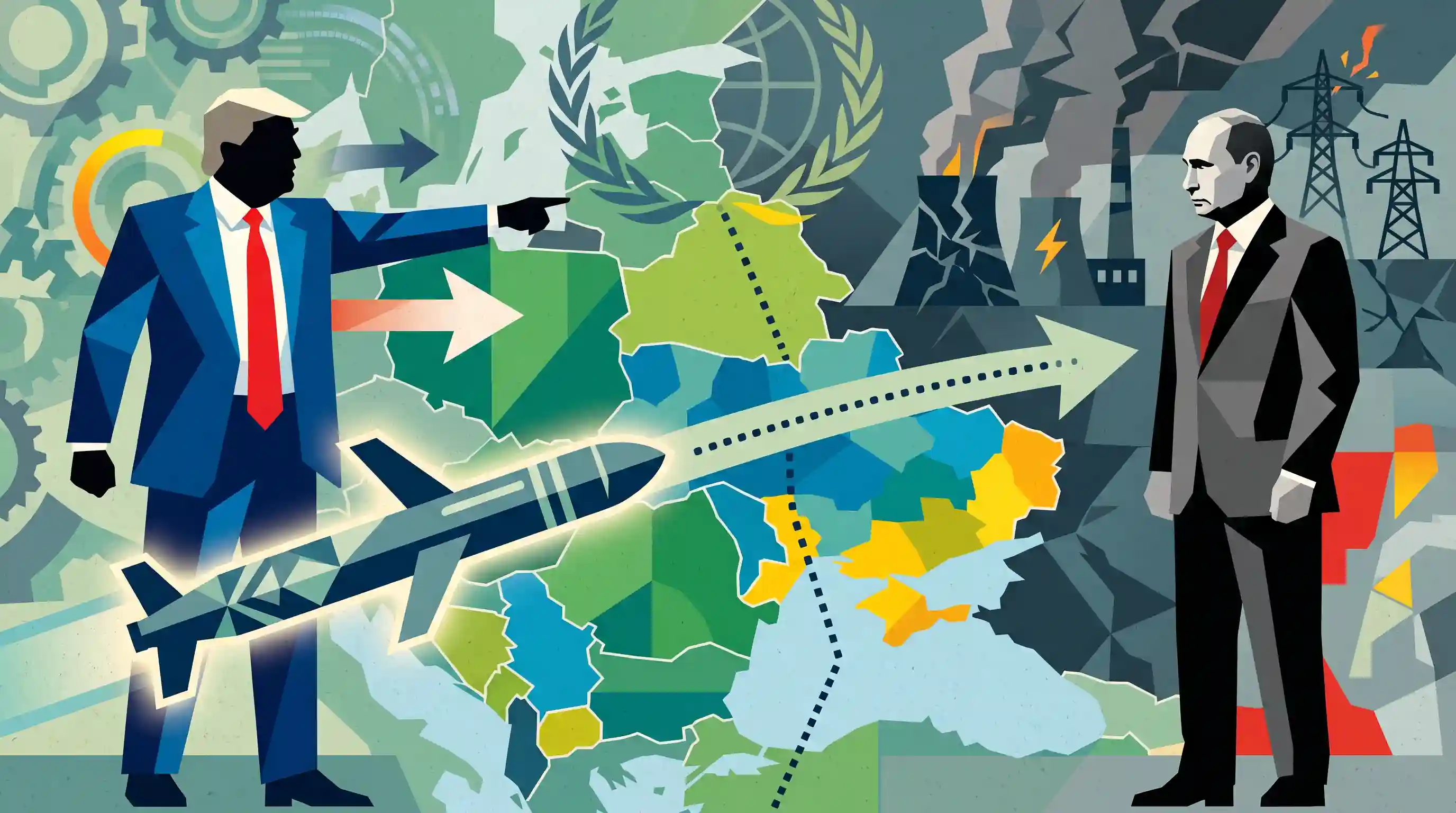
The potential transfer of advanced, long-range cruise missiles like the Tomahawk to Ukraine reflects a major escalation in the conflict and a critical shift in U.S. strategic posture. It highlights the evolving geopolitical dynamics between the West and Russia, which directly impacts global stability, deterrence strategies, and international energy markets.
Summary
U.S. President Donald Trump has issued a stark warning to Russia, threatening to supply Ukraine with long-range Tomahawk cruise missiles if Vladimir Putin does not agree to a swift resolution of the war. This marks a dramatic shift in Trump's foreign policy approach, moving away from pressuring Kyiv into concessions to actively using the threat of advanced military technology to force Moscow to the negotiating table. The escalating rhetoric coincides with renewed Russian attacks on Ukrainian energy infrastructure.
Key Points
- U.S. President Donald Trump warned he might supply Ukraine with long-range Tomahawk cruise missiles if Moscow does not agree to settle the ongoing war.
- The warning marks a significant policy shift for Trump, who previously suggested Kyiv should make concessions but now asserts Ukraine could reclaim lost territories.
- Ukrainian President Volodymyr Zelenskyy considers long-range strike capabilities essential to forcing Russia into genuine peace negotiations.
- The development follows Russian overnight drone and missile strikes targeting Ukraine's power grid to cripple its energy infrastructure ahead of winter.
- Russian President Vladimir Putin cautioned that the provision of U.S. long-range missiles to Ukraine would severely damage relations between Washington and Moscow.
Important Terms
Tomahawk Cruise Missile

A U.S.-made, long-range, all-weather, subsonic cruise missile used for precision deep-land attacks. It can be launched from ships, submarines, or land-based platforms with a range exceeding 1,600 km.
UPSC context
GS Paper III (Science & Technology/Defence); tests understanding of advanced missile systems and their strategic role in modern warfare.
Cruise Missile
A guided missile that remains within the atmosphere and flies at a constant speed to deliver a warhead with high precision. Unlike ballistic missiles, they follow a non-ballistic, low-altitude trajectory.
UPSC context
GS Paper III (Defence); frequently compared with ballistic missiles (e.g., BrahMos vs. Agni) in Prelims and Mains.
Strategic Deterrence
A military strategy where one party threatens to use force or advanced technology to discourage an opponent from taking a particular action or to force them into negotiations.
UPSC context
GS Paper II (International Relations); key concept in global security, nuclear doctrine, and regional stability.
Escalation Dominance
The ability to increase the stakes of a conflict to a level that the opponent cannot match or find too costly to counter, thereby forcing them to de-escalate.
UPSC context
GS Paper II (IR); relevant for studying conflict resolution and superpower dynamics in geopolitics.
Anchorage Understanding
Refers to a reported 2025 informal agreement between U.S. President Trump and Russian President Putin in Alaska, aimed at establishing a framework to end the Russia-Ukraine conflict.
UPSC context
GS Paper II (International Relations); important for tracking specific diplomatic milestones in the Russia-Ukraine peace process.
Trilateral Diplomacy
A diplomatic approach involving three parties (e.g., U.S., Ukraine, and Russia) to negotiate a resolution, often used when bilateral talks reach a stalemate.
UPSC context
GS Paper II (IR); essential for understanding multilateral engagement and mediation in international disputes.
Prelims Trap
Tomahawk is an intercontinental ballistic missile (ICBM) used for high-altitude strikes.
Tomahawk is actually a subsonic cruise missile that flies at low altitudes to evade radar. UPSC frequently swaps the characteristics of cruise and ballistic missiles in S&T statements.
Static Concepts Connected
How do cruise missiles differ from ballistic missiles?
- Flight Path: Ballistic missiles follow a parabolic, mostly unguided trajectory; cruise missiles are continuously guided and fly low, close to the earth's surface.
- Propulsion: Cruise missiles use jet engines and stay in the atmosphere. Ballistic missiles use rocket engines and exit the atmosphere before atmospheric re-entry.
What does the Fourth Geneva Convention protect?
- Civilian Protection: Focuses exclusively on protecting civilians in war zones and occupied territories from murder, torture, and reprisals.
- Civilian Infrastructure: Prohibits the destruction of essential civilian property (like power grids) unless dictated by absolute military necessity, banning collective punishments.
Cross-Topic Patterns
Treaty collapse and arms races
The demise of Cold War pacts like the INF Treaty and suspension of New START has renewed unchecked missile proliferation and 'peace through strength' diplomatic posturing.
Geneva Conventions vs Hybrid War
Targeting energy grids to freeze civilian populations (weaponisation of winter) connects conventional military tactics with severe breaches of International Humanitarian Law.

Expect a Prelims pair-matching question on missile types (cruise/ballistic) or the status of collapsed arms treaties like INF and New START.
Linked PYQs · 3
Linked PYQs · 3
- 2025MainsGS2
"The reform process in the United Nations remains unresolved, because of the delicate imbalance of East and West and entanglement of the USA vs. Russo-Chinese alliance.” Examine and critically evaluate the East-West policy confrontations in this regard.
- 2021MainsGS2
“The USA is facing an existential threat in the form of a China, that is much more challenging than the erstwhile Soviet Union.” Explain.
- 2023PrelimsGS1
Consider the following statements: 1. Ballistic missiles are jet-propelled at subsonic speeds throughout their flights, while cruise missiles are rocket-powered only in the initial phase of flight. 2. Agni-V is a medium-range supersonic cruise missile, while BrahMos is a solid-fuelled intercontinental ballistic missile. Which of the statements given above is/are correct?
