Diplomatic pressure and negotiations on Middle East conflict
Source:Indian Express ↗
Why It Matters
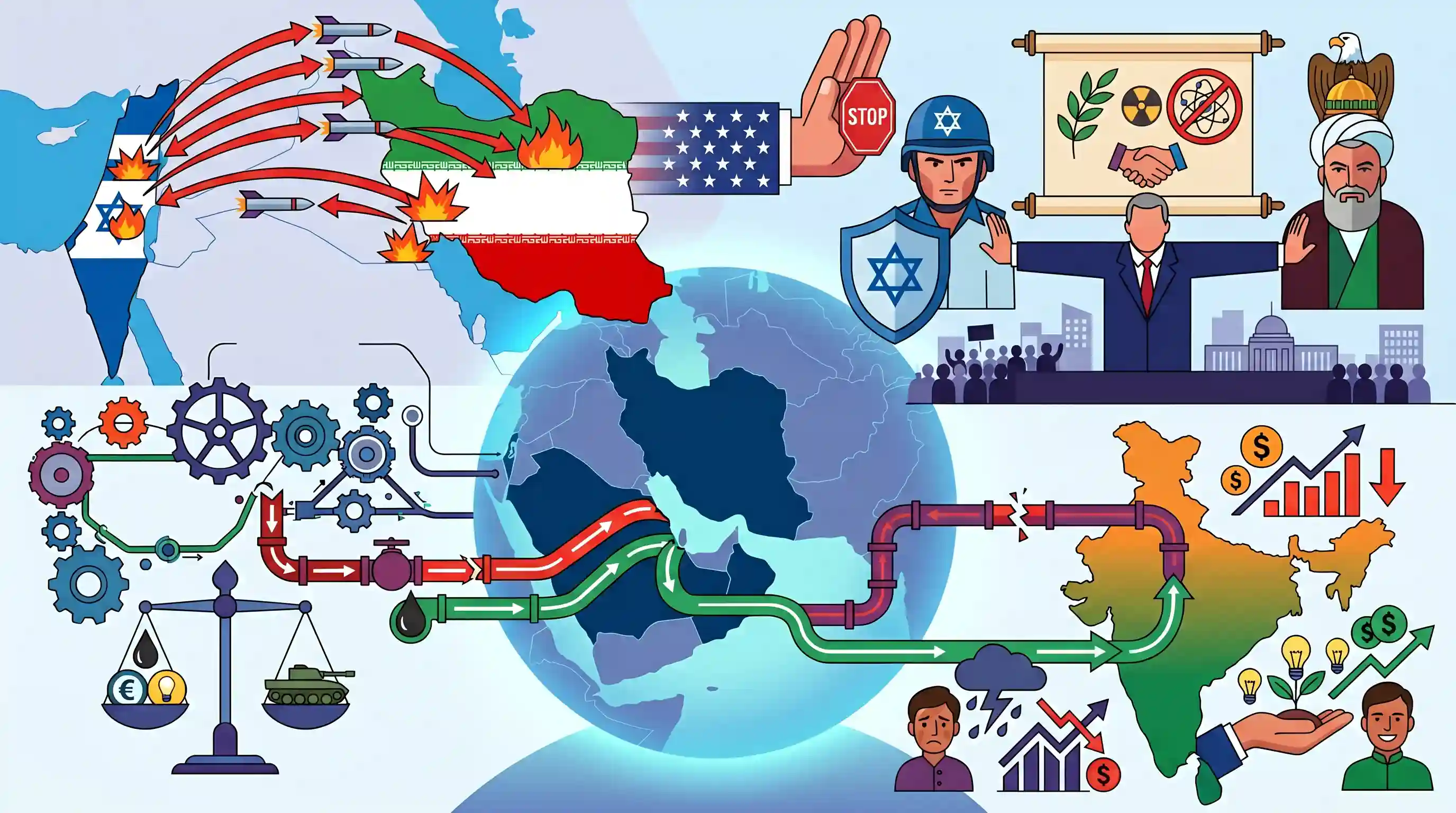
The escalating conflict in the Middle East and the potential revival of a US-Iran nuclear dialogue are crucial for India due to their direct impact on global energy prices, the safety of the Indian diaspora in West Asia, and India's strategic balancing act between Israel and Iran.
Summary
The article details the escalating military conflict between Israel and Iran, marked by retaliatory missile strikes, and the diplomatic intervention of the United States. US President Donald Trump has warned Israeli Prime Minister Benjamin Netanyahu against further escalation, aiming instead to negotiate a comprehensive US-Iran peace deal focused on halting Iran's nuclear weapons program and uranium enrichment. The situation underscores the complex interplay of Middle Eastern geopolitics, global energy security, and the domestic political imperatives of the leaders involved.
Key Points
- Israel and Iran have engaged in direct military strikes, including Israeli attacks on a Hezbollah-linked site in Beirut and Iranian petrochemical infrastructure.
- The US assisted Israel in intercepting Iranian missiles but has issued strong warnings against further Israeli retaliation to prevent a wider regional war.
- US President Donald Trump is attempting to broker a US-Iran peace deal aimed at curbing Iran's uranium enrichment and nuclear weapons program.
- The geopolitical dynamics are influenced by domestic politics, with Trump seeking a diplomatic victory and Netanyahu potentially benefiting politically from prolonged conflict.
Important Terms
US-Iran Nuclear Deal (JCPOA)

A 2015 agreement (JCPOA) that limited Iran's nuclear program in exchange for sanctions relief. In 2026, it refers to efforts to negotiate a new comprehensive peace deal following 2025-26 military escalations.
UPSC context
GS II: International Relations. Tests understanding of multilateral treaties, non-proliferation, and the impact of major power policies on global stability.
Hezbollah
A Lebanese Shia militant group and political party backed by Iran. It functions as a key regional proxy, often engaging in cross-border conflict with Israel, which influences West Asian stability.
UPSC context
GS II: International Relations. Concerns non-state actors, regional security in the Middle East, and their impact on India's strategic interests.
Uranium Enrichment
The technical process of increasing Uranium-235 concentration. Reaching 60% purity is a critical 'threshold' near weapons-grade (90%), serving as the primary focus of non-proliferation diplomacy and regional military tensions.
UPSC context
GS III: Science & Technology and Security. Tests knowledge of nuclear technology, global non-proliferation regimes (NPT), and strategic military threats.
Strait of Hormuz
A critical maritime chokepoint between the Persian Gulf and Gulf of Oman. It facilitates the passage of 20% of global oil, making its stability vital for world energy markets.
UPSC context
GS I: Geography (Chokepoints) and GS II: International Relations. Critical for understanding maritime trade routes and India's energy import vulnerability.
Energy Security
The reliable availability of energy sources at affordable prices. For India, it involves mitigating supply disruptions and price volatility resulting from instability in the oil-rich West Asian region.
UPSC context
GS III: Economic Development. Tests understanding of India's import dependency, inflation management, and the economic impact of geopolitical conflicts.
West Asia
A strategically vital region (Middle East) central to global energy supply and India's 'Link West' policy. It hosts over 9 million Indian diaspora members and remains a major trade partner.
UPSC context
GS II: International Relations. Key focus area for India’s foreign policy, energy security, and protection of the overseas Indian community.
Prelims Trap
The United States is an active party to the 2015 Joint Comprehensive Plan of Action (JCPOA) regulating Iran's nuclear program.
The US unilaterally withdrew from the JCPOA in 2018. Current diplomatic efforts by the US aim to establish a new non-proliferation deal, not revive the 2015 agreement.
Static Concepts Connected
What are the key maritime chokepoints in West Asia for global energy transit?
- Strait of Hormuz: Connects the Persian Gulf to the Gulf of Oman and Arabian Sea; crucial for roughly 20% of global oil consumption.
- Bab el-Mandeb: Connects the Red Sea to the Gulf of Aden; a critical chokepoint for all shipping traffic passing through the Suez Canal.
How does Uranium enrichment differ for civilian reactors versus nuclear weapons?
- Low-Enriched (LEU): Contains 3-5% U-235. This level is sufficient for use as fuel in standard commercial light water nuclear power reactors.
- Highly-Enriched (HEU): Contains 20% or more U-235. Weapons-grade highly enriched uranium specifically requires enrichment to approximately 90% U-235.
- Gas Centrifuges: These devices spin uranium hexafluoride gas at high speeds to separate the heavier U-238 isotopes from the lighter, fissile U-235.
Cross-Topic Patterns
Abraham Accords vs. INSTC
India balances the I2U2 and IMEEC (relying on Israel-Arab normalization) against its strategic investments in Iran’s Chabahar Port and the INSTC to access Central Asia and bypass Pakistan.
Energy security & imported inflation
Disruptions in the Strait of Hormuz directly widen India's Current Account Deficit (CAD) and fuel imported inflation due to India's 85% reliance on crude oil imports.

Expect a multi-statement question mapping West Asian straits (Hormuz/Bab el-Mandeb) with India's connectivity projects (IMEEC/Chabahar).
Linked PYQs · 4
Linked PYQs · 4
- 2018MainsGS2
In what ways would the ongoing US-Iran Nuclear Pact Controversy affect the national interest of India? How should India respond to this situation?
- 2025MainsGS2
"Energy security constitutes the dominant kingpin of India's foreign policy, and is linked with India's overarching influence in Middle Eastern countries.” How would you integrate energy security with India's foreign policy trajectories in the coming years?
- 2017MainsGS2
The question of India's Energy Security constitutes the most important part of India's economic progress. Analyze India's energy policy cooperation with West Asian countries.
- 2018MainsGS2
“India’s relations with Israel have, of late, acquired a depth and diversity, which cannot be rolled back.” Discuss.
