US Diplomacy and Geopolitical Realignment in West Asia
Source:Indian Express ↗
Why It Matters
Understanding shifts in US-West Asia relations is crucial for UPSC aspirants, as the Gulf region directly impacts India's energy security, diaspora remittances, and broader strategic interests in the Middle East amidst evolving global geopolitics.
Summary
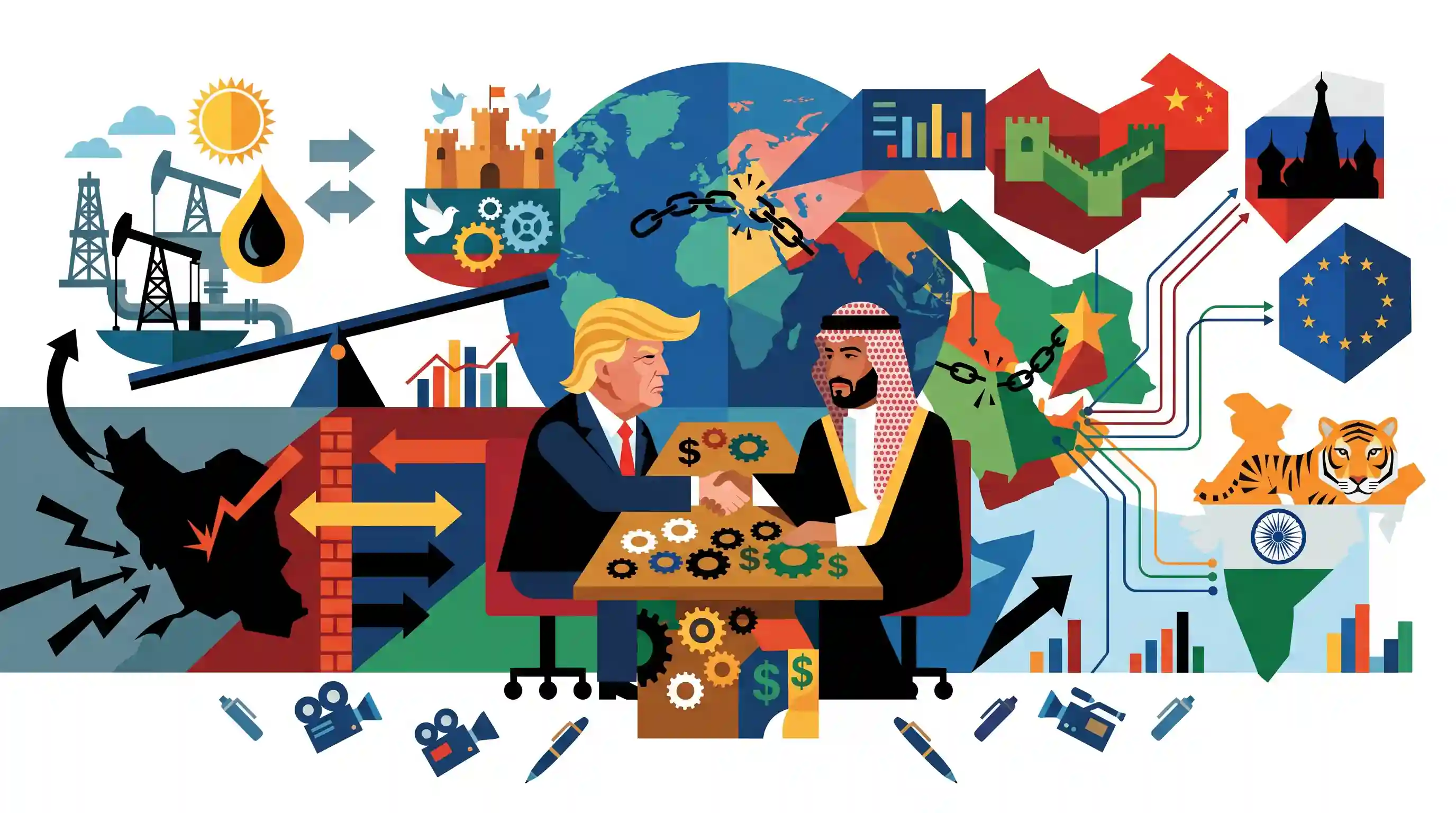
The article examines the strategic significance and political optics of Donald Trump's diplomatic engagements with Gulf leaders, focusing on his meetings with Saudi Crown Prince Mohammed bin Salman. It highlights how these interactions signal a broader transformation in global diplomacy, characterized by a shift towards transactional and personalized bilateral relationships. The evolving US-West Asia dynamic reflects mutual efforts to secure regional stability, manage energy security, and counterbalance adversaries like Iran, all while Gulf nations increasingly assert their strategic autonomy in a multipolar world order.
Key Points
- Donald Trump's diplomatic engagements with Gulf leaders, particularly Saudi Crown Prince Mohammed bin Salman, reflect a highly personalized and transactional approach to US foreign policy in West Asia.
- These high-profile visits are rich in political optics, signaling enduring strategic partnerships and mutual interests in a shifting multipolar world.
- The evolving US-West Asia dynamic underscores a departure from traditional multilateralism, focusing instead on bilateral alignments to manage regional security, balance against Iran, and secure energy markets.
- Such diplomatic maneuvers have broader implications for global geopolitics, highlighting how regional powers in the Gulf are asserting strategic autonomy while navigating great power competition.
Important Terms
Abraham Accords

A series of 2020 normalization agreements between Israel and Arab nations (UAE, Bahrain, Sudan, Morocco) facilitated by the U.S. to promote regional peace and cooperation.
UPSC context
GS Paper 2: International Relations; crucial for understanding shifting West Asian alliances and India's 'Link West' policy.
Gulf Cooperation Council (GCC)
A political and economic union of six Arab states—Saudi Arabia, UAE, Qatar, Kuwait, Oman, and Bahrain—aiming for regional coordination and security.
UPSC context
GS Paper 2: Important for India’s energy security, trade (largest trading bloc), and welfare of the 8.9 million-strong diaspora.
Transactional Diplomacy
A foreign policy approach based on 'quid pro quo' deals and direct national benefits rather than long-term alliances or shared ideological values.
UPSC context
GS Paper 2: Tests awareness of the transition from a rules-based order to deal-based international statecraft.
Strategic Autonomy
The capacity of a state to pursue its national interests and adopt foreign policy choices without being constrained by other states or alliances.
UPSC context
GS Paper 2: Central theme of India’s foreign policy and increasingly relevant for Gulf nations in a multipolar world.
Multipolarity
A global distribution of power where more than two nation-states have significant military, cultural, and economic influence.
UPSC context
GS Paper 2: Essential for analyzing the changing global order and India’s role as a 'leading power.'
Energy Security
The uninterrupted availability of energy sources at an affordable price, vital for a nation's economic stability and growth.
UPSC context
GS Paper 3: Infrastructure/Energy; GS Paper 2: A key driver of India's strategic engagement with West Asia.
Prelims Trap
"Saudi Arabia is a founding signatory of the Abraham Accords, officially normalizing its relations with Israel."
Saudi Arabia is not a signatory. The Abraham Accords were initially signed by the UAE and Bahrain (later Morocco and Sudan) to normalize relations with Israel.
Static Concepts Connected
What is the Gulf Cooperation Council (GCC) and who are its members?
- Formation: Established in 1981, it is a political and economic alliance headquartered in Riyadh, Saudi Arabia.
- Members: Comprises six Arab states bordering the Persian Gulf: Bahrain, Kuwait, Oman, Qatar, Saudi Arabia, and the UAE.
- Notable Exclusions: Iraq and Iran are not members despite having Persian Gulf coastlines, making the GCC an exclusively Arab monarchy bloc.
Which maritime chokepoints in West Asia dictate global energy security?
- Strait of Hormuz: Located between Oman and Iran, it connects the Persian Gulf to the Arabian Sea. It handles roughly 20% of global oil consumption.
- Bab el-Mandeb: The "Gate of Tears" between Yemen and Djibouti/Eritrea, connecting the Red Sea to the Gulf of Aden.
- Suez Canal: An artificial waterway in Egypt connecting the Mediterranean Sea to the Red Sea, facilitating vital direct shipping between Europe and Asia.
Cross-Topic Patterns
Gulf diplomacy + Minilateralism (I2U2/IMEEC)
The shift towards transactional bilateralism creates space for issue-based minilaterals like I2U2 and IMEEC, integrating Gulf capital with India’s geoeconomic ambitions and Western technology.
Strategic Autonomy + Petrodollar transition
Gulf nations joining BRICS+ and exploring oil trades in non-dollar currencies (Yuan/Rupee) reflects their multi-vector balancing, reducing reliance on US financial hegemony while retaining US security umbrellas.

Expect a 2026 Mains question on how the Gulf's 'strategic autonomy' and multi-vector balancing (US, China, BRICS) impacts India's Link West.
Linked PYQs · 3
Linked PYQs · 3
- 2025MainsGS2
"Energy security constitutes the dominant kingpin of India's foreign policy, and is linked with India's overarching influence in Middle Eastern countries.” How would you integrate energy security with India's foreign policy trajectories in the coming years?
- 2025MainsGS2
"The reform process in the United Nations remains unresolved, because of the delicate imbalance of East and West and entanglement of the USA vs. Russo-Chinese alliance.” Examine and critically evaluate the East-West policy confrontations in this regard.
- 2025MainsGS2
"With the waning of globalization, post-Cold War world is becoming a site of sovereign nationalism.” Elucidate.
