US India Trade Friction and Strategic Autonomy Dilemma
Source:Indian Express ↗
Why It Matters
The issue highlights the transactional nature of modern diplomacy where trade levers (tariffs) are used to pressure nations on strategic and defense choices. For UPSC aspirants, it is a classic case study of the friction in Indo-US relations stemming from India's strategic autonomy (reliance on Russian arms and oil) colliding with US economic and geopolitical interests.
Summary
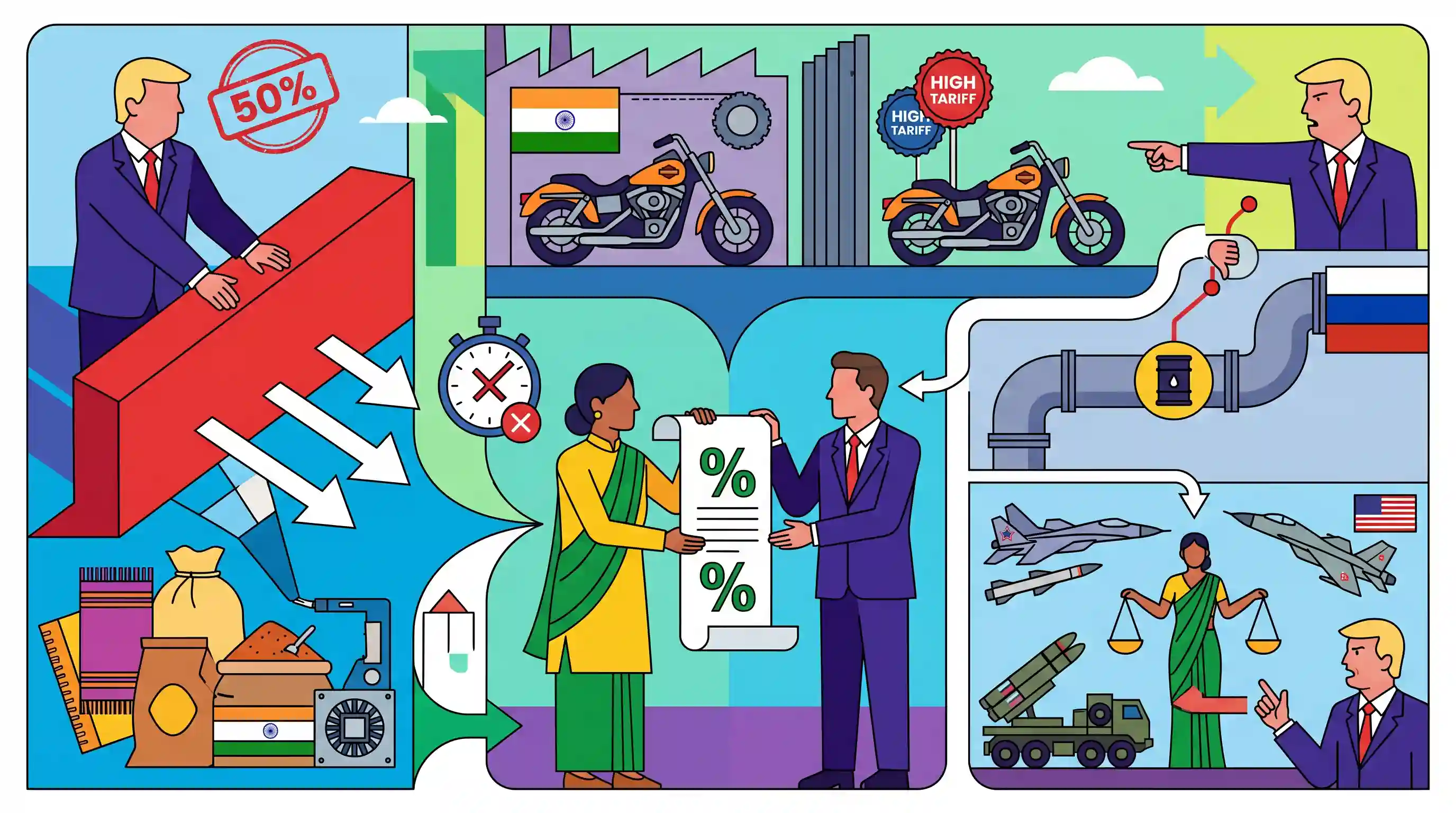
US President Donald Trump defended imposing a 50% tariff on Indian imports, criticizing India as a highly tariffed nation. He claimed his hardline approach forced India to offer a zero-tariff regime. However, Trump indicated this offer might be 'getting late', explicitly linking trade tensions to India's strategic choices—specifically its continued heavy reliance on Russia for oil and military equipment rather than purchasing from the US. He also referenced Harley Davidson establishing a plant in India to bypass steep import duties as an example of India's protective trade practices.
Key Points
- US President Donald Trump defended a 50% tariff on Indian imports, accusing India of maintaining exorbitant tariffs that 'kill' the US economically.
- Trump claimed that his strong tariff policies compelled New Delhi to offer cutting its tariffs to zero, illustrating his strategy of using tariffs as leverage.
- He criticized India's strategic procurement, noting it is a 'one-sided disaster' because India buys most of its oil and military products from Russia rather than the US.
- Trump cited Harley Davidson's move to build a manufacturing plant in India as a direct consequence of a 200% tariff on imported motorcycles.
Important Terms
Trade Protectionism

An economic policy of shielding domestic industries from foreign competition by imposing trade barriers like tariffs, quotas, and subsidies to protect local jobs and businesses.
UPSC context
GS Paper 3 (Economy). Tests understanding of global trade dynamics, impact on domestic manufacturing, and WTO-related challenges.
Strategic Autonomy
A nation's ability to pursue its national interests and make sovereign foreign policy and defense decisions without being constrained by external pressures or binding alliances.
UPSC context
GS Paper 2 (International Relations). Core principle of Indian foreign policy (e.g., balancing ties with US, Russia, and China).
Reciprocal Tariff
A trade policy where a country imposes the same level of import duties on a trading partner that the partner imposes on its goods; also termed 'mirror taxes'.
UPSC context
GS Paper 3 (Trade Policy). Relevant to US-India trade tensions and 'America First' economic policies.
Tariff Barriers
Financial taxes or duties imposed by a government on imported goods at the border, intended to increase the cost of imports and provide a price advantage to domestic products.
UPSC context
GS Paper 3 (Economy/Trade). Fundamental concept for analyzing trade wars, trade deficits, and bilateral agreements.
Press Trust of India (PTI)
India's largest non-profit news agency, owned by a consortium of Indian newspapers, providing national and international news feeds to media outlets since 1947.
UPSC context
Prelims (General Awareness). Important institutional entity providing official reportage on high-level bilateral and national events.
Prelims Trap
"India's recent steep unilateral tariff hikes on foreign automobiles are a direct violation of its WTO obligations."
India leverages 'Tariff Overhang'—the gap between its high WTO-committed Bound Rates and lower Applied Rates. Raising applied tariffs within this limit complies with WTO.
Static Concepts Connected
What is the difference between Bound and Applied tariff rates under the WTO?
- Bound Rate: The maximum tariff ceiling a WTO member legally commits not to exceed for a specific product line.
- Applied Rate: The actual tariff rate charged by customs at the border, which is often much lower than the bound rate.
- Tariff Overhang: The gap between bound and applied rates. It provides developing countries like India the policy space to legally raise tariffs during domestic crises.
What are the different motivations for Foreign Direct Investment (FDI)?
- Tariff-Jumping FDI: Setting up local manufacturing to bypass steep import barriers or protectionist policies of the host country (e.g., Harley Davidson in India).
- Resource-Seeking FDI: Investing to access abundant or cheap factors of production, such as raw materials or low-cost labor.
- Market-Seeking FDI: Investing to directly serve a large domestic market by producing locally, reducing transport costs and time.
Cross-Topic Patterns
Trade Weaponization for Strategic Autonomy
The US linking tariff structures to India's Russian oil and military hardware purchases shows how economic statecraft (tariffs) is increasingly weaponized to dictate a partner's strategic autonomy and defense diversification.
Tariff-Jumping FDI & Make in India
Harley Davidson’s move to India exemplifies how protectionist tariff barriers often force multinational companies to substitute trade with direct investment, directly linking WTO trade policies to FDI inflows.

Expect a 2026 multi-statement question combining WTO tariff structures (Bound vs Applied rates) with FDI motivations (Tariff-jumping).
Linked PYQs · 2
Linked PYQs · 2
- 2018MainsGS2
What are the key areas of reform if the WTO has to survive in the present context of "Trade War', especially keeping in mind the interest of India?
- 2020MainsGS2
What is the significance of Indo-US defence deals over Indo-Russian defence deals? Discuss with reference to stability in the Indo-Pacific region.
