US Healthcare Financing Shift Toward Direct Benefit Cash Transfers
Source:Indian Express ↗
Why It Matters
Highlights the ongoing global debate on healthcare financing—whether states should subsidize insurance frameworks or provide direct cash transfers. It also serves as a crucial case study for comparative constitutional polity, contrasting US mechanisms like the filibuster and government shutdowns with the Indian parliamentary system.
Summary
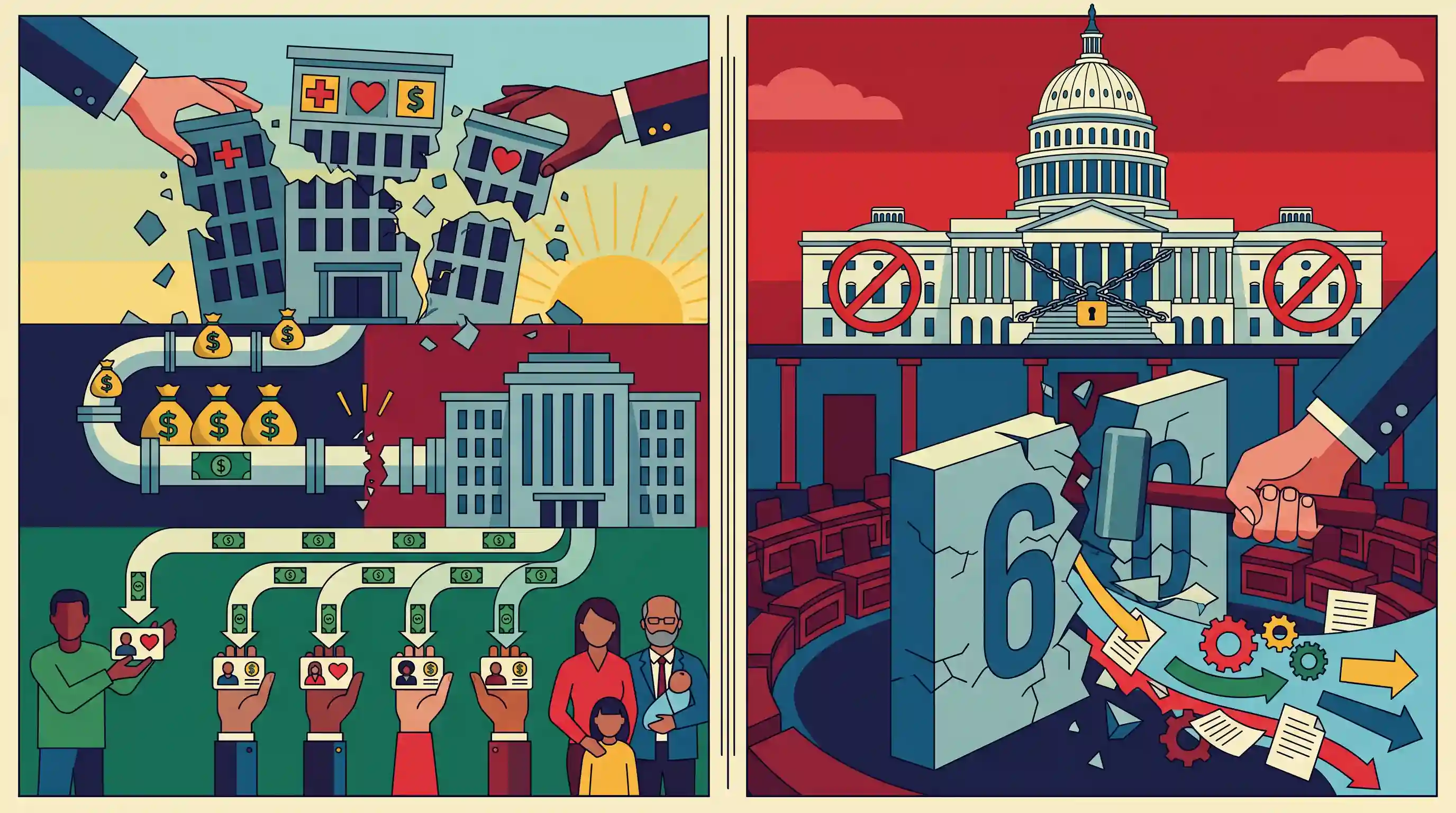
US President-elect Donald Trump has proposed dismantling the Affordable Care Act (Obamacare) and redirecting the federal funds currently subsidizing insurance companies directly to American citizens to purchase their own healthcare. This shift seeks to eliminate intermediaries and radically alter the US healthcare financing model. Concurrently, amidst a federal government shutdown, Trump has urged lawmakers to abolish the Senate filibuster rule, which requires a 60-vote supermajority, to push through his legislative agenda.
Key Points
- US President-elect Donald Trump proposed terminating the Affordable Care Act (Obamacare).
- He suggested redirecting hundreds of billions of dollars currently paid to insurance companies as direct cash payments to citizens for purchasing healthcare.
- The proposal aims to remove insurance intermediaries and shift to a market-driven, direct-transfer healthcare financing model.
- Amidst a federal government shutdown over spending bills, Trump also urged the US Senate to end the filibuster rule to bypass the 60-vote threshold required for most legislation.
Important Terms
Affordable Care Act (Obamacare)

A 2010 US federal law (ACA) that expanded health insurance coverage through Medicaid expansion, individual mandates, and federal subsidies for lower-income citizens.
UPSC context
GS Paper 2 (Social Justice/Health); tests understanding of global health financing models and social security systems.
Filibuster
A procedural tactic in the US Senate used to delay or block legislation by extending debate; it typically requires a 60-vote supermajority (cloture) to overcome.
UPSC context
GS Paper 2 (Governance/Comparative Constitution); tests comparison between US legislative procedures and Indian parliamentary rules.
Direct Benefit Transfer (DBT)
A governance mechanism to transfer subsidies or cash directly to beneficiaries' bank accounts, leveraging technology to eliminate intermediaries and reduce fund leakages.
UPSC context
GS Paper 2 & 3 (Governance/Economy); central to welfare reform, financial inclusion (JAM Trinity), and fiscal efficiency.
Separation of Powers
The division of government into distinct branches (Legislature, Executive, Judiciary) to ensure checks and balances and prevent concentration of power.
UPSC context
GS Paper 2 (Polity/Comparative Constitution); compares the rigid US model with India's flexible 'fusion of powers.'
US Senate
The upper chamber of the US Congress, characterized by equal state representation and unique procedural rules like the filibuster and advice-and-consent powers.
UPSC context
GS Paper 2 (Comparative Constitution); tests differences in powers and functions between the US Senate and India's Rajya Sabha.
Universal Health Coverage (UHC)
A system ensuring all people have access to needed health services (prevention, treatment, rehabilitation) without experiencing financial hardship.
UPSC context
GS Paper 2 (Social Justice/Health); linked to Sustainable Development Goal 3.8 and India's National Health Policy.
Prelims Trap
Failure to pass the Union Budget in India leads to a temporary 'government shutdown' until an agreement is reached.
In India, defeating the budget acts as a no-confidence vote, forcing the government's resignation. Interim funding is seamlessly secured via a 'Vote on Account'.
Static Concepts Connected
How does the Indian Constitution prevent funding-related administrative paralysis?
- Article 116: Allows the Lok Sabha to pass a 'Vote on Account' to grant advance funds for ongoing operations pending the budget's final passage.
- Executive Accountability: Defeat of the Union Budget or a finance bill amounts to a loss of confidence, triggering the government's resignation rather than a prolonged shutdown.
- Charged Expenditures: Expenses like salaries of judges and the President are charged upon the Consolidated Fund and do not require an annual parliamentary vote.
How is Ayushman Bharat (PM-JAY) financed compared to direct cash transfers?
- Cashless Model: It provides paperless, cashless access to secondary and tertiary healthcare at the point-of-service, rather than transferring cash to individuals to buy their own insurance.
- Implementation Vehicles: States implement PM-JAY via an insurance company model, a state-managed trust model, or a mixed model, pooling risks collectively.
Cross-Topic Patterns
Filibuster vs Indian Rajya Sabha
While the US Senate uses the 60-vote filibuster to protect minority interests, India's Rajya Sabha passes ordinary bills by simple majority without mechanisms to indefinitely stall voting.
Limits of DBT in Healthcare
Trump’s push to replace insurance with cash mimics a DBT approach. India heavily uses DBT for welfare, but prefers cashless trust models for health to mitigate market failures and information asymmetry.

Expect GS2 comparative constitution questions contrasting US legislative gridlocks (shutdowns/filibusters) with Indian parliamentary rules.
Linked PYQs · 3
Linked PYQs · 3
- 2024MainsGS2
In a crucial domain like the public healthcare system the Indian State should play a vital role to contain the adverse impact of marketisation of the system. Suggest some measures through which the State can enhance the reach of public healthcare at the grassroots level.
- 2015MainsGS2
Public health system has limitations in providing universal health coverage. Do you think that the private sector could help in bridging the gap? What other viable alternatives would you suggest?
- 2021MainsGS2
Analyze the distinguishing features of the notion of Right to Equality in the Constitutions of the USA and India.
