Protectionist Trade Policies and Bilateral Agreements
Source:The Hindu ↗
Why It Matters
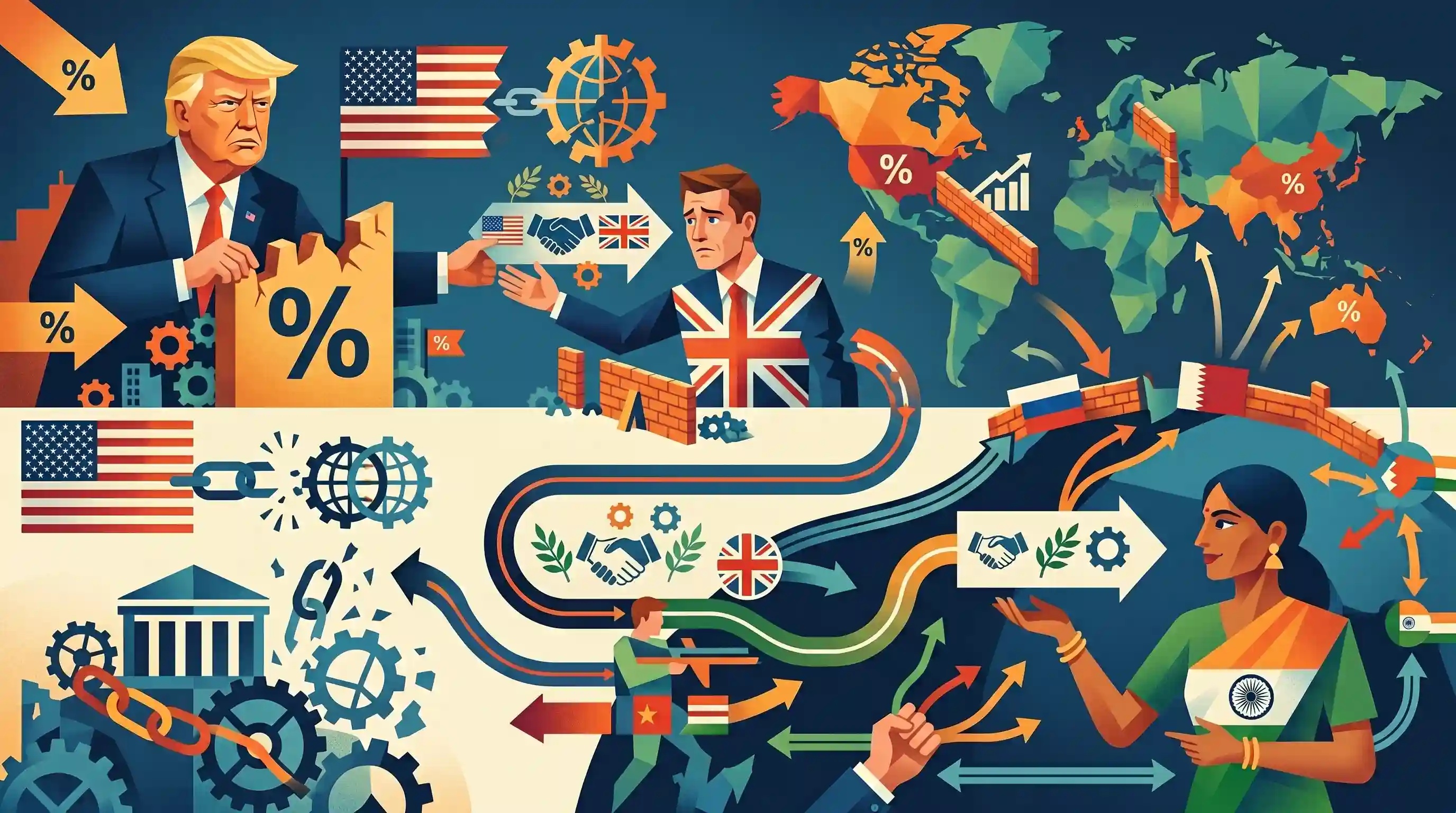
The shift from multilateralism to protectionist bilateral agreements (like the impending US-UK deal and the signed India-UK FTA) directly affects India's export potential, foreign relations, and macroeconomic stability. Understanding these global trade realignments is essential for topics related to IR and global economy.
Summary
U.S. President Donald Trump is set to announce a major trade agreement with the U.K., reflecting a broader U.S. strategy of using tariff threats to force bilateral trade negotiations. This protectionist pivot is accelerating global trade realignments. In response to these tariff threats and its post-Brexit economic objectives, the U.K. recently concluded a landmark Free Trade Agreement (FTA) with India. The growing trend of moving away from multilateral free trade towards bilateral deals and protectionism presents structural shifts that directly impact India's trade strategy and global economic integration.
Key Points
- U.S. President Donald Trump is utilizing the threat of sweeping tariffs to coerce trading partners into negotiating bilateral trade agreements, shifting away from multilateralism.
- The U.S. and the U.K. are poised to announce a major trade deal, reflecting the changing dynamics of global trade.
- Driven by post-Brexit economic necessities and the looming threat of U.S. tariffs, the U.K. recently finalized a significant Free Trade Agreement (FTA) with India.
- Trump has indicated intentions to pursue similar bilateral trade agreements with India, South Korea, and Japan.
- The global transition towards protectionism and sovereign nationalism poses significant challenges and opportunities for India's foreign trade strategy and macroeconomic stability.
Important Terms
India-UK Free Trade Agreement (FTA)

A comprehensive trade pact reducing or eliminating tariffs on over 90% of goods (e.g., Scotch whisky, Indian textiles), easing services trade, and facilitating professional mobility between the two economies.
UPSC context
GS Paper II/III; tests bilateral trade strategy, global supply chain integration, and economic diplomacy post-Brexit.
Protectionism
Economic policy of restricting imports through tariffs, quotas, or regulations to protect domestic industries and workers from foreign competition.
UPSC context
GS Paper III (Economy); tests knowledge of trade wars, deglobalization, and their impact on India's export-led growth.
Brexit
The withdrawal of the United Kingdom from the European Union on January 31, 2020, enabling the UK to pursue an independent trade policy.
UPSC context
GS Paper II; key driver of the UK’s 'Global Britain' strategy and its strategic pivot toward Indo-Pacific partners.
Bilateralism
The conduct of economic or political relations between two sovereign states, often preferred over multilateralism when global trade negotiations (like WTO) stall.
UPSC context
GS Paper II (International Relations); tests understanding of shifts in global trade architecture and 1-on-1 diplomacy.
Tariff
A tax or duty imposed by a government on imported goods, used to increase domestic revenue or as a protectionist tool to discourage imports.
UPSC context
GS Paper III (Economy); relevant to trade disputes, inflation, and the 'America First' trade policy's impact on India.
Multilateralism
Trade relations between three or more nations based on non-discriminatory principles, typically governed by international bodies like the World Trade Organization (WTO).
UPSC context
GS Paper II; tests understanding of global governance challenges and the move toward exclusive trade blocs.
Prelims Trap
Bilateral Free Trade Agreements (FTAs) inherently violate the WTO's Most-Favoured-Nation (MFN) principle.
While MFN mandates equal treatment of all WTO members, Article XXIV of GATT provides an explicit legal exception allowing member states to form FTAs and Customs Unions.
Static Concepts Connected
What are the core non-discrimination principles of the WTO?
- Most-Favored-Nation (MFN): Requires treating all WTO members equally. If you grant a special favor to one, you must do so for all. FTAs are an allowed exception.
- National Treatment: Requires treating foreign and domestic goods equally once the imported goods have entered the domestic market (post-customs).
How do standard FTAs differ from Comprehensive Economic Partnership Agreements (CEPAs)?
- FTA Focus: Primarily focuses on reducing or eliminating customs duties and non-tariff barriers on traded goods.
- CEPA/CECA Focus: Much broader scope; besides goods, it comprehensively covers trade in services, investments, intellectual property rights, and competition policies.
Cross-Topic Patterns
Weaponized Tariffs & Supply Chain Resilience
As the US pivots to tariff coercion, India's push for frameworks like the Supply Chain Resilience Initiative (SCRI) with Japan and Australia becomes critical for insulating its export-led industrial growth.
Post-Brexit Realignment & Indian Leverage
The UK's departure from the EU single market forces it to expedite deals like the India-UK FTA, offering New Delhi crucial leverage to demand concessions in services and professional mobility.

The shift from WTO multilateralism to tariff-driven bilateralism and its impact on India's FTAs is a highly probable GS-II Mains question.
Linked PYQs · 3
Linked PYQs · 3
- 2025MainsGS3
What are the challenges before the Indian economy when the world is moving away from free trade and multilateralism to protectionism and bilateralism? How can these challenges be met?
- 2018MainsGS3
How would the recent phenomena of protectionism and currency manipulations in world trade affect macroeconomic stability of India?
- 2025MainsGS2
"With the waning of globalization, post-Cold War world is becoming a site of sovereign nationalism.” Elucidate.
