United States China Trade Policy and Strategic Tariff Measures
Source:Indian Express ↗
Why It Matters
The US-China trade war fundamentally alters the global economic landscape, driving a global shift toward protectionism and bilateralism. Furthermore, the weaponization of critical supply chains like rare earth minerals poses a significant geopolitical and economic challenge for emerging nations like India.
Summary
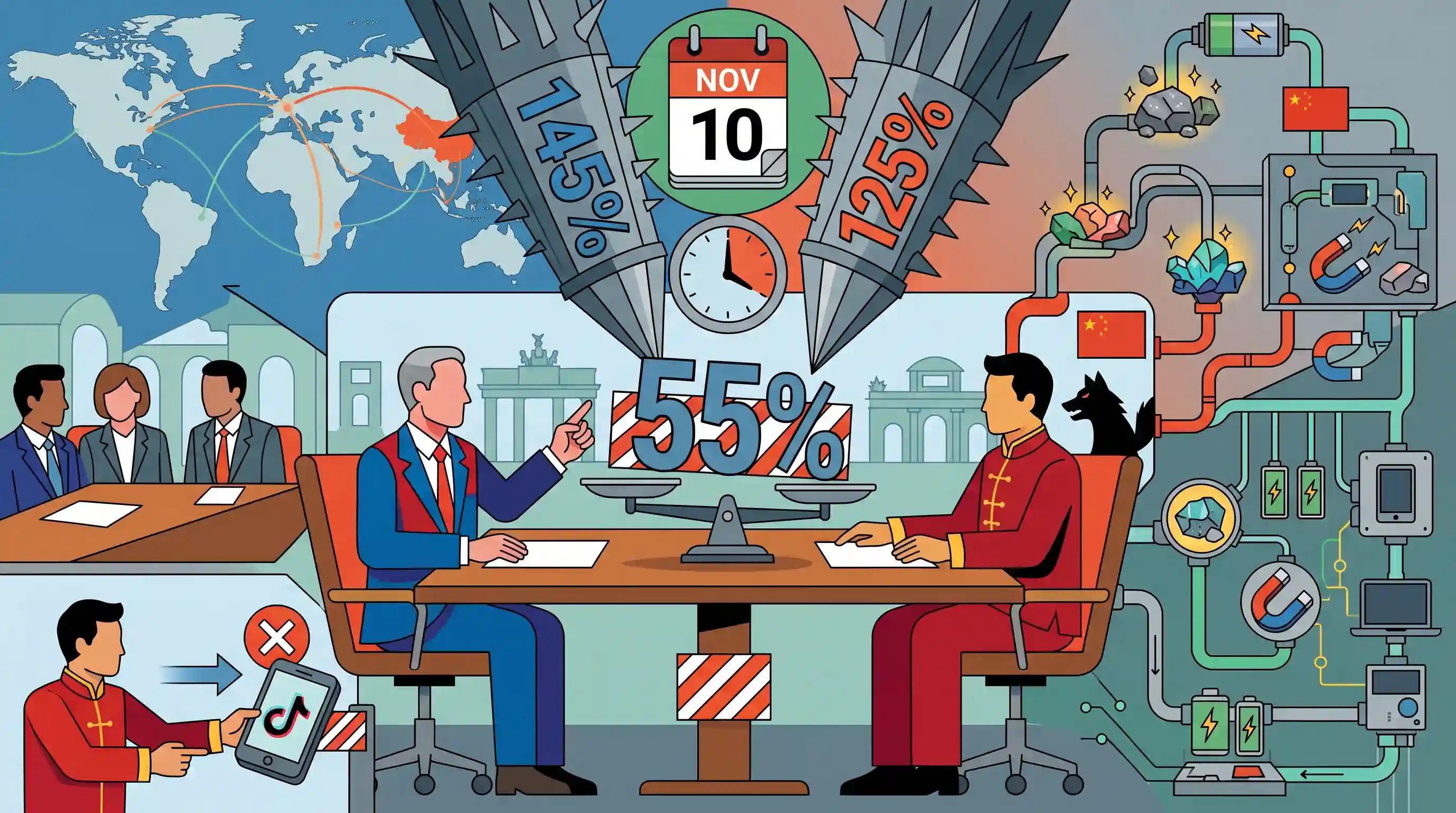
US Trade Representative Jamieson Greer labeled the current 55% tariffs on Chinese imports a 'good status quo' and rejected China's offer to trade TikTok ownership for lower tariffs during talks in Madrid. The US-China trade truce expires on November 10; without an extension, tariffs will snap back to 145% (US) and 125% (China). Greer highlighted China's 'wolf warrior' diplomacy and its leverage over global rare earth mineral supplies as factors complicating the deeply political trade negotiations.
Key Points
- US Trade Representative Jamieson Greer characterized the existing 55% US tariffs on Chinese goods as a 'good status quo'.
- A bilateral trade truce expires on November 10; failing to extend it would trigger snap-back tariffs of 145% by the US and 125% by China.
- The US rejected a proposal from Chinese Vice Premier He Lifeng to cede control of TikTok to a US consortium in exchange for lowered tariffs.
- Negotiations are politically charged, exacerbated by China's aggressive 'wolf warrior' diplomacy and its leverage over the global supply of rare earth minerals and magnets.
Important Terms
Rare Earth Minerals

A group of 17 metallic elements (lanthanides plus scandium and yttrium) essential for high-tech manufacturing, defense systems, and green energy. China dominates their processing, creating significant global supply chain vulnerabilities.
UPSC context
GS Paper I & III: Geography and Economic Development; tests knowledge of critical minerals and strategic resource security.
Wolf Warrior Diplomacy
An assertive and often confrontational style of diplomacy adopted by Chinese officials under Xi Jinping. It prioritizes proactive defense of national interests and strident responses to Western criticism.
UPSC context
GS Paper II: International Relations; tests understanding of China’s foreign policy shifts and their impact on global geopolitics.
Office of the United States Trade Representative (USTR)
A US federal agency responsible for developing and coordinating international trade policy. It leads negotiations with foreign governments and enforces trade laws, including intellectual property standards and tariff regulations.
UPSC context
GS Paper II: Bilateral and Global Groupings; tests knowledge of key international trade bodies and policy mechanisms.
Protectionism
Economic policy of restricting imports through tariffs, quotas, or regulations to shield domestic industries from foreign competition. It is often debated in the context of deglobalization and trade wars.
UPSC context
GS Paper III: Indian Economy; tests understanding of trade barriers, their economic impact, and global trade dynamics.
Section 301 Investigation
A provision of the US Trade Act of 1974 that authorizes the USTR to investigate and respond to "unfair" foreign trade practices, often leading to the imposition of retaliatory tariffs.
UPSC context
GS Paper II: International Relations; tests knowledge of legal instruments used in trade disputes and bilateral tensions.
Prelims Trap
Snap-back tariffs are dispute resolution mechanisms triggered exclusively under the World Trade Organization (WTO) framework.
False. In the US-China trade war, snap-back tariffs are bilateral retaliatory actions (often using domestic laws like US Section 301) operating outside WTO protocols.
Static Concepts Connected
What are the three authorized trade defence measures under the WTO?
- Anti-dumping duties (ADD): Applied by a government when foreign companies sell goods below their fair market value, injuring domestic industries.
- Countervailing duties (CVD): Tariffs levied to neutralize explicit foreign government subsidies that artificially lower the price of exported goods.
- Safeguard measures: Temporary, non-discriminatory import restrictions to protect a specific domestic industry from an unforeseen, sudden surge in imports.
What makes Rare Earth Elements (REEs) a geopolitical weapon?
- The 17 Elements: They comprise 17 specific metallic elements (15 lanthanides plus scandium and yttrium) that are chemically similar.
- Critical Applications: Crucial for permanent magnets used in electric vehicles, wind turbines, precision-guided munitions, and advanced electronics.
- Processing Monopoly: Despite the name, they are relatively abundant. The strategic choke point is highly concentrated extraction and refining capacity, overwhelmingly dominated by China.
Cross-Topic Patterns
Protectionism driving China Plus One strategy
US-China tariff walls accelerate the restructuring of Global Value Chains. India actively leverages this geopolitical vacuum via its PLI schemes to position itself as a reliable alternative manufacturing hub.
Rare Earths driving minilateral alliances
China’s near-monopoly on rare earth processing directly catalyzed the Quad's critical mineral supply chain initiatives and the US-led Mineral Security Partnership (MSP), which India has joined.

A 2026 multi-statement question will likely fuse WTO national security exceptions (Article XXI) with critical mineral supply chain dominance.
Linked PYQs · 2
Linked PYQs · 2
- 2025MainsGS3
What are the challenges before the Indian economy when the world is moving away from free trade and multilateralism to protectionism and bilateralism? How can these challenges be met?
- 2021MainsGS2
“The USA is facing an existential threat in the form of a China, that is much more challenging than the erstwhile Soviet Union.” Explain.
