Trump and Xi Set for South Korea Bilateral Summit Amid Trade Tensions
Source:The Hindu ↗
Why It Matters
The shifting dynamics of the US-China relationship profoundly affect global supply chains, international trade regulations, and regional stability in the Indo-Pacific. The weaponization of trade (rare earth elements and tariffs) and accusations surrounding transnational issues like fentanyl highlight emerging diplomatic friction points that India must navigate.
Summary
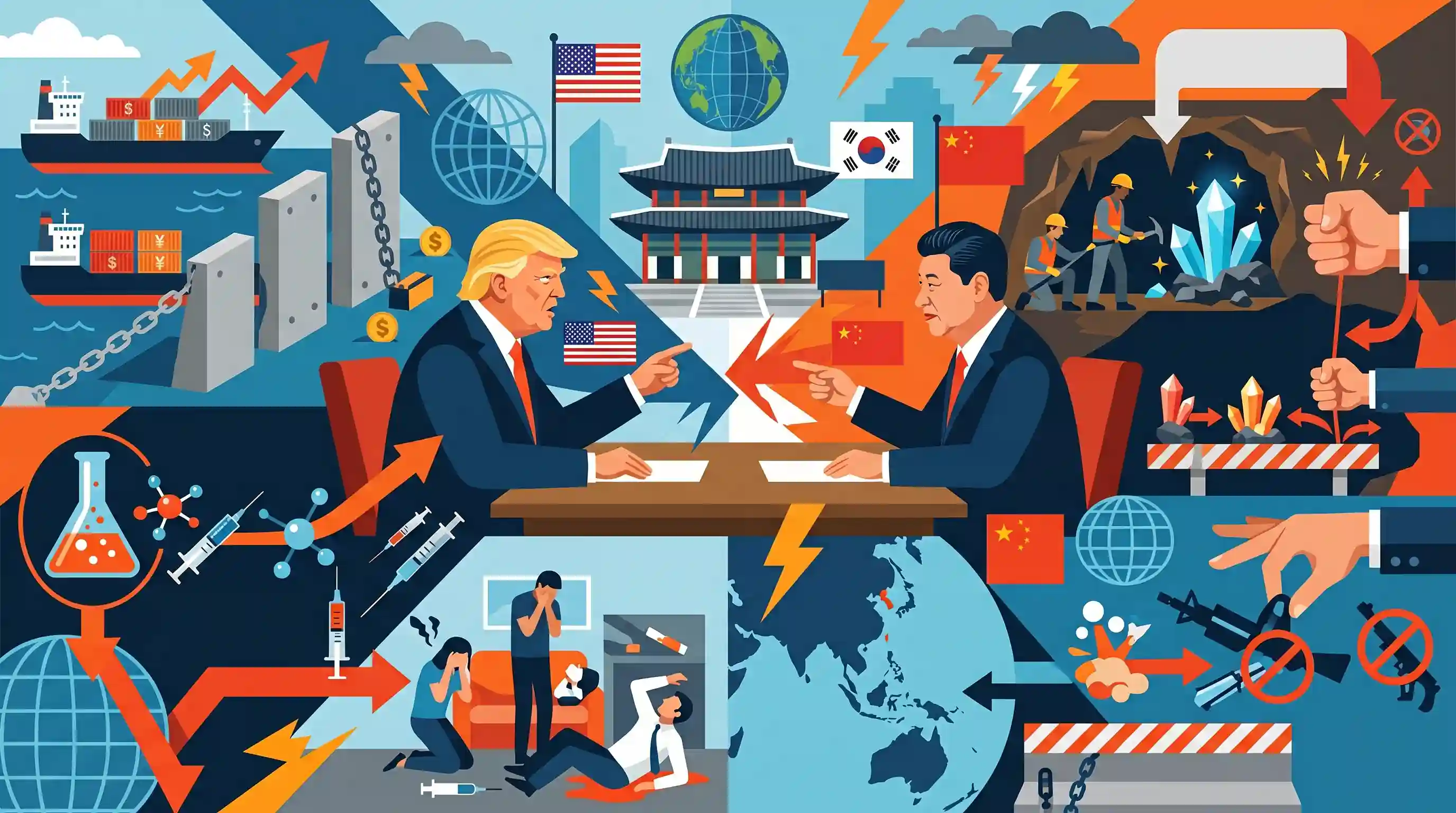
U.S. President Donald Trump and Chinese President Xi Jinping are set to meet in South Korea following the APEC CEO Summit, amidst escalating bilateral trade tensions. The high-stakes meeting comes as China tightens export controls on critical rare-earth minerals and the U.S. threatens new tariffs. Additionally, the U.S. plans to confront China over the flow of fentanyl precursor chemicals, which it blames for a domestic overdose crisis, while Beijing counters that Washington is weaponizing the issue to justify economic protectionism.
Key Points
- U.S. President Donald Trump and Chinese President Xi Jinping are scheduled to meet in South Korea as part of Trump's diplomatic swing through Asia.
- The meeting occurs against a backdrop of escalating trade tensions, highlighted by Beijing's expanded export restrictions on rare-earth minerals and Trump's renewed threats of tariffs.
- A primary issue on the bilateral agenda is the synthetic opioid crisis, with the U.S. accusing China of failing to curb the flow of fentanyl precursor chemicals.
- China has rebuffed these accusations, claiming the U.S. is using the fentanyl issue to unfairly justify tariff hikes and economic sanctions.
Important Terms
APEC (Asia-Pacific Economic Cooperation)

A 21-member regional economic forum established to promote free trade and sustainable development in the Pacific Rim through non-binding, consensus-based cooperation.
UPSC context
GS Paper-II: International Relations. Focuses on regional groupings, trade liberalization, and India’s long-standing bid for membership.
Rare-earth Minerals
A group of 17 metallic elements essential for high-tech manufacturing, including semiconductors, electric vehicle batteries, and advanced defense systems like missile guidance and radar.
UPSC context
GS Paper-I (Geography) & III (Security/Economy). Tests resource distribution, China's market dominance, and India's National Critical Mineral Mission.
Fentanyl Precursors
Chemical substances used in legitimate industrial processes that are illegally diverted to manufacture fentanyl, a potent synthetic opioid responsible for a global overdose crisis.
UPSC context
GS Paper-III: Internal Security. Relates to non-traditional security threats, organized crime, and international drug trafficking networks.
Export Controls
Government regulations that restrict the export of specific goods, software, or technologies (e.g., minerals, chips) to foreign countries to protect national security and maintain economic leverage.
UPSC context
GS Paper-III: Economy & Security. Tests understanding of 'trade-as-a-weapon,' strategic trade authorizations (SCOMET), and global supply chain disruptions.
Economic Protectionism
Economic policies—such as high tariffs, import quotas, and subsidies—designed to shield domestic industries and labor from foreign competition.
UPSC context
GS Paper-III: Indian Economy. Key to analyzing 'Atmanirbhar Bharat,' trade wars, and the global shift from multilateralism to bilateralism.
Indo-Pacific
A geopolitical region comprising the tropical waters of the Indian Ocean and the western and central Pacific Ocean, a focal point for global maritime trade and power competition.
UPSC context
GS Paper-II: International Relations. Central to India’s maritime security (SAGAR), regional stability, and the strategic significance of the Quad.
Prelims Trap
APEC operates through legally binding trade agreements, and India is a full member state.
APEC is a non-binding cooperative forum, and India is only an observer, not a full member, making this a frequent UPSC elimination statement.
Static Concepts Connected
What are Rare Earth Elements (REEs) and their primary source in India?
- 17 Elements: A group of 17 metallic elements (15 lanthanides plus scandium and yttrium) essential for green technologies and high-tech electronics.
- Monazite Sand: India's primary indigenous source is Monazite sand, predominantly found in the beach placers of Kerala, Tamil Nadu, and Odisha.
- Regulated Material: Because it contains thorium, Monazite is heavily regulated and classified as a 'prescribed substance' under the Atomic Energy Act, 1962.
What is the mandate of APEC and what is India's relationship with it?
- Non-Binding Forum: A 21-member regional economic forum in the Asia-Pacific that operates exclusively on consensus and voluntary, non-binding commitments.
- India's Status: India has observer status, not full membership. Full membership has been stalled since a 1997 moratorium on new members (which later expired).
Cross-Topic Patterns
Critical Minerals & the MSP
China's weaponization of REE exports makes plurilateral supply-chain pacts highly relevant. India's recent induction into the US-led Minerals Security Partnership (MSP) directly aims to counter this exact geopolitical vulnerability.
Non-Traditional Security as Statecraft
The weaponization of fentanyl shifts drug trafficking from a standard border-management issue (like the Golden Crescent/Triangle) into an instrument of asymmetric international statecraft and trade leverage.

Export controls on critical minerals (REEs) combined with plurilateral responses (like the MSP) are highly probable 2026 Prelims targets.
Linked PYQs · 4
Linked PYQs · 4
- 2018MainsGS2
What are the key areas of reform if the WTO has to survive in the present context of "Trade War', especially keeping in mind the interest of India?
- 2012PrelimsGS1
Recently, there has been a concern over the short supply of a group of elements called 'rare earth metals'. Why? 1. China, which is the largest producer of these elements, has imposed some restrictions on their export. 2. Other than China, Australia, Canada and Chile, these elements are not found in any country. 3. Rare earth metals are essential for the manufacture of various kinds of electronic items and there is a growing demand for these elements. Which of the statements given above is/are correct?
- 2018MainsGS3
India's proximity to two of the world's biggest illicit opium-growing states has enhanced her internal security concerns. Explain the linkages between drug trafficking and other illicit activities such as gunrunning, money laundering and human trafficking. What counter-measures should be taken to prevent the same?
- 2021MainsGS2
The newly tri-nation partnership AUKUS is aimed at countering China's ambitions in the Indo-Pacific region. Is it going to supersede the existing partnerships in the region? Discuss the strength and impact of AUKUS in the present scenario.
