US Foreign Policy Shifts and Regime Change in Venezuela
Source:Indian Express ↗
Why It Matters
This development highlights aggressive shifts in US foreign policy, direct military interventions, and the complexities of regime change and state sovereignty in Latin America. It also touches upon current affairs facts important for Prelims regarding the Nobel Peace Prize rules and the geopolitical significance of Venezuela.
Summary
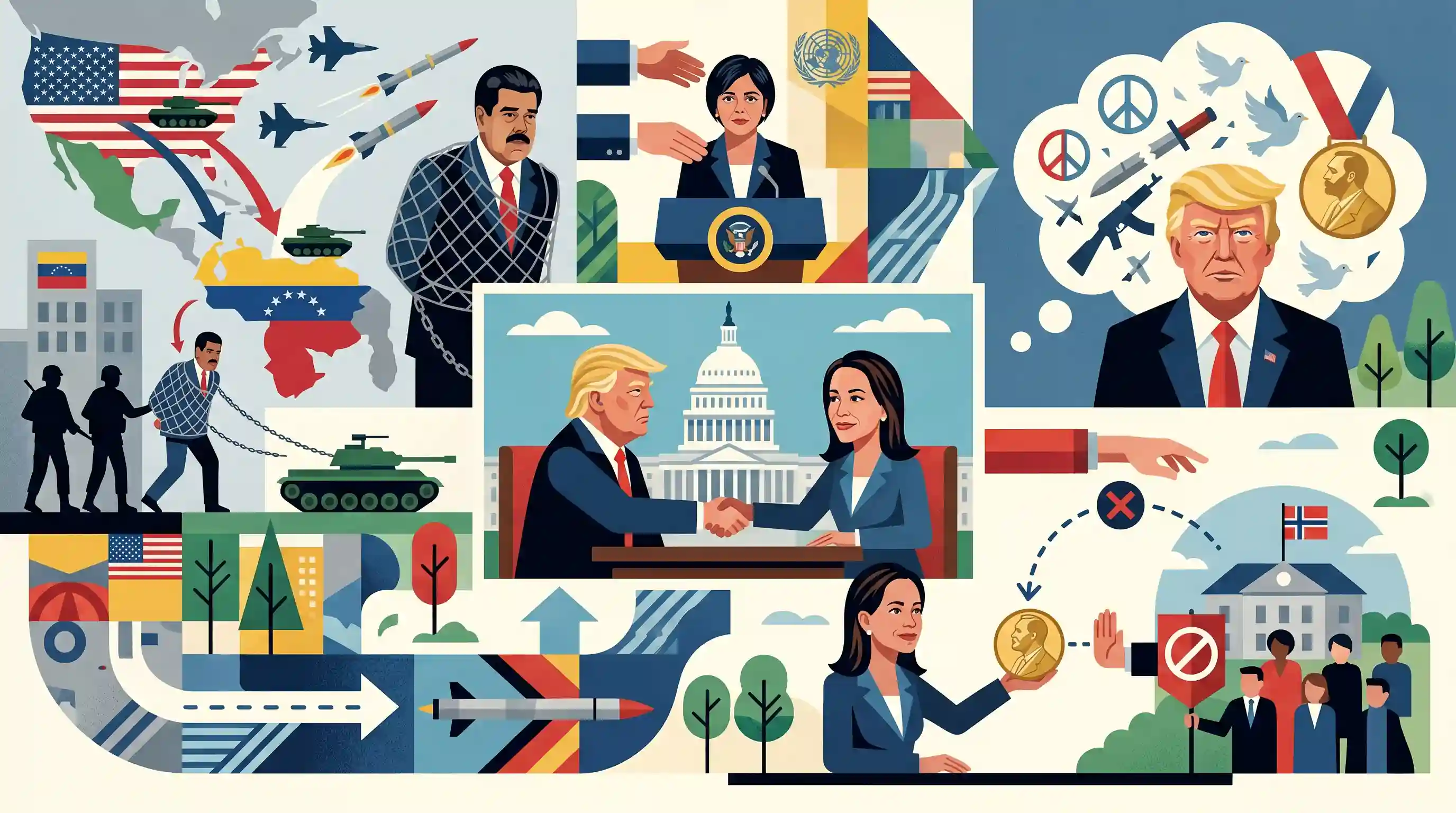
US President Donald Trump is scheduled to meet Venezuelan opposition leader and 2025 Nobel Peace Prize laureate María Corina Machado in Washington. The meeting takes place against the backdrop of direct US military intervention in Venezuela, which culminated in the capture of former President Nicolas Maduro and the installation of Delcy Rodríguez as acting president. Trump suggested that the US would essentially govern Venezuela for the foreseeable future, noting Machado's challenges in garnering domestic support. Additionally, Machado's stated intent to transfer her Nobel Prize to Trump was rejected by the Norwegian Nobel Institute, though Trump reiterated his belief that he is the most deserving candidate for the award due to his efforts in 'settling wars'.
Key Points
- US President Donald Trump is set to meet Venezuelan opposition leader María Corina Machado at the White House.
- The meeting follows recent US military intervention in Venezuela that resulted in the capture of former leader Nicolas Maduro.
- Following Maduro's ouster, Delcy Rodríguez was sworn in as the acting president of Venezuela.
- Trump indicated that the United States will effectively 'run' Venezuela for several years, highlighting concerns over Machado's lack of popular support to govern independently.
- Machado, the 2025 Nobel Peace Prize laureate, proposed transferring her award to Trump, a move the Norwegian Nobel Institute clarified is strictly prohibited by their rules.
- Trump claimed he deserves the Nobel Peace Prize more than anyone in history for his role in settling wars.
Important Terms
Norwegian Nobel Institute

The organization supporting the Norwegian Nobel Committee in selecting laureates. It manages the Nobel Peace Prize's legal framework, emphasizing that the award is non-transferable and personal to the recipient.
UPSC context
GS Paper II (International Institutions); tests understanding of global soft power and the administrative rules of major international accolades.
White House
The official residence and office of the U.S. President. It functions as the executive hub for formulating and directing American foreign policy and military strategy.
UPSC context
GS Paper II (International Relations); tests knowledge of the U.S. executive's role in global security and bilateral diplomatic relations.
Regime Change
The replacement of one government by another, typically through foreign military, economic, or political pressure. It is a controversial tool of interventionism in international relations.
UPSC context
GS Paper II (International Relations); tests concepts of democratic transitions, political stability, and the ethical/legal debates over foreign-led political shifts.
Sovereignty
The supreme authority of a state to govern its territory and people without external interference. It is a foundational principle of the UN Charter and international law.
UPSC context
GS Paper II (IR) and PSIR Optional; a core concept for analyzing the legality of foreign interventions and state independence.
US Military Intervention
The use of a nation's armed forces to influence the internal affairs or political landscape of another country. It often involves surgical strikes or full-scale military presence.
UPSC context
GS Paper II (IR/Security); tests understanding of 'interventionism,' regional hegemony, and the modern application of the Monroe Doctrine.
María Corina Machado
A prominent Venezuelan opposition leader. In this context, she is the 2025 Nobel Peace Prize laureate seeking international legitimacy during a transition of power.
UPSC context
GS Paper II (International Relations); tests the role of political leadership in foreign-backed democratic transitions and regional geopolitics.
Prelims Trap
A Nobel Peace Prize can be officially transferred to another person if the original laureate formally requests it.
Under the official statutes of the Nobel Foundation, a Nobel Prize cannot be legally transferred, revoked, or reassigned after the award is announced.
Static Concepts Connected
What historical doctrines frame US military interventions in Latin America?
- Monroe Doctrine: Issued in 1823, it asserted the Western Hemisphere as an exclusive US sphere of influence, warning European powers against colonial interference.
- Roosevelt Corollary: Added in 1904, it claimed the US right to exercise an 'international police power' in Latin America, setting a precedent for preemptive interventions.
Why does Venezuela face an economic crisis despite massive oil wealth?
- Resource Curse: Despite possessing the world's largest proven crude oil reserves, an over-reliance on oil exports makes the economy highly vulnerable to global price shocks.
- Structural Collapse: The crisis is compounded by sustained hyperinflation, lack of economic diversification, domestic mismanagement, and severe international sanctions.
Cross-Topic Patterns
Resource Curse + Geopolitics
Venezuela's massive crude reserves juxtaposed with its economic collapse and external military intervention perfectly illustrates the 'resource curse' or Dutch disease within political economy.
Sovereignty vs Interventionism
Direct military intervention and the assertion that the US will 'run' Venezuela challenges the core UN Charter principles regarding state sovereignty and non-interference.

Direct US military intervention in Venezuela makes Latin American geopolitics, oil reserves, and UN Charter principles highly probable for 2026.
Linked PYQs · 3
Linked PYQs · 3
- 2024PrelimsGS1
Consider the following statements : Statement-I : Recently, Venezuela has achieved a rapid recovery from its economic crisis and succeeded in preventing its people from fleeing/emigrating to other countries. Statement-II : Venezuela has the world's largest oil reserves. Which one of the following is correct in respect of the above statements?
- 2025PrelimsGS1
Consider the following countries : I. Bolivia II. Brazil III. Colombia IV. Ecuador V. Paraguay VI. Venezuela Andes mountains pass through how many of the above countries?
- 2025MainsGS2
"The reform process in the United Nations remains unresolved, because of the delicate imbalance of East and West and entanglement of the USA vs. Russo-Chinese alliance.” Examine and critically evaluate the East-West policy confrontations in this regard.
