US Arms Sales to Taiwan and Cross Strait Geopolitical Tensions
Source:The Hindu ↗
Why It Matters
The Taiwan Strait is a critical maritime chokepoint and a major flashpoint for a potential great-power conflict between the U.S. and China. For India, maintaining peace in the Indo-Pacific and securing freedom of navigation is vital for its economic and strategic interests (Act East policy, Quad). Understanding the friction over Taiwan helps analyze broader Indo-Pacific security dynamics.
Summary
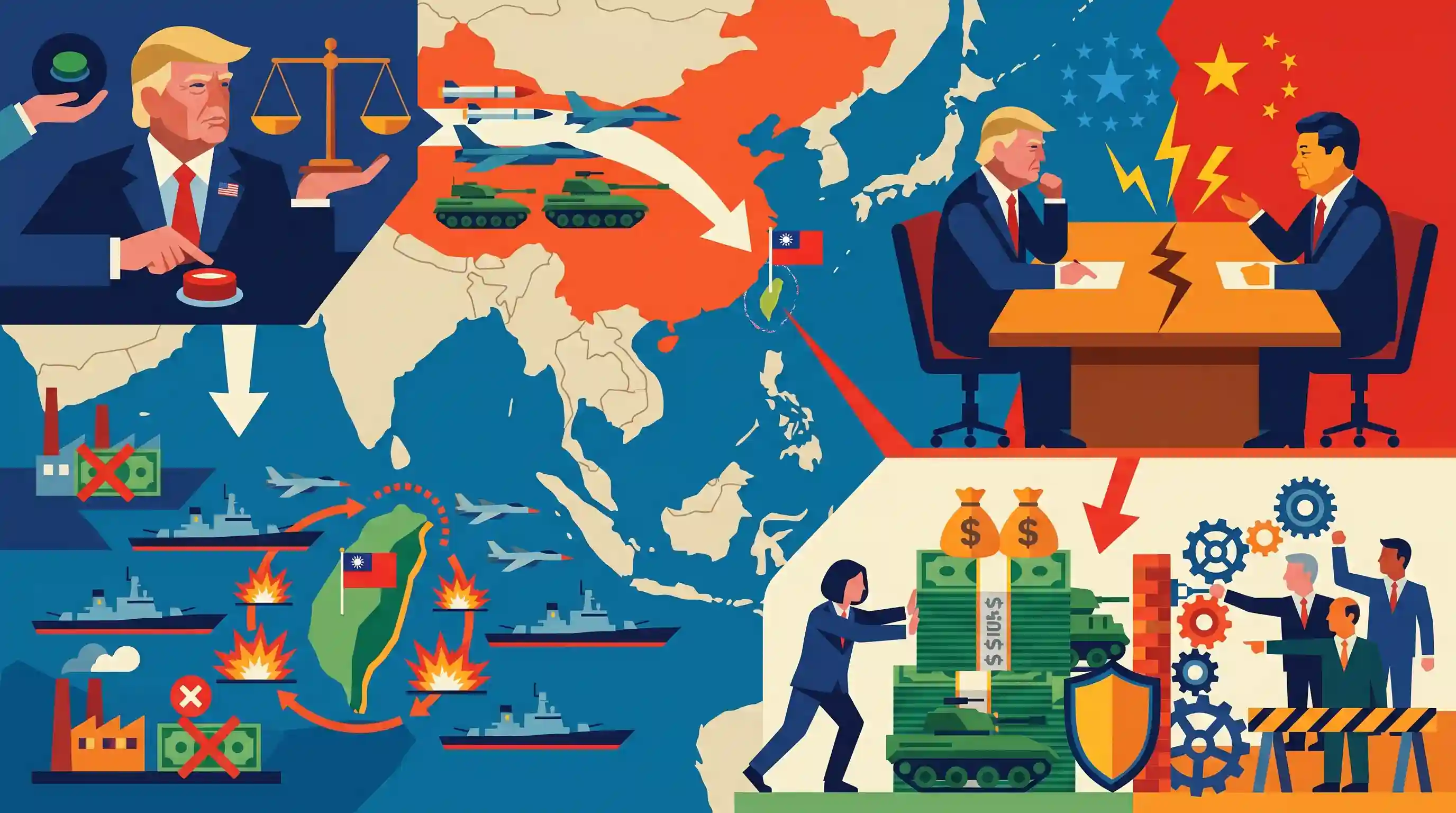
U.S. President Donald Trump is expected to soon decide on whether to approve further arms sales to Taiwan, a move that comes amid heightened tensions and ahead of a planned meeting with Chinese President Xi Jinping. Previous U.S. arms transfers prompted Beijing to retaliate with economic sanctions and massive military drills simulating a blockade of Taiwan. Simultaneously, Taiwan is grappling with internal political friction as its opposition-controlled parliament blocks President Lai Ching-te’s sweeping $40 billion defense spending package, raising concerns over its readiness amidst growing Chinese assertiveness in the region.
Key Points
- U.S. President Donald Trump is nearing a decision on providing additional weapons to Taiwan, preceding a highly anticipated meeting with Chinese President Xi Jinping in Beijing.
- In December, the U.S. authorized an $11 billion arms package for Taiwan, leading China to sanction American defense firms and execute extensive live-fire blockade drills around Taiwan.
- Despite not formally recognizing Taiwan diplomatically, the U.S. remains its foremost military supporter and is bound by domestic law to provide defensive capabilities.
- Taiwanese President Lai Ching-te's proposal for an additional $40 billion in defense spending is currently being stalled by an opposition-controlled parliament, highlighting domestic hurdles in Taiwan's deterrence strategy.
- China's top diplomat Wang Yi has explicitly warned the U.S. against plotting to use Taiwan as a geopolitical flashpoint, underscoring the severe deterioration in cross-strait and U.S.-China relations.
Important Terms
Kuomintang (KMT)

Taiwan’s main opposition party; historically ruling China, it now favors the '1992 Consensus' and closer economic ties with Beijing while maintaining the status quo.
UPSC context
GS-II: India-China relations and regional geopolitics; tests understanding of internal political actors influencing the Taiwan Strait's stability.
Taiwan People's Party (TPP)
A centrist 'third-force' party founded in 2019; it currently holds the balance of power as a 'kingmaker' in Taiwan's parliament (Legislative Yuan).
UPSC context
GS-II: International Relations; significant for understanding how Taiwan's domestic legislative deadlock impacts regional security and U.S. defense cooperation.
Democratic Progressive Party (DPP)
Taiwan’s ruling party, led by President Lai Ching-te; it emphasizes a distinct Taiwanese identity and is viewed by Beijing as 'pro-independence.'
UPSC context
GS-II: Geopolitics of the Indo-Pacific; critical for analyzing shifting power dynamics and China’s 'One China' principle.
Asymmetric Warfare
A military strategy (often called the 'Porcupine Strategy') focusing on mobile, low-cost tools like missiles and drones to deter a numerically superior force.
UPSC context
GS-III: Internal Security and Defense; relevant for discussing modernization of armed forces and maritime security in the Indo-Pacific.
Legislative Yuan
Taiwan’s unicameral parliament; the highest legislative organ responsible for passing national budgets, including defense spending and arms procurement.
UPSC context
GS-II: Comparative Constitutions/International Relations; highlights how parliamentary oversight can influence a nation's foreign policy and defense readiness.
1992 Consensus
A 1992 understanding where both sides acknowledge 'one China' but interpret its meaning differently; the DPP rejects it while the KMT supports it.
UPSC context
GS-II: International Relations; the core diplomatic friction point in China-Taiwan relations and a frequent topic in Indo-Pacific security analysis.
Cross-Strait Relations
The complex diplomatic and military relationship between mainland China (PRC) and Taiwan (ROC), separated by the Taiwan Strait.
UPSC context
GS-II: International Relations; fundamental for questions on Indo-Pacific stability, semiconductor supply chains, and India’s 'One China' policy stance.
Prelims Trap
The US formally recognizes Taiwan as a sovereign state and maintains a mutual defense treaty with it.
The US adheres to the "One China Policy" acknowledging Beijing. It maintains only unofficial ties and supplies defensive weapons to Taiwan under the 1979 Act.
Static Concepts Connected
What separates the US 'One China Policy' from the PRC's 'One China Principle'?
- One China Principle: PRC's core belief that there is only one China and Taiwan is an inalienable part of it to be reunified.
- One China Policy: The US acknowledges (but doesn't explicitly endorse) Beijing's claim, maintaining formal diplomatic ties with the PRC and only unofficial ties with Taipei.
- Strategic Ambiguity: US policy of remaining intentionally vague on whether it would militarily defend Taiwan against an unprovoked Chinese attack, acting as a dual deterrent.
What constitutes the 'First Island Chain' in the Indo-Pacific?
- Definition: A string of major archipelagos off the East Asian mainland coast, viewed as a crucial line of defense in US geopolitical strategy.
- Key Nodes: It runs from the Kuril Islands, through Japan, the Ryukyu Islands, Taiwan, to the northern Philippines and Borneo.
- Strategic Significance: It acts as a natural barrier restricting China's People's Liberation Army Navy (PLAN) from projecting unhindered power into the wider Pacific Ocean.
Cross-Topic Patterns
Taiwan blockade & semiconductor supply chains
A blockade would severely disrupt global tech supply chains, testing the effectiveness of India's ISM (India Semiconductor Mission) and PLI schemes for domestic electronics manufacturing.
Island Chain dynamics & maritime chokepoints
China's aggressive gray-zone tactics around Taiwan mirror its broader strategy in the South China Sea, linking cross-strait tensions to ASEAN's maritime disputes and UNCLOS interpretations.

Expect a multi-statement Prelims question contrasting 'Strategic Ambiguity', the 'First Island Chain', and UNCLOS in the Indo-Pacific.
Linked PYQs · 3
Linked PYQs · 3
- 2014MainsGS2
With respect to the South China sea, maritime territorial disputes and rising tension affirm the need for safeguarding maritime security to ensure freedom of navigation and over flight throughout the region. In this context, discuss the bilateral issues between India and China.
- 2021MainsGS2
“The USA is facing an existential threat in the form of a China, that is much more challenging than the erstwhile Soviet Union.” Explain.
- 2021MainsGS2
The newly tri-nation partnership AUKUS is aimed at countering China's ambitions in the Indo-Pacific region. Is it going to supersede the existing partnerships in the region? Discuss the strength and impact of AUKUS in the present scenario.
