US Protectionist Tariffs and Geopolitical Trade War Tactics
Source:The Hindu ↗
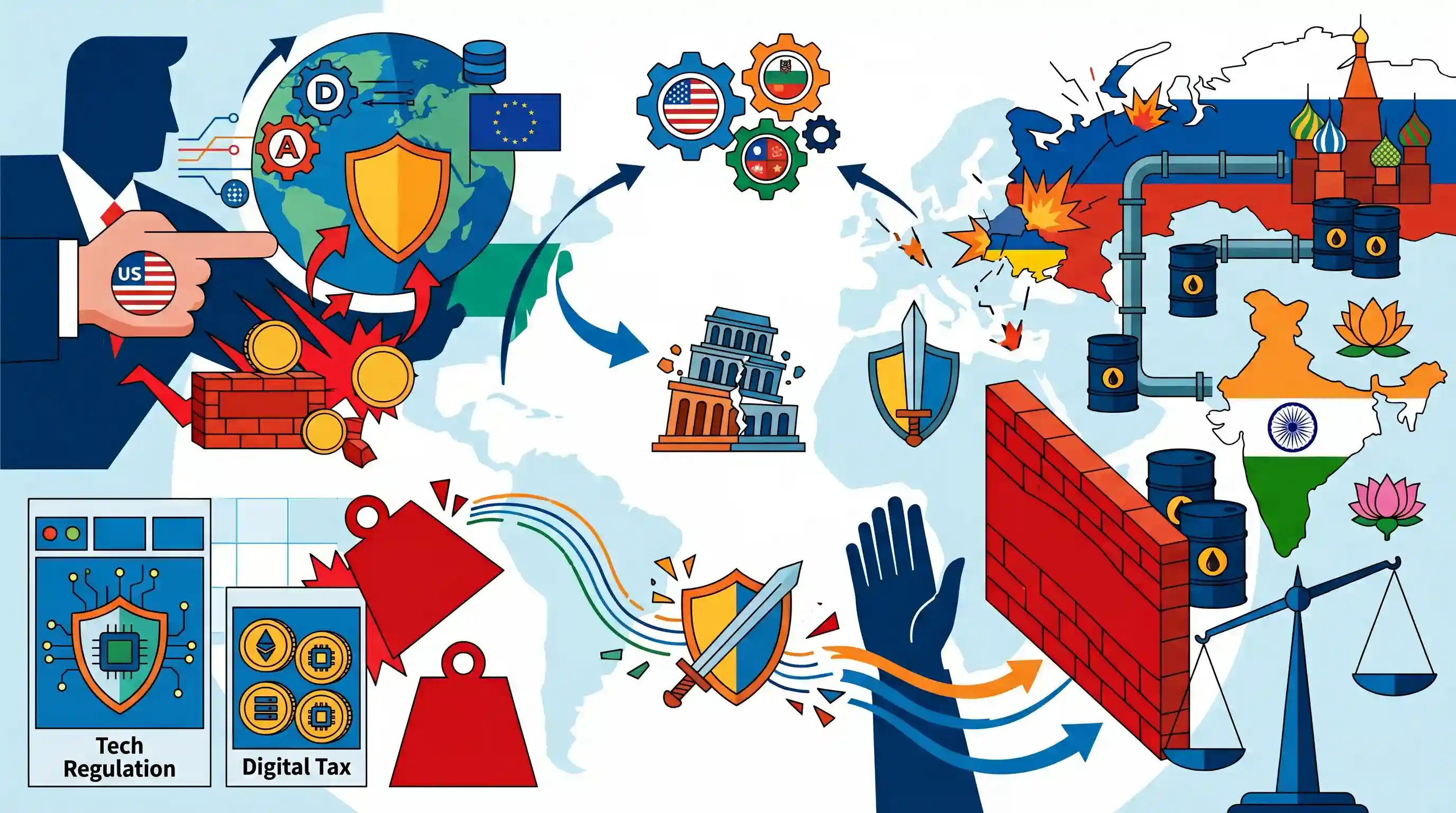
Why It Matters
The weaponization of tariffs to counter domestic digital regulations and dictate foreign energy procurement (such as India's Russian oil imports) demonstrates the growing overlap of technology, trade protectionism, and geopolitics. This poses a direct challenge to India's strategic autonomy and highlights vulnerabilities in global multilateral trade frameworks like the WTO.
Summary
U.S. President Donald Trump has threatened significant tariffs and export controls on countries that implement digital taxes or tech regulations (like the EU's DMA and DSA), arguing they discriminate against American tech firms. Demonstrating his protectionist and transactional approach to foreign policy, Trump also doubled tariffs on Indian goods as a penalty for India's ongoing purchase of Russian oil amid the Ukraine war.
Key Points
- U.S. President Donald Trump threatened retaliatory tariffs and export controls against nations imposing digital taxes or regulations (like the EU's DMA and DSA) that target American tech giants.
- Canada rescinded its planned digital services tax on U.S. multinational companies after Washington canceled bilateral trade talks.
- Trump doubled U.S. tariffs on Indian products in retaliation for India's continued purchase of Russian oil, using trade barriers to enforce geopolitical alignment.
- The developments highlight a shift towards aggressive trade protectionism, where both sector-specific and countrywide tariffs are utilized to protect U.S. corporate interests and dictate foreign policies.
Important Terms
Digital Markets Act (DMA)

An EU regulation identifying large digital platforms as 'gatekeepers' to ensure contestability and fair competition in the digital sector by preventing market power abuse.
UPSC context
GS II (Governance) & GS III (Economy/IT). Tests knowledge of global tech regulation and its impact on multilateral trade.
Digital Services Act (DSA)
An EU regulatory framework establishing transparency and accountability for online intermediaries regarding content moderation, illegal goods, and the mitigation of systemic risks like disinformation.
UPSC context
GS II (Governance) & GS III (S&T). Relevant for discussions on digital sovereignty and safety.
Equalisation Levy
A direct tax introduced by India on digital transactions of non-resident e-commerce firms to ensure a level playing field for domestic companies (often called 'Google Tax').
UPSC context
GS III (Economy/Taxation) & GS II (Policies of developed countries). Tests understanding of international tax disputes.
Protectionism
Economic policy of restricting imports through tariffs or quotas to shield domestic industries from foreign competition, often characterizing transactional trade approaches.
UPSC context
GS III (Economy/Globalisation). Tests conceptual understanding of trade wars and their impact on India's export-led growth.
Reciprocal Tariffs
A trade policy where a country imposes tariffs on imports at the same rate that the trading partner imposes on its own exports, emphasizing 'even treatment.'
UPSC context
GS II (International Relations). Crucial for analyzing US-India trade dynamics and 'transactional' foreign policy.
European Union (EU)
A 27-member political and economic union that operates as a single market and frequently establishes global regulatory standards (Brussels Effect) for digital markets.
UPSC context
GS II (Regional Groupings). Essential for studying India-EU trade relations and global digital governance.
Prelims Trap
Digital Services Taxes (DSTs) are multilateral measures mandated globally under the OECD BEPS framework.
India's Equalisation Levy and similar DSTs are unilateral measures enacted specifically because a binding multilateral consensus (OECD BEPS Pillar 1) on taxing digital giants has been repeatedly delayed.
Static Concepts Connected
What is Base Erosion and Profit Shifting (BEPS) and how do DSTs address it?
- BEPS mechanism: Multinationals exploit gaps in tax rules to artificially shift profits to low-tax jurisdictions where little or no actual economic activity occurs.
- Digital challenge: Tech firms generate huge value from local users without a physical presence, escaping traditional corporate tax nets built for brick-and-mortar entities.
- DST solution: Unilateral taxes like India's Equalisation Levy tax gross revenues (rather than profits) generated from domestic users to ensure tech giants pay a fair share locally.
Which core WTO principles are violated by unilateral retaliatory tariffs?
- MFN Principle: Most-Favored-Nation (MFN) mandates equal trade treatment for all WTO members. Targeted, punitive tariffs against specific nations directly violate this non-discrimination rule.
- Bound Tariffs: WTO members commit to 'bound' ceiling rates for tariffs. Sudden, massive retaliatory hikes usually breach these legally binding limits.
- Bypassing DSB: Unilateral actions ignore the WTO Dispute Settlement Body, replacing the multilateral rule-of-law with coercive economic statecraft.
Cross-Topic Patterns
Trade weaponization for geopolitical alignment
Linking U.S. tariffs to India's Russian oil purchases breaks the firewall between GS2 geopolitics and GS3 trade policy, marking a shift from economic logic to geopolitical coercion.
Ex-ante digital regulations (EU vs India)
The EU's Digital Markets Act (DMA) classifying 'gatekeepers' directly mirrors India's proposed Digital Competition Bill, which targets Systemically Significant Digital Enterprises (SSDEs) with pre-emptive rules.

Expect a multi-statement question on OECD BEPS Pillar 1 & 2 vs. unilateral Digital Services Taxes (like India's Equalisation Levy) in 2026.
Linked PYQs · 4
Linked PYQs · 4
- 2016PrelimsGS1
The term 'Base Erosion and Profit Shifting' is sometimes seen in the news in the context of
- 2018MainsGS2
What are the key areas of reform if the WTO has to survive in the present context of "Trade War', especially keeping in mind the interest of India?
- 2023MainsGS2
Discuss the role of the Competition Commission of India in containing the abuse of dominant position by the Multi-National Corporations in India. Refer to the recent decisions.
- 2012MainsGS2
How have the US sanctions against Iran affected India's bilateral relations with Iran?
