US Iran Tensions and Middle East Energy Security Implications
Source:The Hindu ↗
Why It Matters
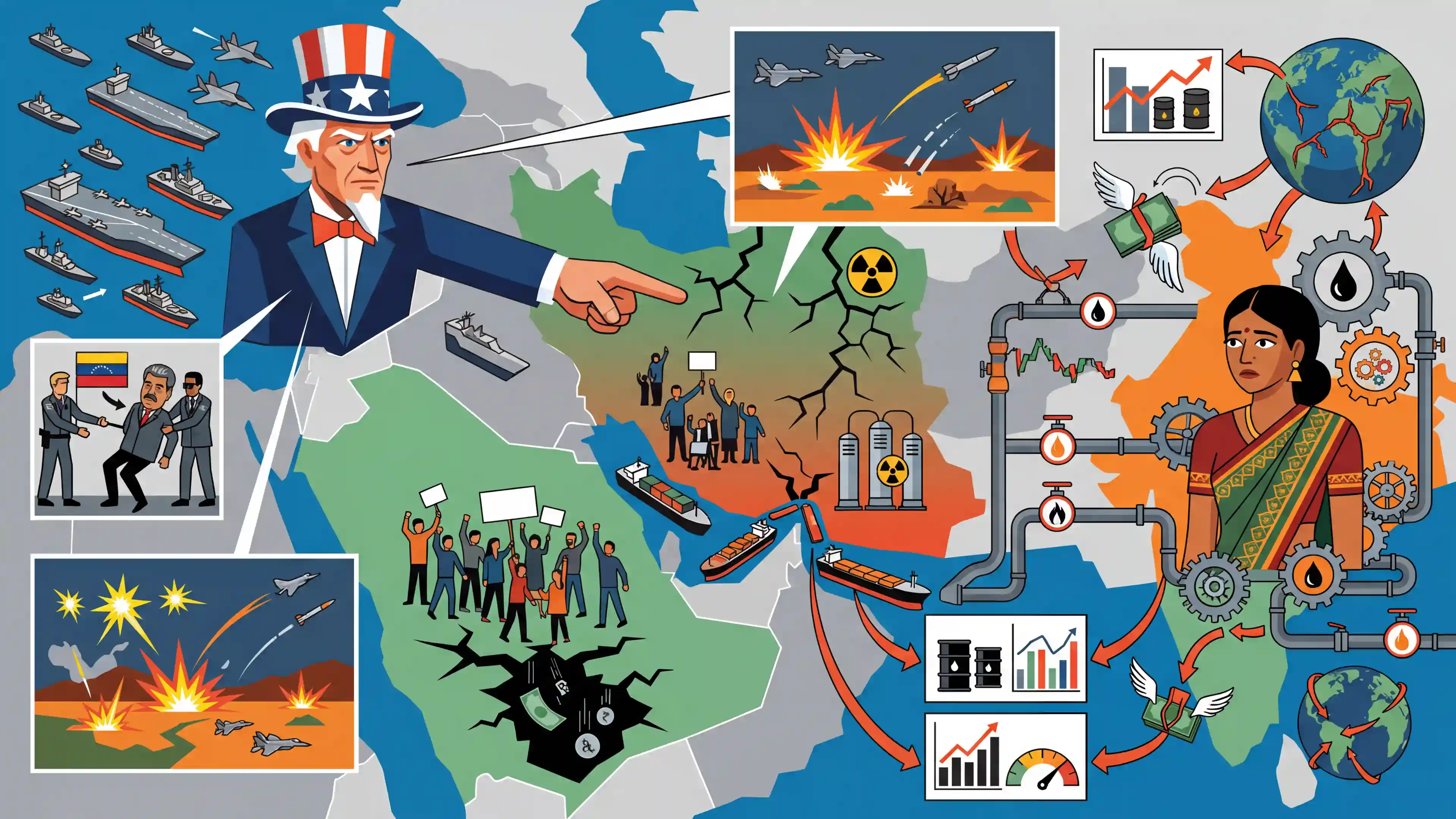
The escalating US-Iran conflict has direct implications for India's energy security and diaspora in the Middle East. It highlights critical themes in international relations, including the fragility of non-proliferation agreements (nuclear deals), state sovereignty versus foreign intervention, and the geopolitical vulnerability of strategic maritime chokepoints like the Strait of Hormuz.
Summary
US President Donald Trump has issued a severe warning to Iran, threatening military action and demanding a rapid agreement regarding its nuclear program. Emphasizing his administration's aggressive geopolitical posture, Trump announced the deployment of a "massive armada" to the region and cited the recent US abduction of Venezuela's President Nicolas Maduro as proof of his willingness to intervene in sovereign nations. The escalating tensions follow a brief military conflict in June 2025 involving US and Israeli strikes on Iran, and coincide with ongoing domestic protests within Iran fueled by a collapsing currency. The situation poses significant risks to Middle Eastern stability and global energy corridors like the Strait of Hormuz.
Key Points
- US President Trump announced the deployment of a 'massive armada,' led by the aircraft carrier Abraham Lincoln, to increase military pressure on Iran.
- Trump issued an ultimatum for a new nuclear deal, threatening military retaliation with 'speed and violence' and recalling the June 2025 'Operation Midnight Hammer' strikes.
- The rhetoric explicitly highlighted the recent US abduction of Venezuelan President Nicolas Maduro to signal Washington's aggressive stance on foreign intervention and regime change.
- Iran warned of unprecedented retaliation, while simultaneously navigating domestic anti-government protests sparked by economic instability, which Tehran blames on foreign intelligence like Israel's Mossad.
- The geopolitical escalation raises fears of conflict in the Middle East, directly threatening maritime chokepoints like the Strait of Hormuz and global energy security.
Important Terms
Joint Comprehensive Plan of Action (JCPOA)

The 2015 landmark deal between Iran and P5+1 powers to curb Iran's nuclear enrichment in exchange for relief from economic sanctions.
UPSC context
GS Paper-II (International Relations); tests knowledge of global non-proliferation and India's strategic interests in West Asia.
Operation Midnight Hammer
The name for the June 2025 US-led military strike targeting Iranian nuclear facilities at Fordow, Natanz, and Isfahan using stealth bombers.
UPSC context
GS Paper-II (Effect of policies of developed countries); tests analysis of modern military interventions and regional stability.
Strait of Hormuz
A vital maritime choke point between the Persian Gulf and Gulf of Oman, handling roughly one-fifth of global oil consumption.
UPSC context
GS Paper-I & III (Geography & Energy Security); critical for India's oil import dependency and maritime trade routes.
International Atomic Energy Agency (IAEA)
The UN's nuclear watchdog responsible for monitoring Iran's compliance with nuclear restrictions and verifying the peaceful nature of nuclear materials.
UPSC context
GS Paper-II (International Institutions); tests understanding of global governance and non-proliferation treaty frameworks.
Abduction of Nicolas Maduro
The 2026 US intervention in Venezuela resulting in the capture of President Maduro to face drug trafficking charges in Manhattan.
UPSC context
GS Paper-II (International Relations); explores concepts of national sovereignty, international law, and US 'Gunboat Diplomacy'.
Mossad
Israel's national intelligence agency, frequently cited for its role in identifying and countering regional nuclear threats through covert operations.
UPSC context
GS Paper-II (West Asian Geopolitics); tests awareness of key security actors and their impact on regional conflict.
Prelims Trap
The Strait of Hormuz is a maritime chokepoint connecting the Persian Gulf to the Red Sea.
It connects the Persian Gulf to the Gulf of Oman. Aspirants frequently confuse it with the Bab el-Mandeb strait, which links the Red Sea to the Gulf of Aden.
Static Concepts Connected
What is the geographical and economic significance of the Strait of Hormuz?
- Geographical location: A narrow strategic waterway connecting the Persian Gulf to the Gulf of Oman and the Arabian Sea.
- Bordering nations: It is bounded by Iran to the north, and the United Arab Emirates and Oman (specifically the Musandam Peninsula) to the south.
- Energy transit: It handles roughly 20% of global oil supplies, making it an irreplaceable chokepoint for global energy security and India's crude imports.
What are the core components of the Joint Comprehensive Plan of Action (JCPOA)?
- P5+1 framework: A 2015 multilateral nuclear agreement between Iran and the P5+1 (US, UK, France, Russia, China, and Germany) alongside the European Union.
- Nuclear restrictions: Iran agreed to cap uranium enrichment and submit to stringent IAEA inspections in exchange for the comprehensive lifting of international economic sanctions.
- US withdrawal: The US unilaterally withdrew in 2018, crippling the deal's framework and prompting Iran to progressively breach its uranium enrichment limitations.
Cross-Topic Patterns
Geopolitical shocks and Indian macroeconomics
Disruptions in the Strait of Hormuz spike global crude prices, directly impacting India's imported inflation, widening the Current Account Deficit (CAD), and exacerbating rupee depreciation.
Gunboat diplomacy and extraterritoriality
The deployment of naval armadas and extraterritorial abductions (e.g., Maduro) bypass the UN Charter, signaling a stark transition from rule-based multilateralism to coercive unilateral statecraft.

Middle East map questions tracking chokepoints (Hormuz, Bab el-Mandeb) alongside energy security implications are highly likely in 2026.
Linked PYQs · 3
Linked PYQs · 3
- 2025MainsGS2
"Energy security constitutes the dominant kingpin of India's foreign policy, and is linked with India's overarching influence in Middle Eastern countries.” How would you integrate energy security with India's foreign policy trajectories in the coming years?
- 2025MainsGS2
"With the waning of globalization, post-Cold War world is becoming a site of sovereign nationalism.” Elucidate.
- 2024PrelimsGS1
Consider the following statements : Statement-I : Sumed pipeline is a strategic route for Persian Gulf oil and natural gas shipments to Europe. Statement-II : Sumed pipeline connects the Red Sea with the Mediterranean Sea. Which one of the following is correct in respect of the above statements?
