Implications of US Protectionist Tariffs for Indian Economy
Source:Indian Express ↗
Why It Matters
Highlights a critical structural shift in the global economy from multilateral free trade to unilateral protectionism. This is highly relevant for GS3 Economy (impact on Indian exports/macroeconomic stability) and GS2 International Relations (US-India bilateral ties and the weakening of WTO frameworks).
Summary
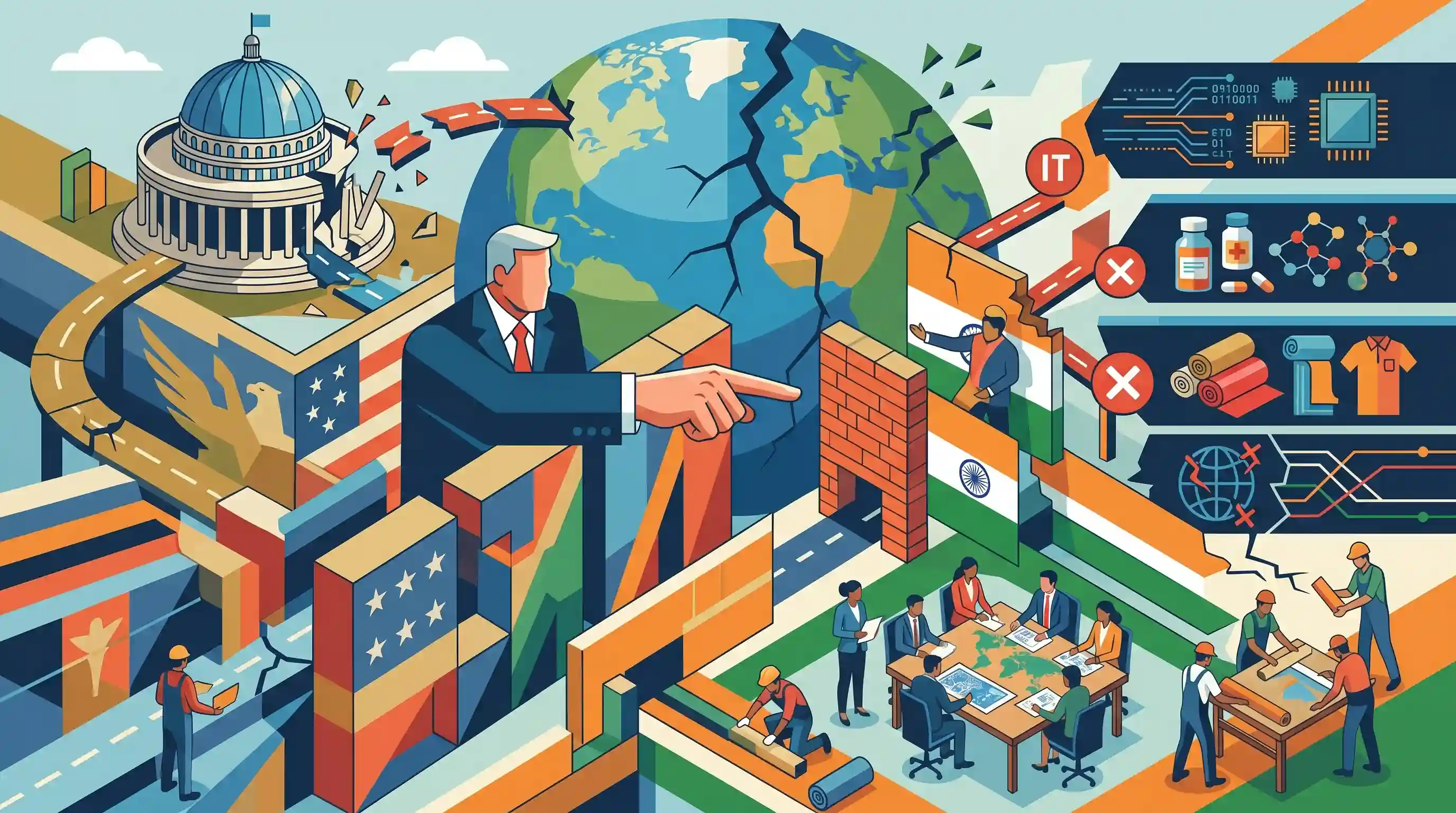
The article examines the geopolitical and economic consequences of Donald Trump’s proposed tariff regime, focusing on the implications for US-India trade ties. It highlights a paradox in international trade diplomacy: while the US frequently criticizes India's tariff barriers, America's own pivot to 'America First' protectionism reflects a noticeable double standard. This aggressive tariff policy poses direct threats to key Indian exports such as IT, pharmaceuticals, and textiles. More broadly, the US approach underlines a global transition away from the multilateral, rules-based order of the WTO toward transactional bilateralism. For India, adapting to this protectionist environment requires recalibrating trade strategies and engaging in robust bilateral negotiations to sustain macroeconomic stability and export growth.
Key Points
- Donald Trump's proposed universal baseline tariffs signify a renewed wave of American protectionism aimed at shielding domestic manufacturing and reducing trade deficits.
- The US critique of India as a high-tariff nation ('tariff king') highlights a double standard, given America's own escalating reliance on protective import barriers.
- Indian export sectors, including pharmaceuticals, textiles, and IT services, are vulnerable to tariff hikes, threatening bilateral trade volumes.
- The global shift away from the World Trade Organization's (WTO) multilateral framework necessitates that India negotiate transactional, bilateral trade agreements to safeguard its macroeconomic stability.
Important Terms
World Trade Organization (WTO)

An international organization that regulates global trade. It provides a framework for negotiating trade agreements and a dispute settlement mechanism to ensure a rules-based international trading system.
UPSC context
GS Papers II & III; key for international institutions and trade policy debates.
Protectionism
Economic policy of shielding domestic industries from foreign competition using trade barriers like tariffs and quotas. It marks a shift from global liberalization toward nationalistic 'America First' strategies.
UPSC context
GS Paper III; relevant for 'Effects of Liberalization' and 'Industrial Growth' topics.
Transactional Bilateralism
A trade approach favoring specific, immediate quid-pro-quo agreements between two nations over broad multilateral rules. It emphasizes direct leverage and reciprocity rather than long-term strategic or universal norms.
UPSC context
GS Paper II; essential for analyzing shifts in US-India bilateral trade diplomacy.
Generalized System of Preferences (GSP)
A US trade program providing non-reciprocal, duty-free entry for products from developing countries. India’s 2019 removal from this program remains a major point of bilateral trade friction.
UPSC context
GS Paper II; tests 'Effect of Policies of Developed Countries' on India.
Reciprocal Tariff
A tax on imports imposed by a country specifically to match the tariff levels applied by a trading partner on its own exports, often used as a coercive tool.
UPSC context
GS Paper III; relevant for understanding trade wars and 'America First' economic policies.
Bound Tariff
The maximum tariff rate a WTO member commits to for a product. While India's 'applied' rates are lower, the US frequently criticizes its high 'bound' ceilings as protectionist.
UPSC context
GS Paper III; tests technical knowledge of WTO commitments and trade barriers.
Multilateralism
The practice of coordinating national trade policies through international institutions like the WTO. It is currently challenged by a global shift toward unilateralism and bilateral deals.
UPSC context
GS Paper II; central to 'Global Groupings' and the rules-based international order.
Prelims Trap
India faces a persistent trade deficit with the United States due to stringent American protectionist tariffs.
False. Despite tariffs and US complaints, the US remains India's largest export destination, and India consistently runs a substantial bilateral trade surplus with the United States.
Static Concepts Connected
What are the standard WTO-compliant trade remedy measures?
- Anti-Dumping Duty: Imposed when a foreign company exports goods at a price lower than its domestic market price, aiming to protect local industry from unfair competition.
- Countervailing Duty: Levied to neutralize the negative effects of financial subsidies provided by an exporting country's government to its domestic producers.
- Safeguard Duty: A temporary emergency measure applied when a sudden, unforeseen surge in imports threatens serious injury to domestic producers of similar goods.
What is the WTO's Most-Favoured-Nation (MFN) principle?
- Core Principle: A foundational WTO rule requiring members to treat all other members equally; a trade concession granted to one must be granted to all.
- Allowed Exceptions: Countries can legally bypass MFN obligations to form Free Trade Agreements (FTAs) or to grant preferential access to developing nations under Generalized System of Preferences.
Cross-Topic Patterns
WTO Paralysis & Bilateral Dispute Resolution
As the US blocks WTO Appellate Body appointments, nations are bypassing multilateral deadlock. Highlighting this shift, India and the US bilaterally resolved six major outstanding WTO disputes outside the global body in 2023.
Tariff Barriers vs. Strategic Friendshoring
US protectionism runs parallel to strategic "friendshoring" initiatives like IPEF. India must navigate strict US tariffs while simultaneously attempting to integrate into US-led, China-plus-one supply chain resilience agreements.

Expect a 2026 Mains question linking WTO Appellate Body paralysis, Western protectionism (Trump tariffs), and India's pivot to FTAs.
Linked PYQs · 4
Linked PYQs · 4
- 2025MainsGS3
What are the challenges before the Indian economy when the world is moving away from free trade and multilateralism to protectionism and bilateralism? How can these challenges be met?
- 2018MainsGS3
How would the recent phenomena of protectionism and currency manipulations in world trade affect macroeconomic stability of India?
- 2016MainsGS2
The broader aims and objectives of WTO are to manage and promote international trade in the era of globalization. But the Doha round of negotiations seem doomed due to differences between the developed and the developing countries." Discuss in the Indian perspective.
- 2012MainsGS2
Discuss the likely negative impact of the protectionist measures proposed by the US on India's software industry.
