US Trade Act Section 122 and Protectionist Tariffs Impact
Source:Indian Express ↗
Why It Matters
The volatility of US trade policies and growing protectionism directly impact India's export growth and macroeconomic stability. The weaponization of trade acts and non-trade issues (like labor standards) creates critical challenges for India's economic diplomacy and future Free Trade Agreement negotiations.
Summary
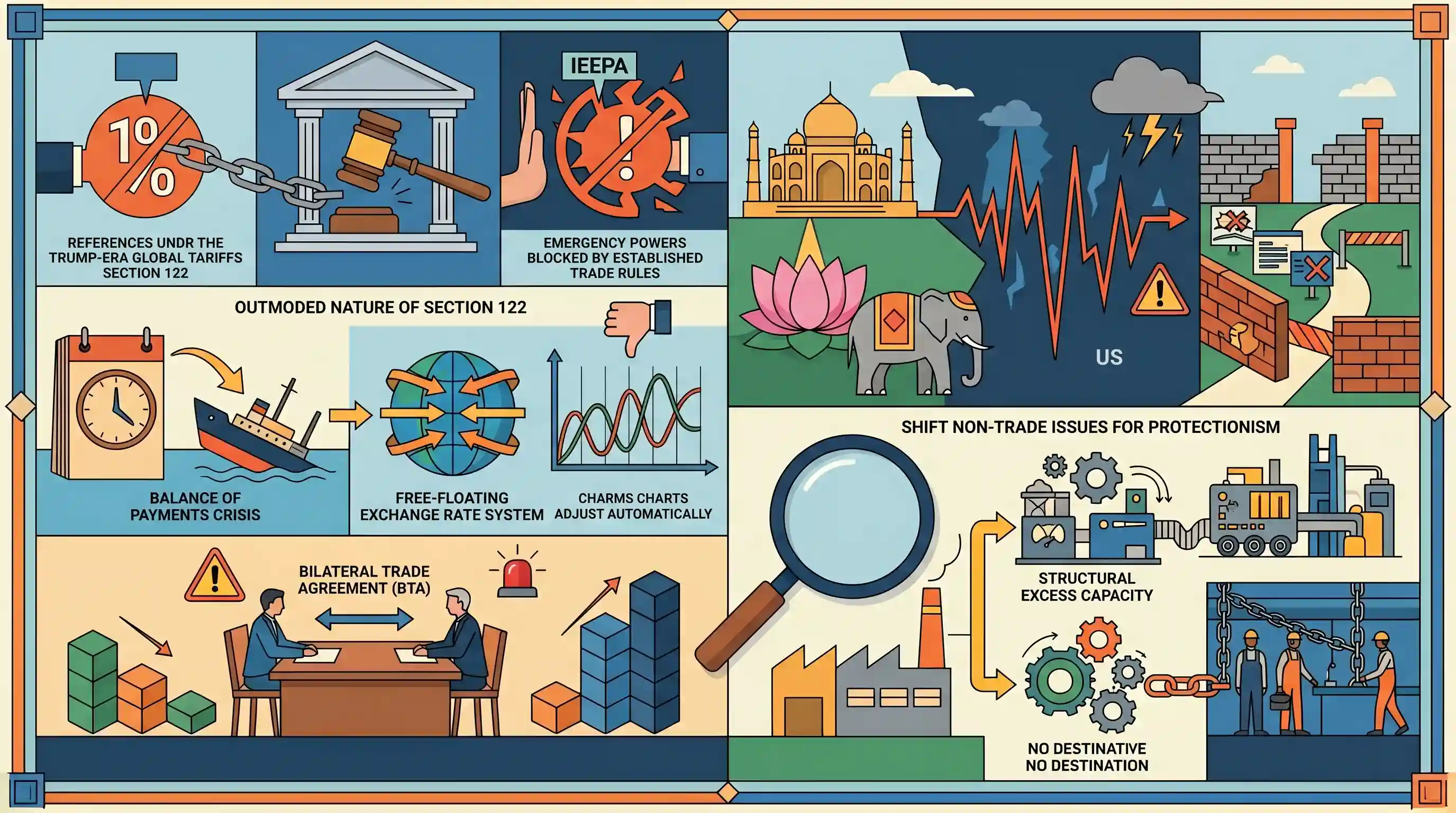
A US federal court has struck down Donald Trump’s 10% global tariffs invoked under Section 122 of the US Trade Act of 1974. The court previously blocked similar tariffs under the International Emergency Economic Powers Act (IEEPA), citing that emergency powers could not override established trade law. Section 122 was originally designed in the 1970s for balance of payments crises and is largely viewed as economically unjustified under today’s free-floating exchange rate system. The volatile US trade policy framework poses significant risks to India. Trade experts caution India against rushing into a Bilateral Trade Agreement, as the US demands unilateral tariff reductions while maintaining its own Most-Favoured-Nation (MFN) tariffs. Furthermore, India faces scrutiny under Section 301 investigations alleging "structural excess capacity" and violations of ILO "forced labour" standards, highlighting a shift towards weaponizing non-trade issues in global protectionism.
Key Points
- A US federal court blocked Donald Trump's attempt to impose a 10% global tariff under Section 122 of the US Trade Act of 1974, ruling against his protectionist agenda.
- The Trump administration had previously tried to impose these tariffs using the International Emergency Economic Powers Act (IEEPA), which the court also struck down.
- Section 122 tariffs are historically linked to the gold standard era to manage balance of payments crises, but trade experts argue they lack justification in the modern free-floating dollar system.
- The US is investigating India under Section 301 for alleged "structural excess capacity" and violations of ILO "forced labour" standards, signaling the use of non-trade barriers.
- Trade experts advise India to delay concluding a Bilateral Trade Agreement with the US until trade policies stabilize, as the US is reportedly seeking one-sided tariff reductions without lowering its own MFN tariffs.
Important Terms
Section 122 of the US Trade Act of 1974

A US trade law provision allowing the President to impose temporary import surcharges (up to 15%) for 150 days during balance-of-payments crises.
UPSC context
GS Paper II/III: Tests understanding of executive trade powers and their impact on India's export stability and macroeconomic relations.
International Emergency Economic Powers Act (IEEPA)
A 1977 law granting the US President authority to regulate international commerce and freeze assets during a declared national emergency.
UPSC context
GS Paper II: Relevant for topics on executive overreach, judicial review, and the legal framework of US economic sanctions.
Section 301 of the US Trade Act of 1974
A tool under the Trade Act of 1974 used by the US to investigate and retaliate against "unfair" foreign trade practices.
UPSC context
GS Paper III: Essential for understanding unilateral trade barriers, WTO compliance, and risks to Indian sectors like steel and electronics.
Section 232 of the Trade Expansion Act of 1962
A provision allowing the US President to restrict imports if they are deemed a threat to "national security" following an investigation.
UPSC context
GS Paper III: Important for analyzing non-tariff barriers and protectionism in global supply chains (e.g., steel, semiconductors).
US Court of International Trade (USCIT)
An Article III federal court in the US that adjudicates civil actions related to customs and international trade laws.
UPSC context
GS Paper II: Relevant to the rule of law in international trade and judicial checks on executive trade policy.
Bilateral Trade Agreement (BTA)
A reciprocal trade treaty between two nations to reduce tariffs and trade barriers to enhance economic integration.
UPSC context
GS Paper II: Critical for analyzing India-US strategic economic relations and the shift from multilateralism to bilateralism.
Prelims Trap
US Section 301 and Section 122 are WTO-compliant trade defense mechanisms used to manage structural excess capacity and balance of payments.
These are unilateral US domestic laws, not WTO mechanisms. Invoking them often violates WTO's core principles (like MFN) and bypasses the multilateral dispute settlement body.
Static Concepts Connected
What are the permitted exceptions to the WTO's Most-Favoured-Nation (MFN) principle?
- RTAs and FTAs: Countries can grant preferential treatment to partners within Free Trade Agreements (FTAs) or Customs Unions under GATT Article XXIV.
- GSP Framework: Developed nations can offer non-reciprocal preferential tariffs to developing countries under the Generalized System of Preferences (GSP).
- Trade Remedies: Targeted anti-dumping, countervailing, and safeguard duties can be applied against specific countries to counter unfair trade practices.
How does a free-floating exchange rate naturally adjust Balance of Payments (BoP) deficits?
- Automatic Depreciation: A BoP deficit increases the supply of the domestic currency in forex markets, leading to automatic currency depreciation.
- Trade Balance Correction: Depreciation makes domestic exports cheaper globally and imports costlier, which naturally improves the trade balance without requiring artificial tariffs.
- No Reserve Depletion: Unlike fixed exchange systems (gold standard), floating regimes do not require central bank depletion of forex reserves to maintain pegs during crises.
Cross-Topic Patterns
Labour standards as non-tariff barriers
Developed economies increasingly use non-trade issues like ILO forced labour norms or environmental metrics (like the EU's CBAM) as backdoor protectionist tools against developing nations like India.
Unilateral domestic laws vs Multilateralism
The US bypassing the WTO via Section 301 mirrors its use of CAATSA in geopolitics, showcasing a broader trend of weaponizing domestic law to override multilateral consensus.

Expect a 2026 Prelims question contrasting WTO's MFN exceptions with unilateral domestic trade laws and labour/climate non-tariff barriers.
Linked PYQs · 4
Linked PYQs · 4
- 2025MainsGS3
What are the challenges before the Indian economy when the world is moving away from free trade and multilateralism to protectionism and bilateralism? How can these challenges be met?
- 2018MainsGS3
How would the recent phenomena of protectionism and currency manipulations in world trade affect macroeconomic stability of India?
- 2021PrelimsGS1
Consider the following statements : The effect of devaluation of a currency is that it necessarily 1. improves the competitiveness of the domestic exports in the foreign markets 2. increases the foreign value of domestic currency 3. improves the trade balance Which of the above statements is/are correct?
- 2022PrelimsGS1
Consider the following statements: 1. Tight monetary policy of US Federal Reserve could lead to capital flight. 2. Capital flight may increase the interest cost of firms with existing External Commercial Borrowings (ECBs). 3. Devaluation of domestic currency decreases the currency risk associated with ECBs. Which of the statements given above are correct?
