Expert Suggests India Explore Export Diversification Amid Tariffs
Source:The Hindu ↗
Why It Matters
The article sheds light on the ongoing shift from global multilateralism and free trade to protectionism, requiring students to understand the macroeconomic and strategic responses available to India (e.g., decoupling and export diversification) and the impact of such shifts on global development milestones like the SDGs.
Summary
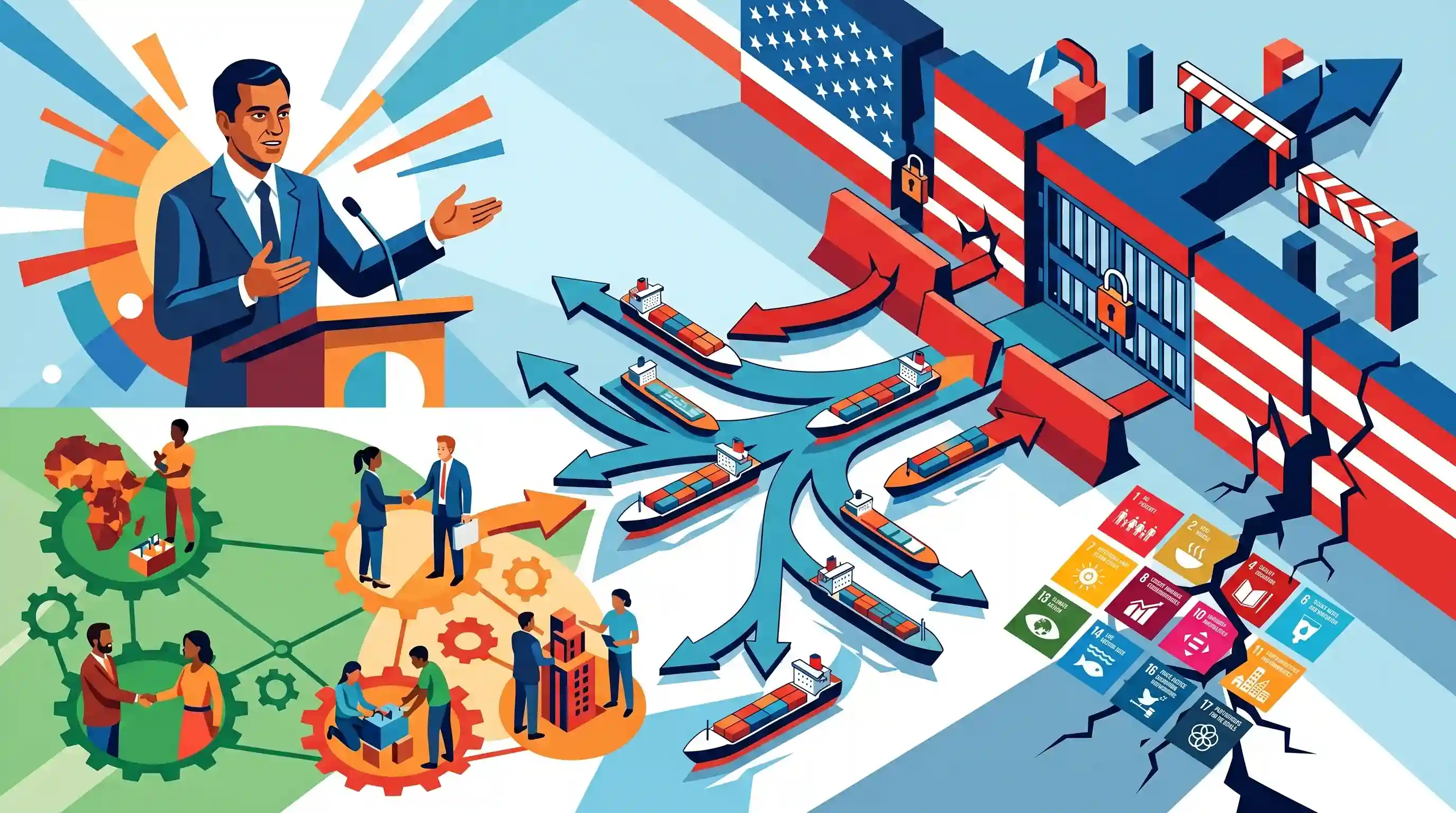
Trade policy expert Biswajit Dhar, speaking at a seminar in Thiruvananthapuram, has urged India to explore 'decoupling' from the U.S. and diversifying its export destinations in response to aggressive U.S. tariff policies under Donald Trump. Dhar emphasized that India must strengthen its economic ties with other developing nations. He warned that the protectionist stance of the U.S. marks a departure from the post-war global development consensus and threatens the achievement of the Sustainable Development Goals (SDGs), likening current U.S. behavior to imperialistic hegemony.
Key Points
- Trade policy expert Biswajit Dhar suggested that India should consider decoupling from the U.S. and diversifying its export markets to counter new U.S. tariff policies under Donald Trump.
- Dhar advocated for India to deepen its engagement with other developing countries instead of purely focusing on developed-nation ambitions.
- He warned that recent U.S. tariff measures might dismantle the post-war development discourse and serve as a 'death knell' for the Sustainable Development Goals (SDGs).
- Dhar criticized the U.S. approach, likening it to a global hegemon extracting tributes from poorer nations, effectively pushing the world toward a new age of imperialism.
Important Terms
Sustainable Development Goals (SDGs)

A set of 17 interlinked global objectives adopted by the UN in 2015 to end poverty, protect the planet, and ensure prosperity by 2030.
UPSC context
GS II (Governance) and III (Economy/Environment); tests knowledge of global development frameworks and India's progress toward international commitments.
Decoupling
The strategic reduction of economic interdependence and supply chain reliance between nations (e.g., US and China) to minimize geopolitical and trade-related risks.
UPSC context
GS II (International Relations) and III (Economy); relevant for trade policy, strategic autonomy, and global supply chain shifts.
Seventh State Finance Commission
A constitutional body established under Article 243-I/Y to review the finances of local self-governments and recommend resource devolution between the state and local bodies.
UPSC context
GS II (Polity/Governance); tests understanding of fiscal federalism, decentralization, and the 73rd and 74th Constitutional Amendments.
Gulati Institute of Finance and Taxation (GIFT)
An autonomous research institute in Kerala specializing in public finance and taxation policy, providing fiscal inputs for state-level governance and federal relations.
UPSC context
GS III (Economy); relevant for fiscal policy, state finance management, and specialized economic research institutions.
Centre for Development Studies (CDS)
A premier social science research institute in Thiruvananthapuram, established by economist K.N. Raj, known for its contributions to applied economics and the 'Kerala Model'.
UPSC context
GS III (Economy); tests familiarity with development economics, social indicators, and institutional frameworks for policy research.
Protectionism
Economic policy of restricting imports from other countries through methods such as tariffs on imported goods, import quotas, and various other government regulations.
UPSC context
GS III (Economy/Trade); critical for understanding trade wars, WTO challenges, and domestic industry support mechanisms.
Prelims Trap
"India's official foreign trade policy advocates 'decoupling' from the United States."
Decoupling is an expert's radical suggestion here. India's actual policy focuses on 'de-risking' and multi-alignment, not severing ties with its largest export destination.
Static Concepts Connected
What is the difference between Decoupling and De-risking?
- Decoupling: Radical unwinding and severing of broad cross-border economic ties and supply chains to isolate from a specific country.
- De-risking: Selectively reducing vulnerabilities and supply-chain dependencies in critical/strategic sectors without completely abandoning overall trade relations and globalization.
How do unilateral tariffs conflict with the Sustainable Development Goals (SDGs)?
- SDG 17 mandate: Explicitly calls for a universal, rules-based, open, non-discriminatory, and equitable multilateral trading system to assist developing nations.
- Fiscal impact: Protectionist tariffs curb developing nations' export revenues, directly shrinking the crucial financial resources required to achieve domestic 2030 Agenda targets.
Cross-Topic Patterns
Tariff weaponization + WTO crisis
Unilateral US tariffs bypass multilateral rules. This protectionist shift is exacerbated by the deliberate crippling of the WTO's Appellate Body, leaving developing nations without effective dispute resolution.
Global South + Export diversification
India's push for South-South cooperation aligns with its 'Voice of Global South' diplomacy, driving export diversification toward Africa, Latin America, and ASEAN to offset Western trade barriers.

The distinction between 'decoupling' and 'de-risking', paired with their impact on SDG 17, is highly probable for a 2026 Prelims MCQ.
Linked PYQs · 4
Linked PYQs · 4
- 2025MainsGS3
What are the challenges before the Indian economy when the world is moving away from free trade and multilateralism to protectionism and bilateralism? How can these challenges be met?
- 2018MainsGS3
How would the recent phenomena of protectionism and currency manipulations in world trade affect macroeconomic stability of India?
- 2025MainsGS2
"With the waning of globalization, post-Cold War world is becoming a site of sovereign nationalism.” Elucidate.
- 2016MainsGS2
The broader aims and objectives of WTO are to manage and promote international trade in the era of globalization. But the Doha round of negotiations seem doomed due to differences between the developed and the developing countries." Discuss in the Indian perspective.
