US Protectionist Tariffs and India-US Democratic Diplomacy Framework
Source:Indian Express ↗
Why It Matters
Evaluates the impact of US domestic policies (trade protectionism and immigration restrictions) on India's strategic and economic interests, which is a frequent theme in GS2 International Relations questions regarding bilateral ties and the diaspora.
Summary
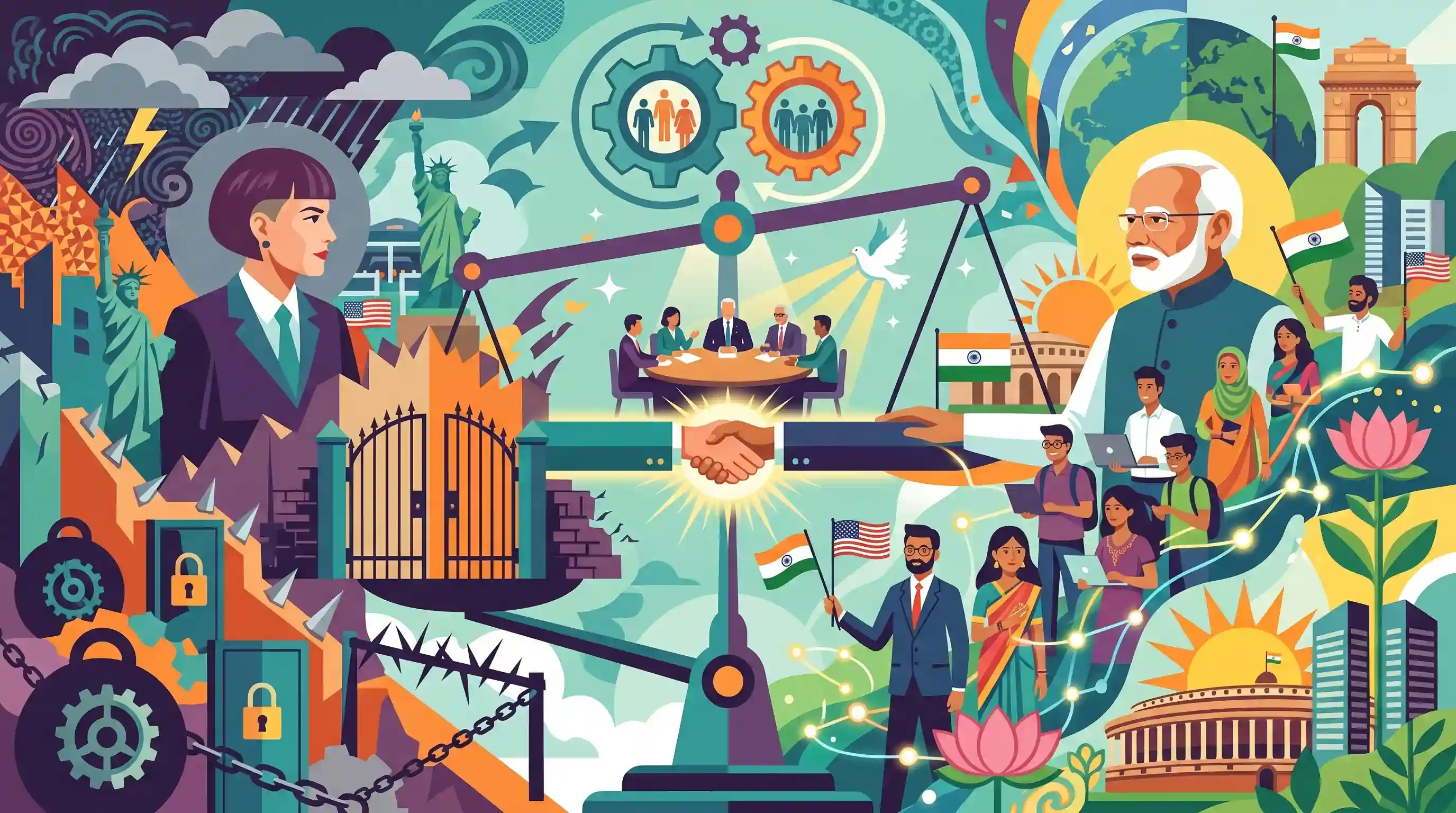
The article analyzes the implications of Donald Trump's proposed tariffs and potential immigration restrictions on India-US relations. While these protectionist measures present economic and diplomatic challenges, they also offer Prime Minister Narendra Modi and the Indian government an opportunity to showcase how leading democracies can resolve disputes through constructive dialogue. The piece highlights that shared democratic values provide a strong foundation for navigating trade friction, securing the interests of the Indian diaspora, and maintaining a robust strategic partnership in an increasingly polarized global environment.
Key Points
- Evaluates the potential impact of Donald Trump's proposed protectionist tariff policies on Indian exports and the broader India-US bilateral trade relationship.
- Discusses the vulnerability of Indian professionals to restrictive US visa and immigration policies, emphasizing the significant role of the Indian diaspora in the US economy.
- Asserts that despite points of friction, the shared democratic frameworks of India and the US provide reliable mechanisms for effective dispute resolution.
- Suggests that proactive diplomacy by Prime Minister Narendra Modi can set a global precedent for resolving trade and immigration conflicts among major democratic nations.
Important Terms
H-1B Visa Program

A non-immigrant U.S. visa for high-skilled professionals in specialty occupations. It is vital for India's IT sector, with Indians receiving approximately 70-71% of all such visas annually.
UPSC context
GS-II: International Relations/Diaspora. Tests the impact of foreign immigration policies on Indian economic interests and skilled labor mobility.
Reciprocal Tariff
A trade policy where a country imposes import duties on another country’s goods at a rate matching the duties levied on its own exports. It signifies a "tit-for-tat" approach to market access.
UPSC context
GS-III: Economy/Trade. Tests knowledge of protectionism, transactional diplomacy, and its impact on India’s manufacturing and export competitiveness.
Section 301 (Trade Act of 1974)
A provision under the U.S. Trade Act of 1974 allowing the President to investigate and penalize foreign trade practices deemed unfair, discriminatory, or restrictive to U.S. commerce.
UPSC context
GS-II: International Relations. Tests understanding of unilateral trade laws and their use as leverage in bilateral negotiations.
Strategic Autonomy
India’s foreign policy principle of maintaining independent decision-making in international affairs, ensuring that its choices (e.g., energy imports from Russia) are governed by national interest rather than external pressure.
UPSC context
GS-II: Bilateral and Global Groupings. A core IR concept testing the ability to analyze India’s balancing act between major powers.
Comprehensive Global Strategic Partnership
The formal status of India-U.S. ties since 2020, encompassing cooperation in defense, space, health, and critical technologies (iCET), while navigating differences in trade and energy policies.
UPSC context
GS-II: Bilateral Relations. Fundamental for questions on India-U.S. cooperation and institutional frameworks like the 2+2 Dialogue.
Indian Diaspora
The community of Indian-origin people living in the U.S., acting as a significant diplomatic bridge and domestic lobby that influences policy on immigration, trade, and defense.
UPSC context
GS-II: International Relations. Specifically tests the "Effect of Diaspora on India’s interests" sub-topic in the syllabus.
Prelims Trap
India currently enjoys duty-free access to US markets under the Generalized System of Preferences (GSP).
The US revoked India's GSP status in 2019. Despite recent bilateral negotiations and targeted tariff reductions, this overarching preferential status remains suspended.
Static Concepts Connected
How does the GSP relate to the WTO's Most-Favored-Nation (MFN) principle?
- MFN Principle: Requires WTO members to apply the same tariff rates to all other members equally, effectively prohibiting trade discrimination.
- Enabling Clause: Creates a legal exception to MFN, allowing developed nations to offer preferential, lower tariffs (GSP) specifically to developing nations.
- Unilateral Action: GSP is a non-reciprocal concession. The granting country can unilaterally withdraw it without violating WTO rules, as the US did in 2019.
How do professional visas (H-1B) connect to international trade agreements?
- GATS Mode 4: Under the WTO's General Agreement on Trade in Services, Mode 4 covers the temporary movement of natural persons supplying services across borders.
- Non-Tariff Barriers: India traditionally argues that restrictive US visa quotas (H-1B caps) act as protectionist non-tariff barriers, directly hindering its IT service exports.
Cross-Topic Patterns
Strategic Autonomy vs. Trade Coercion
India’s independent foreign policy, such as energy procurement from Russia, often triggers Western economic friction and punitive tariffs, linking GS-2 IR directly to GS-3 Trade.
Diaspora as an Economic Lobbying Force
Beyond remittances, the Indian diaspora's outsized economic contribution (5-6% of US income taxes) provides structural leverage against restrictive immigration policies in bilateral negotiations.

Expect a GS-2 mains question or a prelims multi-statement linking US trade protectionism (tariffs/GSP) with India's strategic autonomy.
Linked PYQs · 3
Linked PYQs · 3
- 2019MainsGS2
‘What introduces friction into the ties between India and the United States is that Washington is still unable to find for India a position in its global strategy, which would satisfy India's national self-esteem and ambitions.’ Explain with suitable examples.
- 2012MainsGS2
Discuss the likely negative impact of the protectionist measures proposed by the US on India's software industry.
- 2020MainsGS2
Indian diaspora has a decisive role to play in the politics and economy of America and European Countries'. Comment with examples.
