US Tariff Exemption Provides Breathing Room for Indian Exporters
Source:Indian Express ↗
Why It Matters
The issue of reciprocal tariffs reflects a broader global shift from multilateralism to protectionism. Understanding India's response and negotiation strategy is crucial for analyzing the country's economic policy, export competitiveness, and bilateral relations with major trading partners like the US.
Summary
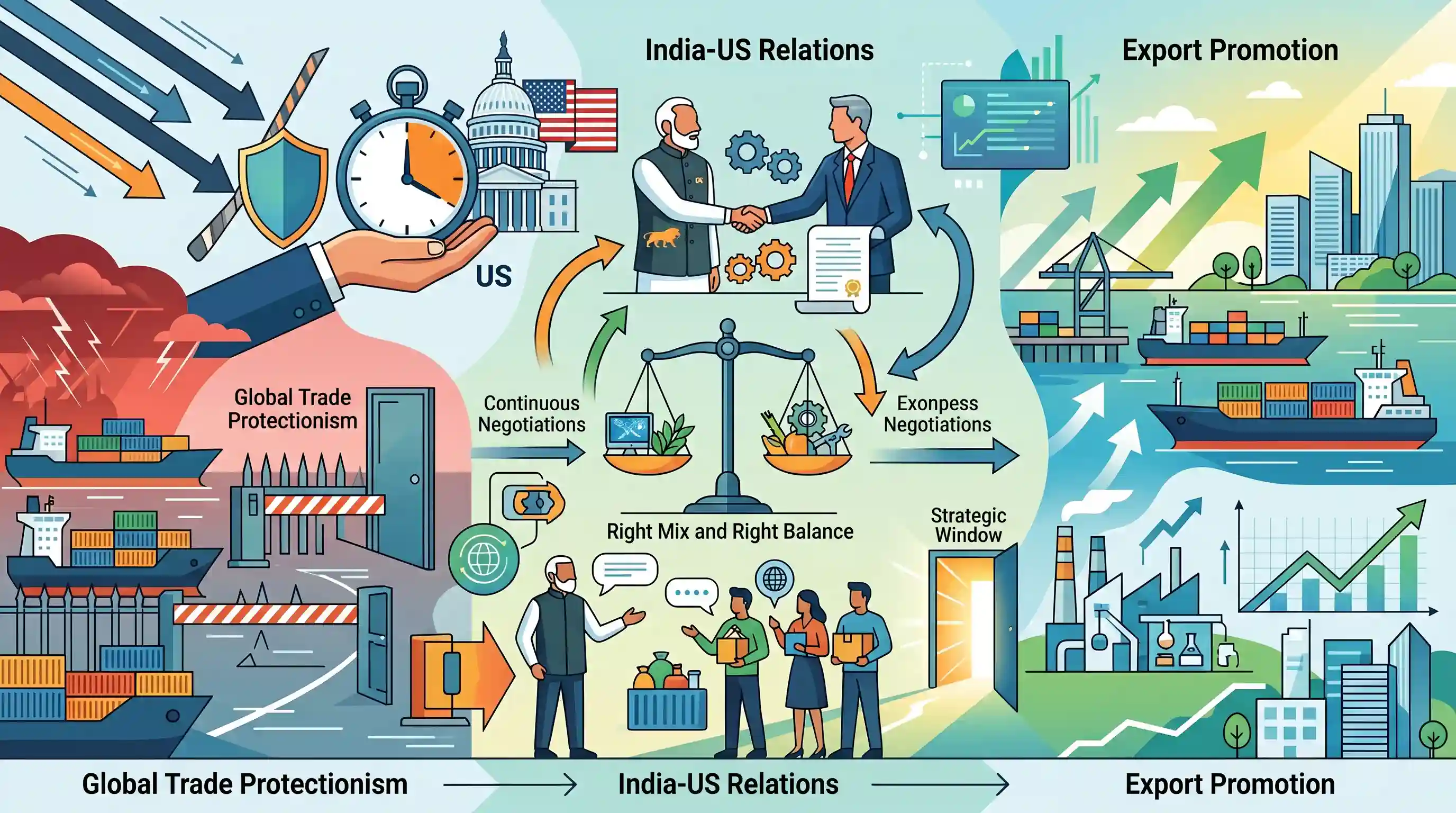
The United States has granted India a 90-day temporary exemption from incoming reciprocal trade tariffs. In response, Commerce and Industry Minister Piyush Goyal assured Indian exporters that ongoing negotiations for a proposed India-US trade deal will seek the "right mix and right balance." This breather gives India a strategic window to negotiate terms and mitigate the impact of rising global trade protectionism on its export sector.
Key Points
- The United States has granted India a 90-day breather from proposed reciprocal trade tariffs.
- Commerce Minister Piyush Goyal assured Indian exporters that the government will negotiate a trade deal with the US that strikes the 'right mix and right balance.'
- The temporary exemption provides a crucial negotiation window for India to protect its export interests against rising US protectionism.
- This development highlights the ongoing global shift away from multilateral free trade towards protectionism and bilateral trade agreements.
Important Terms
Reciprocal Tariffs

Duties imposed by a country on imports from a trading partner in direct response to similar tariffs levied by that partner on its own goods.
UPSC context
GS Paper III (Economy). Critical for understanding global trade wars, WTO norms, and India's export-import policy (EXIM).
India-US Trade Deal
A negotiated framework, often starting as an interim agreement, aimed at reducing trade barriers and balancing the trade deficit between India and the United States.
UPSC context
GS Paper II (International Relations). Tests knowledge of bilateral agreements with major powers and strategic economic diplomacy.
Ministry of Commerce and Industry
The nodal Indian ministry responsible for formulating and implementing foreign trade policy, managing industrial growth, and negotiating international economic agreements.
UPSC context
GS Paper II (Governance). Essential for understanding the executive's role in economic regulation and international representation.
Trade Protectionism
The use of trade barriers like tariffs and quotas to shield domestic industries from foreign competition, often at the cost of global trade flow.
UPSC context
GS Paper III (Economy). Relevant for discussions on globalization vs. nationalism and the impact on India's growth.
Export Promotion
A set of policy measures and incentives designed to increase the volume and value of a country's exports to improve its trade balance.
UPSC context
GS Paper III (Economy). Tests understanding of initiatives like 'Make in India' and SEZs in boosting foreign exchange.
Prelims Trap
"The imposition of reciprocal tariffs is a recognized mechanism under the WTO's Most-Favored-Nation (MFN) principle."
Reciprocal tariffs actually violate the MFN principle. MFN mandates treating all WTO members equally, prohibiting conditional tariffs based on another country's specific duty rates.
Static Concepts Connected
How does GSP differ from the WTO's MFN principle?
- MFN Principle: A core WTO rule requiring countries to extend the same trade concessions to all member nations equally, ensuring non-discrimination.
- GSP Exemption: A formalized UNCTAD exception to MFN that allows developed nations to offer preferential, lower tariffs to developing countries without extending them to wealthy nations.
- India-US Context: The US revoked India's GSP beneficiary status in 2019; negotiating its restoration is a central pillar of the ongoing India-US Trade Policy Forum (TPF) dialogues.
What are the legitimate trade remedy measures permitted under WTO?
- Anti-Dumping Duty: Imposed when a country exports a product at a price lower than its normal value in its own domestic market.
- Countervailing Duty: Levied to neutralize the negative effects of subsidies provided by a foreign government to its domestic producers.
- Safeguard Duty: Temporary tariffs applied to shield domestic industries from a sudden, unforeseen and massive surge in imports that threatens serious injury.
Cross-Topic Patterns
Protectionism & Currency Dynamics
Rising US tariffs often push affected nations to devalue currencies to maintain export competitiveness, linking trade barriers directly to forex volatility and the RBI's market intervention strategies.
Shift from WTO to Bilateral FTAs
The paralysis of the WTO's dispute settlement body has driven India to prioritize bilateral trade deals (like CEPA with UAE and ECTA with Australia) to secure resilient export markets.

Expect a multi-statement Prelims question contrasting WTO's MFN principle with GSP exceptions, alongside India-US trade surplus facts.
Linked PYQs · 3
Linked PYQs · 3
- 2025MainsGS3
What are the challenges before the Indian economy when the world is moving away from free trade and multilateralism to protectionism and bilateralism? How can these challenges be met?
- 2018MainsGS2
India and USA are two large democracies. Examine the basic tenets on which the two political systems are based.
- 2023PrelimsGS1
Consider the following statements: Statement-I: Recently, the United States of America (USA) and the European Union (EU) have launched the 'Trade and Technology Council'. Statement-II: The USA and the EU claim that through this they are trying to bring technological progress and physical productivity under their control. Which one of the following is correct in respect of the above statements?
