US Tariffs and Protectionism Impact India Export Competitiveness
Source:Indian Express ↗
Why It Matters
The article practically demonstrates the economic impact of global protectionism on India's export competitiveness. It underscores the challenges for India's trade policy amid a shift towards tariff wars and bilateralism, directly relevant to the GS3 syllabus on the Indian Economy and issues relating to planning, mobilization of resources, growth, development and employment.
Summary
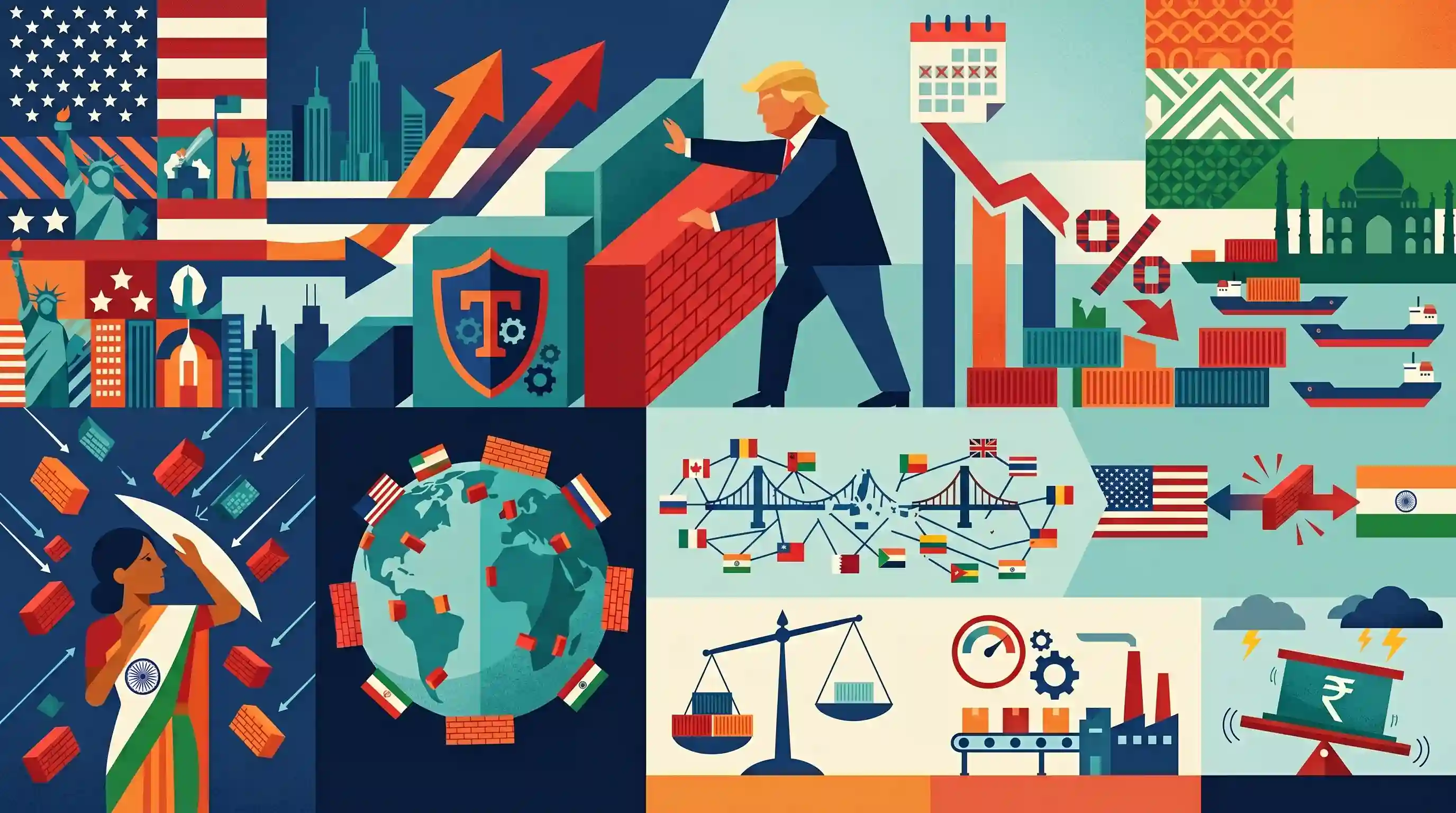
Donald Trump's protectionist trade policies and tariffs have significantly impacted India's export economy, dragging down its merchandise exports to the US by 9% in October. This decline highlights India's vulnerability to global protectionist shifts, bilateral trade barriers, and the moving away from multilateralism. The downturn in one of India's largest export markets raises concerns about India's overall merchandise trade deficit, manufacturing momentum, and macroeconomic stability in the face of evolving US-India trade dynamics.
Key Points
- India's merchandise exports to the United States experienced a 9% decline in October, significantly influenced by tariffs and protectionist trade policies under the Trump administration.
- The export drop illustrates the vulnerability of India's external sector to changing trade policies in its major destination markets.
- This trend reflects the broader global shift away from multilateral free trade frameworks toward protectionism, tariff barriers, and bilateralism.
- A sustained decline in US-bound exports could widen India's merchandise trade deficit and adversely impact export-oriented domestic manufacturing sectors, necessitating diversification of export markets.
Important Terms
Protectionism

Government policies that restrict international trade through tariffs, quotas, or subsidies to protect domestic industries from foreign competition.
UPSC context
GS Paper III (Economy) and II (International Relations); tests understanding of global trade barriers and economic nationalism.
Generalized System of Preferences (GSP)
A trade program allowing developing countries to export certain goods to developed nations with reduced or zero tariffs. The US revoked India's GSP status in 2019.
UPSC context
GS Paper II (IR) and III (Economy); crucial for India-US trade diplomacy and export competitiveness.
Trade Deficit
An economic condition where the value of a country's imports exceeds the value of its exports. India maintains a trade surplus with the US but a deficit overall.
UPSC context
GS Paper III (Economy); key indicator of macroeconomic stability and external sector strength.
Bilateral Trade
The exchange of goods and services between two nations based on mutual agreements, often used as an alternative to multilateral trade systems.
UPSC context
GS Paper II (International Relations); fundamental to understanding India's strategic and economic partnerships.
Multilateralism
A system of trade involving multiple nations governed by shared rules (e.g., WTO), which protectionist policies often challenge in favor of bilateralism.
UPSC context
GS Paper II (IR); focuses on the role of international organizations like the WTO in global governance.
Merchandise Exports
Physical goods exported to other countries. In India, these are primarily engineering goods, textiles, and gems & jewelry, which are sensitive to tariff changes.
UPSC context
GS Paper III (Economy); vital for manufacturing growth and calculating the Balance of Payments.
Reciprocal Tariffs
Tariffs imposed by a country on imports from a trading partner that matches the tariff rates the partner imposes on its own imports.
UPSC context
GS Paper II (IR) and III (Economy); tests knowledge of trade war tactics and tariff-based diplomacy.
Prelims Trap
"India consistently runs a merchandise trade deficit with the United States, similar to its trade relations with China."
India traditionally maintains a merchandise trade SURPLUS with the US. It is one of the few major economies where Indian exports consistently exceed imports.
Static Concepts Connected
What are the core trade remedy measures permitted under WTO rules?
- Anti-Dumping Duty: Levied when a country exports a product at a price lower than its normal value in the exporting country's domestic market.
- Countervailing Duty: Imposed to neutralize the negative effects of unfair subsidies provided by the exporting country's government to its manufacturers.
- Safeguard Measures: Temporary restrictions (tariffs or quotas) applied to protect a specific domestic industry from a sudden, unforeseen surge in imports.
How does the merchandise trade deficit impact the Current Account Deficit (CAD)?
- Trade Deficit: The shortfall between merchandise (goods) exports and imports. It forms the largest and most volatile component of India's Current Account.
- Invisibles Surplus: Includes services, transfers (like remittances), and income. A consistent surplus in invisibles helps offset India's high merchandise trade deficit, keeping the overall CAD manageable.
Cross-Topic Patterns
US Tariffs vs 'China Plus One'
Blanket US protectionism harms emerging economies too, complicating India's efforts to integrate into shifting Global Value Chains (GVCs) and benefit from the 'China Plus One' strategy.
Exchange Rates vs Export Competitiveness
While a depreciating Indian Rupee typically makes exports cheaper globally, high destination-market tariffs can completely neutralize this currency advantage, stunting expected export growth.

Expect a 2026 prelims question linking India's trade surplus with the US, global tariff barriers, and their combined effect on India's CAD.
Linked PYQs · 4
Linked PYQs · 4
- 2018MainsGS3
How would the recent phenomena of protectionism and currency manipulations in world trade affect macroeconomic stability of India?
- 2025MainsGS3
What are the challenges before the Indian economy when the world is moving away from free trade and multilateralism to protectionism and bilateralism? How can these challenges be met?
- 2020PrelimsGS1
With reference to the international trade of India at present, which of the following statements is/are correct? 1. India's merchandise exports are less than its merchandise imports. 2. India's imports of iron and steel, chemicals, fertilisers and machinery have decreased in recent years. 3. India's exports of services are more than its imports of services. 4. India suffers from an overall trade/current account deficit. Select the correct answer using the code given below:
- 2023PrelimsGS1
Consider the following statements: Statement-I: India accounts for 3.2% of global export of goods. Statement-II: Many local companies and some foreign companies operating in India have taken advantage of India's 'Production-linked Incentive' scheme. Which one of the following is correct in respect of the above statements?
