New Protectionist Tariffs Fuel Imported Inflation Pressures in US
Source:Indian Express ↗
Why It Matters
It illustrates the direct macroeconomic consequences—specifically cost-push and imported inflation—of protectionist trade policies and tariff barriers, serving as an excellent contemporary case study for questions on international trade, deglobalization, and inflation dynamics.
Summary
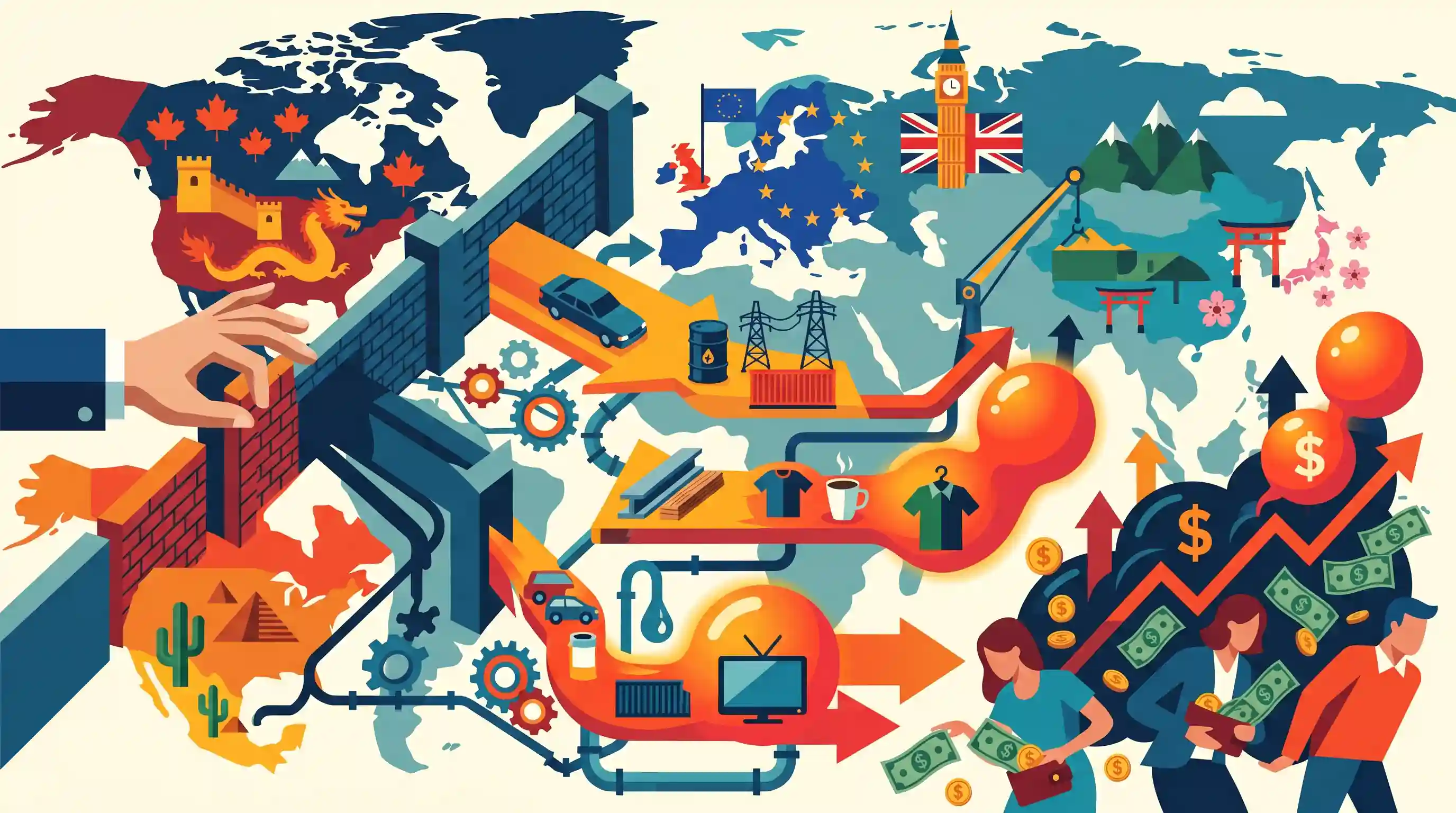
The article examines the widespread inflationary impact of sweeping new tariffs imposed by the US administration on its global trading partners. Driven by a protectionist agenda aimed at boosting domestic manufacturing, the US has levied substantial tariffs on imports from nations like China, Canada, and Mexico, while negotiating reduced rates with the EU, UK, and Japan. Affecting diverse sectors ranging from everyday consumer goods like clothing and coffee to automobiles, construction materials, and energy, these trade barriers are projected to trigger significant cost-push imported inflation. Economists warn that rather than purely benefiting domestic industries, the added costs of disrupting established global supply chains will ultimately be borne by American consumers, offering a real-world case study on the economic consequences of unwinding free trade.
Key Points
- The US administration has implemented sweeping new tariffs on goods from several major trading partners, marking a significant escalation in protectionist trade policies.
- While the EU, UK, and Japan successfully negotiated lower tariff rates, imports from Canada, Mexico, China, and various Asian nations still face sharply elevated levies.
- The tariffs impact a wide array of consumer and industrial sectors, raising the cost of imported clothing, food (coffee, olive oil), alcohol, vehicles, construction materials, and crude oil.
- Economists and industry bodies warn that the primary immediate effect will be cost-push imported inflation, as the financial burden of disrupting global supply chains is passed on to American consumers.
Important Terms
European Union

A supranational political and economic union of 27 member states in Europe, operating through a single market and common trade policy.
UPSC context
GS II - International Relations; tests knowledge of regional blocs and their impact on global trade and India’s strategic interests.
European Commission
The executive branch of the European Union responsible for proposing legislation, implementing decisions, and negotiating international trade agreements on behalf of the bloc.
UPSC context
GS II - International Institutions; tests understanding of the executive functions of supranational organizations in managing global trade disputes.
Budget Lab at Yale
A non-partisan research center at Yale University that provides data-driven analysis on the fiscal and macroeconomic impacts of government policies, such as tariffs.
UPSC context
GS III - Economy; tests the ability to analyze how protectionist measures trigger imported inflation and impact household purchasing power.
National Association of Home Builders
A major US trade association representing the housing industry; it monitors how tariffs on materials like lumber and steel increase home construction costs.
UPSC context
GS III - Economy; tests knowledge of cost-push inflation and how trade barriers affect specific domestic sectors like infrastructure.
American Fuel and Petrochemical Manufacturers
A trade association representing US refiners and petrochemical companies; it advocates for free trade in energy products and opposes tariffs on industrial inputs.
UPSC context
GS III - Economy and Energy; tests understanding of the ripple effects of trade policy on global energy supply chains.
Canadian Chamber of Commerce
Canada's largest business lobby group that represents the interests of domestic companies in international trade negotiations and disputes, particularly regarding US trade deals.
UPSC context
GS II - International Relations; tests knowledge of bilateral trade mechanisms and the role of non-state actors in diplomacy.
Prelims Trap
"Import tariffs are paid directly by the exporting country's government to the importing nation."
Tariffs are taxes paid by domestic importers at the customs border, not by the exporting nation. The financial burden is ultimately passed to domestic consumers via cost-push inflation.
Static Concepts Connected
What are the primary drivers of 'Imported Inflation' in an economy?
- Currency Depreciation: A weaker domestic currency makes buying foreign goods more expensive in local terms, directly raising domestic price levels.
- Commodity Price Shocks: Global supply shocks or price spikes in essential raw materials (like crude oil or edible oils) inflate domestic production costs.
- Trade Barriers: High import duties, tariffs, or quotas restrict supply and directly add to the final retail price of imported consumer and intermediate goods.
How do unilateral tariffs interact with the WTO's Most-Favored-Nation (MFN) principle?
- The Core Principle: Under WTO rules, a country must treat all its trading partners equally. A tariff rate applied to one must be applied to all.
- Legal Exceptions: Countries can legally bypass MFN for Free Trade Agreements (FTAs) or under specific, rigorous 'national security' and 'trade remedy' exceptions.
- Trade War Violations: Unilateral, selective tariffs against specific countries (without WTO dispute settlement backing) often violate the MFN core principle, risking retaliatory measures.
Cross-Topic Patterns
US inflation and RBI's monetary policy
US cost-push inflation caused by tariffs could delay Federal Reserve rate cuts. Prolonged high US rates risk capital flight from India, pressuring the Rupee and complicating RBI's monetary policy.
Trade diversion and 'China Plus One'
Sweeping US tariffs on Chinese goods accelerate the 'China Plus One' strategy, opening lucrative export market-share opportunities for Indian textiles, auto-components, and electronics through 'trade diversion'.

Expect a 2026 multi-statement Prelims question linking 'Imported Inflation' to global tariff wars, currency depreciation, and RBI actions.
Linked PYQs · 4
Linked PYQs · 4
- 2025MainsGS3
What are the challenges before the Indian economy when the world is moving away from free trade and multilateralism to protectionism and bilateralism? How can these challenges be met?
- 2016MainsGS2
The broader aims and objectives of WTO are to manage and promote international trade in the era of globalization. But the Doha round of negotiations seem doomed due to differences between the developed and the developing countries." Discuss in the Indian perspective.
- 2023PrelimsGS1
Consider the following statements: Statement-I: In the post-pandemic recent past, many Central Banks worldwide had carried out interest rate hikes. Statement-II: Central Banks generally assume that they have the ability to counteract the rising consumer prices via monetary policy means. Which one of the following is correct in respect of the above statements?
- 2021PrelimsGS1
With reference to Indian economy, demand-pull inflation can be caused/ increased by which of the following? 1. Expansionary policies 2. Fiscal stimulus 3. Inflation-indexing wages 4. Higher purchasing power 5. Rising interest rates Select the correct answer using the code given below.
