US National Security Strategy and Global Policy Shift
Source:The Hindu ↗
Why It Matters
This paradigm shift in U.S. foreign policy profoundly impacts the global world order, marking a transition from liberal internationalism to sovereign nationalism and transactional diplomacy. For UPSC aspirants, understanding this realignment is essential as it alters geopolitical dynamics in the Indo-Pacific, Europe, and the Middle East, fundamentally challenging the multilateral institutions (like NATO) and directly impacting India's strategic calculations and multi-alignment policy.
Summary
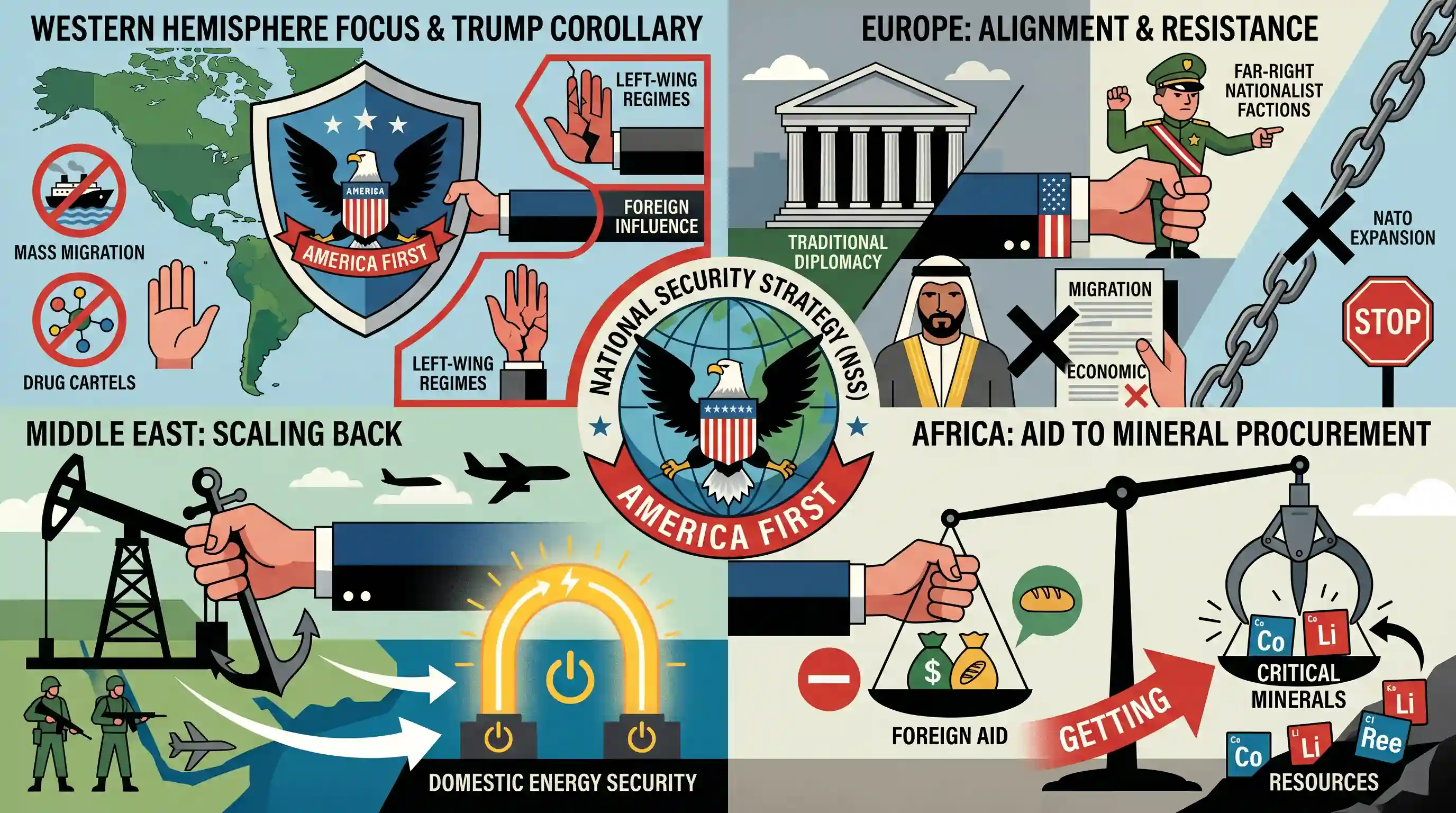
The newly released National Security Strategy (NSS) by the Trump administration signals a profound transformation in U.S. foreign policy, shifting away from global dominance and ideological promotion toward a transactional, 'America First' regional focus. Reinvoking the Monroe Doctrine via a 'Trump Corollary,' the U.S. intends to aggressively secure the Western Hemisphere against mass migration, drug cartels, and left-wing regimes. In a striking departure from traditional diplomacy, the NSS openly vows to foster 'resistance' in Europe by aligning with far-right nationalist factions, criticizing the continent's policies on migration and economic trajectory. Furthermore, the strategy plans to halt NATO expansion, scale back Middle Eastern engagements due to domestic energy security, and pivot African relations from aid to the procurement of critical minerals.
Key Points
- The new US National Security Strategy (NSS) marks a historic shift from global interventionism to a regionally focused, 'America First' approach.
- The US plans to halt the perpetual expansion of NATO, pushing for a swift end to the Ukraine war, and expects allies like Japan and South Korea to pay more for regional defense (e.g., Taiwan).
- In Europe, the Trump administration explicitly vows to cultivate 'resistance' by allying with far-right movements, criticizing the EU's current trajectory on migration and civilization.
- The strategy introduces a 'Trump Corollary' to the Monroe Doctrine, focusing intensely on curbing mass migration, aggressively targeting Latin American drug cartels, and countering socialist regimes in the Western Hemisphere.
- Globally, the US is shifting priorities: the Middle East’s importance has waned due to US energy independence, while engagement with Africa will pivot from aid to securing critical minerals.
Important Terms
National Security Strategy (NSS)

A mandated periodic document by the U.S. President outlining the nation's security concerns, global priorities, and strategic approach to defense, diplomacy, and economic policy.
UPSC context
GS Paper II: Impact of developed countries' policies on India; essential for analyzing shifts in global world order.
America First
A nationalist foreign policy doctrine prioritizing U.S. sovereignty, economic protectionism, and bilateral transactions over multilateral agreements and global ideological promotion.
UPSC context
GS Paper II: International Relations; tests understanding of unilateralism versus multilateralism and its effect on Indian interests.
Monroe Doctrine
A 19th-century policy asserting U.S. dominance in the Western Hemisphere and opposing European interference in the affairs of North and South American nations.
UPSC context
GS Paper II: Historical foundations of foreign policy; relevant for regional hegemony and geopolitical spheres of influence.
Trump Corollary
A 2025 policy extension of the Monroe Doctrine, asserting U.S. rights to secure the Western Hemisphere against migration, drug cartels, and extra-hemispheric competitors like China.
UPSC context
GS Paper II: New geopolitical doctrines; critical for evaluating current U.S. shifts toward regionalism and interventionism.
NATO
An intergovernmental military alliance established in 1949 for collective defense, currently facing U.S. pressure for increased burden-sharing and a halt to eastward expansion.
UPSC context
GS Paper II: Global groupings; vital for questions on European security and the Russia-Ukraine conflict.
Strategic Autonomy
The capacity of a state to pursue its own national interests and foreign policy without being constrained by other states or alliances.
UPSC context
GS Paper II: Core tenet of Indian foreign policy; tests how India navigates shifting U.S. and global alliances.
Prelims Trap
"The 'Trump Corollary' aims to contain Chinese military expansionism in the Indo-Pacific region."
The corollary is a reinvocation of the Monroe Doctrine, focused exclusively on the Western Hemisphere (Latin America) to tackle migration, cartels, and socialist regimes.
Static Concepts Connected
What is the historical significance of the Monroe Doctrine?
- 1823 Origins: Introduced in 1823 to warn European powers against further colonization or the establishment of puppet monarchs in the Americas.
- Roosevelt Corollary: A 1904 addition asserting the US right to intervene militarily in Latin American nations to maintain stability, formalizing US regional hegemony.
Why is Africa critical for the global energy transition?
- Cobalt & Lithium: Africa holds massive reserves of battery-critical minerals, notably cobalt in the Democratic Republic of Congo and lithium in Zimbabwe.
- Supply Chain Security: Global powers are moving from humanitarian aid to strategic procurement agreements to break China's existing monopoly on green-tech mineral processing.
Cross-Topic Patterns
Shale revolution alters Middle East geopolitics
The US shale oil and gas boom has secured domestic energy independence, structurally downgrading the Middle East's importance in Washington's strategic calculations compared to previous decades.
Geoeconomics of African critical minerals
Replacing traditional humanitarian aid with mineral procurement illustrates how great-power competition over green-tech is reshaping North-South relations into transactional, supply-chain diplomacy.
Demise of liberal internationalism
Halting NATO expansion and actively backing far-right 'resistance' in Europe marks a definitive end to post-Cold War liberal internationalism, shifting toward sovereign, transactional nationalism.

Expect a 2026 IR question matching the 'Trump Corollary' to Latin America, alongside US policy shifts on NATO and African critical minerals.
Linked PYQs · 3
Linked PYQs · 3
- 2025MainsGS2
"With the waning of globalization, post-Cold War world is becoming a site of sovereign nationalism.” Elucidate.
- 2023MainsGS2
‘The expansion and strengthening of NATO and a stronger US-Europe strategic partnership works well for India.’ What is your opinion about this statement ? Give reasons and examples to support your answer.
- 2025MainsGS2
"The reform process in the United Nations remains unresolved, because of the delicate imbalance of East and West and entanglement of the USA vs. Russo-Chinese alliance.” Examine and critically evaluate the East-West policy confrontations in this regard.
