Strait of Hormuz Gunfire on Indian Ships Triggers US Crisis Meet
Source:Indian Express ↗
Why It Matters
The Strait of Hormuz is one of the world's most critical maritime choke points for oil transit. Disruptions there directly threaten India's energy security, global supply chains, and the safety of Indian shipping and diaspora in the region, making it highly relevant for India's foreign policy and economic resilience.
Summary
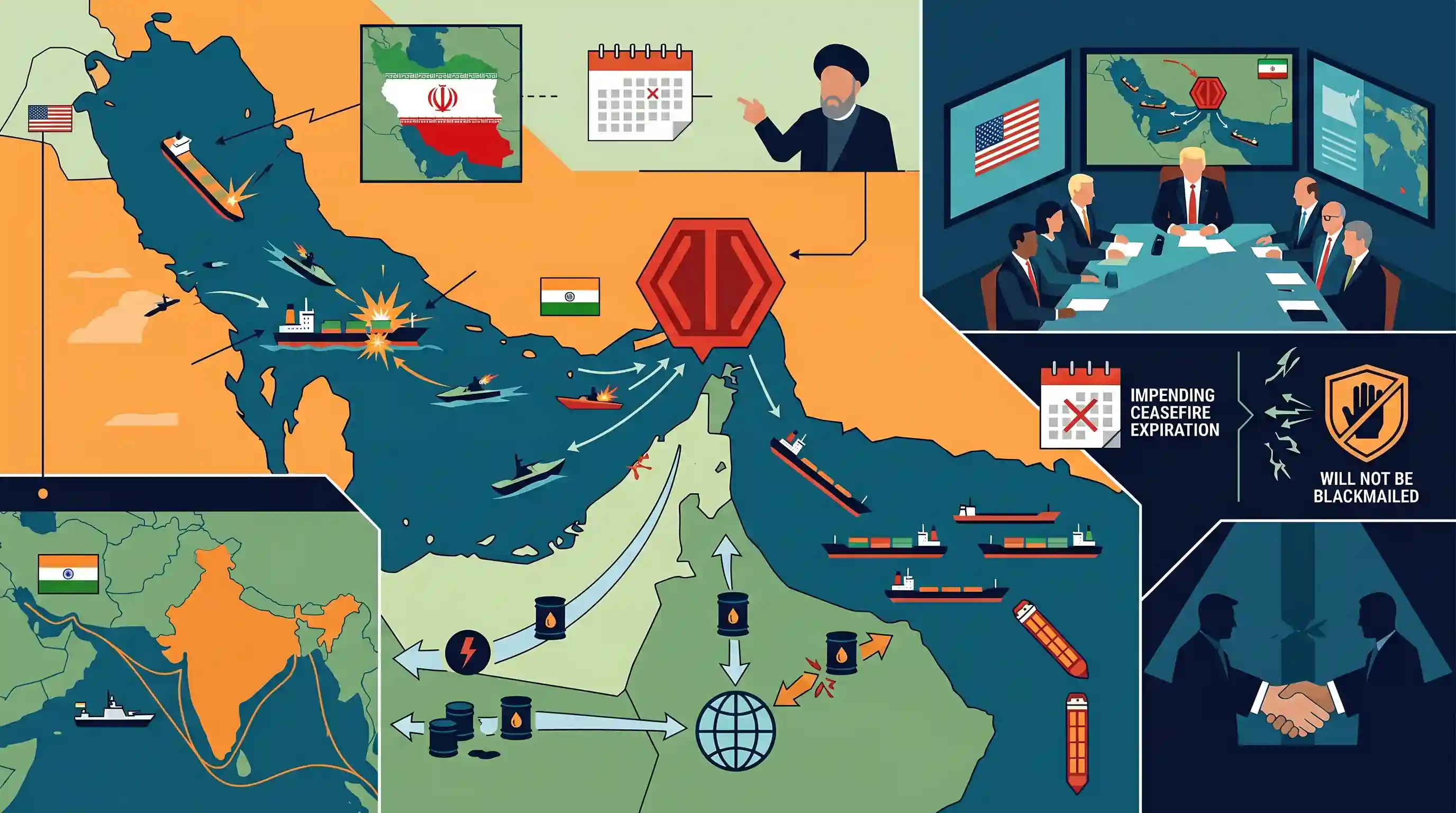
Following an incident where gunfire hit Indian ships in the Strait of Hormuz—forcing the closure of the critical global oil transit route—US President Donald Trump convened a Situation Room meeting. The escalation coincides with the impending expiration of a ceasefire and threats from Iran to block the waterway. Highlighting the ongoing volatility of US-Iran relations, Trump stated that the US will not be blackmailed, even as backchannel diplomatic talks continue. The crisis underscores significant concerns for global energy flows, Indian maritime security, and Middle Eastern geopolitical stability.
Key Points
- President Donald Trump convened a meeting in the White House Situation Room after gunfire hit Indian ships in the Strait of Hormuz, causing the closure of the crucial oil route.
- Tensions between the US and Iran are high as a regional ceasefire nears expiration, and Iran threatens to close the waterway again.
- Trump warned that the US 'can't be blackmailed' by Iran's pressure tactics, although he confirmed that backchannel talks between the two nations are still ongoing.
- The incident highlights the strategic vulnerability of the Strait of Hormuz and its direct impact on global energy security and Indian maritime interests.
Important Terms
Strait of Hormuz

A strategic chokepoint between the Persian Gulf and Gulf of Oman through which ~20% of global oil flows. It is vital for India's energy supply, especially crude and LNG imports.
UPSC context
GS Paper 1 & 2; tests knowledge of critical maritime chokepoints and India's energy dependency on West Asia.
Maritime Security
The protection of sea lanes, coastal borders, and marine resources from threats like piracy, terrorism, and geopolitical conflict to ensure free trade and regional stability.
UPSC context
GS Paper 3 (Internal Security); relevant for India's IOR interests and its role as a "Net Security Provider."
Energy Security
The uninterrupted availability of energy sources at affordable prices, involving the management of supply risks, price volatility, and the maintenance of strategic petroleum reserves.
UPSC context
GS Paper 3 (Economy/Security); critical for assessing economic resilience and the impact of global supply shocks on India.
Backchannel Diplomacy
Informal, confidential communication between states conducted outside official channels to build trust, explore solutions, or de-escalate crises without public or media scrutiny.
UPSC context
GS Paper 2 (International Relations); tests understanding of conflict resolution strategies and non-official diplomatic methods.
Situation Room
An intelligence management and crisis support complex in the White House used by the US President for secure communications and command-and-control during global emergencies.
UPSC context
GS Paper 2 (International Relations); represents the institutional crisis-management frameworks of major global powers affecting international security.
Prelims Trap
"Coastal states can temporarily suspend transit passage through the Strait of Hormuz for security reasons under UNCLOS."
False. International straits guarantee 'transit passage'—allowing continuous, unhindered navigation—which coastal states cannot suspend. This differs from 'innocent passage' in territorial waters, which can be suspended.
Static Concepts Connected
Which water bodies do the major Middle Eastern maritime chokepoints connect?
- Strait of Hormuz: Connects the Persian Gulf to the Gulf of Oman and the Arabian Sea.
- Bab el-Mandeb: Connects the Red Sea to the Gulf of Aden and the broader Indian Ocean.
- Suez Canal: Artificial sea-level waterway in Egypt connecting the Mediterranean Sea to the Red Sea.
What are the key features of the Indian Navy's Operation Sankalp?
- Genesis: Launched in 2019 following a series of attacks on merchant ships in the Gulf of Oman.
- Mandate: To provide continuous escorts and safeguard Sea Lines of Communication (SLOCs) for Indian-flagged merchant vessels.
- Strategic significance: Demonstrates India's proactive blue-water naval posture to protect critical energy flows in the Persian Gulf.
Cross-Topic Patterns
Oil chokepoints & imported inflation
Disruptions in Hormuz spike crude prices and freight insurance, transmitting imported inflation to India, widening the current account deficit, and increasing macroeconomic risks of stagflation.
UNCLOS & Transit Passage rights
India's naval escorts rely on UNCLOS provisions that guarantee unimpeded 'transit passage' through international straits, distinguishing this right from suspendable 'innocent passage' in territorial waters.

Expect a map-based Prelims question pairing Middle-East chokepoints (Hormuz, Bab el-Mandeb) with specific regional conflicts and UNCLOS.
Linked PYQs · 5
Linked PYQs · 5
- 2025MainsGS2
"Energy security constitutes the dominant kingpin of India's foreign policy, and is linked with India's overarching influence in Middle Eastern countries.” How would you integrate energy security with India's foreign policy trajectories in the coming years?
- 2024MainsGS2
Discuss the geopolitical and geostrategic importance of Maldives for India with a focus on global trade and energy flows. Further also discuss how this relationship affects India's maritime security and regional stability amidst international competition ?
- 2017MainsGS2
The question of India's Energy Security constitutes the most important part of India's economic progress. Analyze India's energy policy cooperation with West Asian countries.
- 2020MainsGS2
What is the significance of Indo-US defence deals over Indo-Russian defence deals? Discuss with reference to stability in the Indo-Pacific region.
- 2025MainsGS3
Why is maritime security vital to protect India's sea trade? Discuss maritime and coastal security challenges and the way forward.
