US Sets August Deadline for Russia Ukraine Peace Accord
Source:Indian Express ↗
Why It Matters
This article illustrates the aggressive shift in US foreign policy under the Trump administration concerning the Russia-Ukraine conflict. The use of strict deadlines, threats of severe sanctions, and coordinated efforts with NATO to arm Ukraine underscores changing geopolitical dynamics and the mechanisms of international conflict resolution, which are highly relevant for the GS Paper 2 syllabus on international relations and global groupings.
Summary
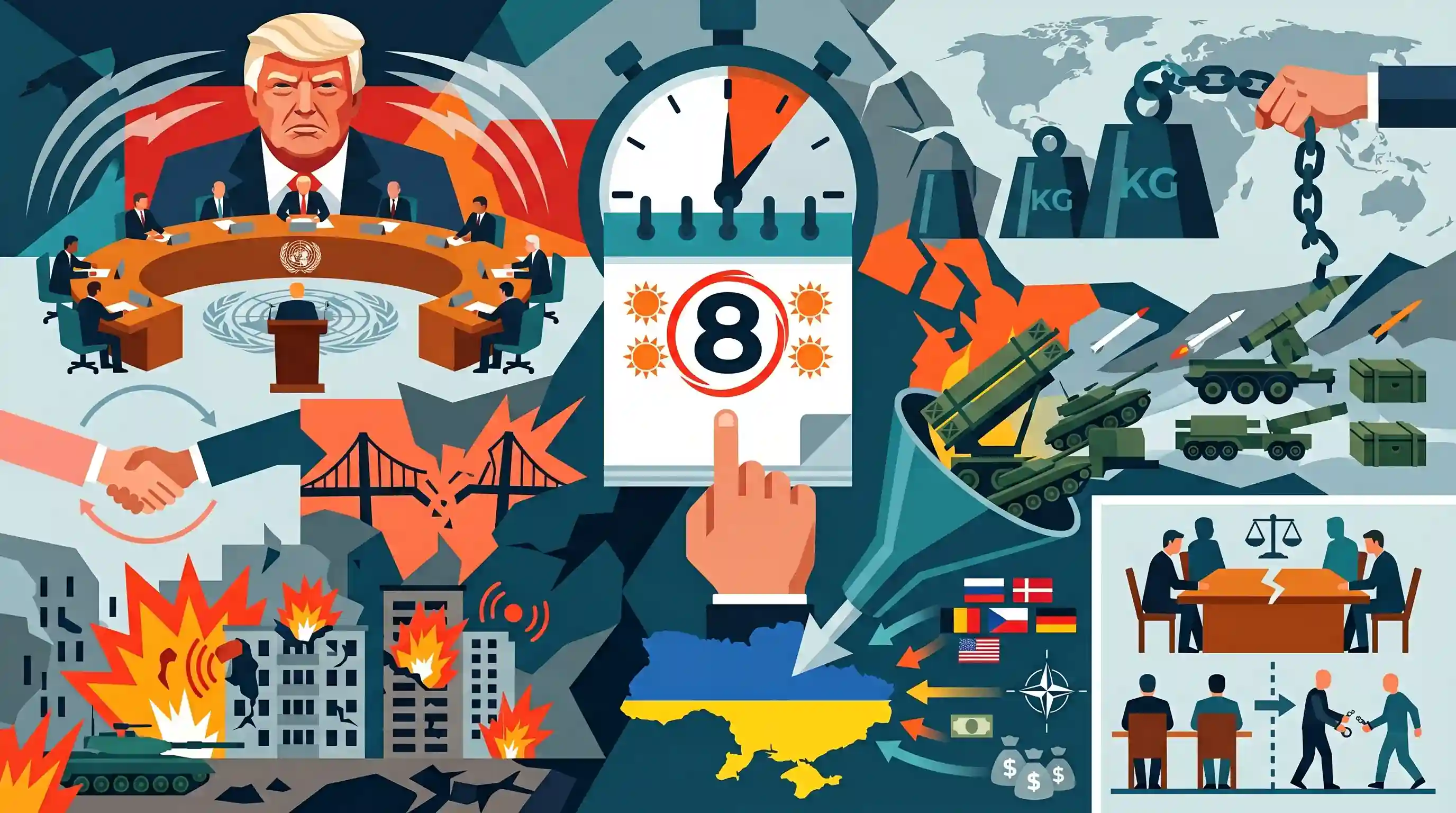
US President Donald Trump has issued a strict August 8 deadline for Russia and Ukraine to finalize a peace deal, as announced to the UN Security Council. Signaling a shift from his previously conciliatory tone, Trump expressed disillusionment with Russian President Vladimir Putin over ongoing strikes on Ukrainian civilian areas. To pressure Moscow, the US administration has threatened severe new sanctions and secured an agreement with NATO for European allies to provide billions of dollars in armaments, including Patriot missile defense systems, to Ukraine if a ceasefire is not met. Meanwhile, recent bilateral talks in Istanbul have stalled, yielding only a prisoner exchange.
Key Points
- US President Donald Trump has set a firm August 8 deadline for a peace agreement to end the Russia-Ukraine war, communicating this via a US diplomat to the UN Security Council.
- Trump's tone towards Russian President Vladimir Putin has become disillusioned following continued Russian attacks on Ukrainian cities like Kyiv.
- To enforce the deadline, Trump has threatened harsh sanctions against Russia if a ceasefire is not initiated.
- The US has also coordinated an agreement with NATO Secretary General Mark Rutte for European allies to purchase billions of dollars in armaments, including Patriot missile defense systems, for Ukraine if peace talks fail.
- Recent diplomatic negotiations in Istanbul between Russia and Ukraine have yielded little progress, resulting only in a prisoner exchange rather than substantive peace steps.
Important Terms
UN Security Council (UNSC)

One of the six principal UN organs, responsible for international peace and security. It comprises 15 members (5 permanent with veto power) and can issue binding resolutions.
UPSC context
GS Paper II (International Relations); tests understanding of global governance structures and India's quest for permanent membership.
NATO (North Atlantic Treaty Organization)
A transatlantic intergovernmental military alliance established in 1949. It operates on the principle of collective defense (Article 5), where an attack on one is an attack on all.
UPSC context
GS Paper II; crucial for analyzing European security architecture and the geopolitical shifts impacting India's strategic autonomy.
Patriot Missile Defense System
An advanced, mobile, all-weather surface-to-air missile (SAM) system designed to detect and intercept incoming tactical ballistic missiles, cruise missiles, and aircraft.
UPSC context
GS Paper III (Science & Technology/Defense); relevant for questions on modern warfare, air defense mechanisms, and global defense trade.
Economic Sanctions
Coercive measures (e.g., asset freezes, trade embargoes) used by nations or international bodies to influence a target country's behavior without resorting to direct military force.
UPSC context
GS Paper II (International Relations); tests knowledge of non-military foreign policy tools and their impact on global trade and sovereignty.
Prelims Trap
The UN Security Council mandated an August 8 deadline for a Russia-Ukraine peace deal.
The US unilaterally announced this deadline *at* a UNSC meeting. The UNSC itself did not mandate it, as Russia holds a veto and blocks all substantive resolutions against it.
Static Concepts Connected
What are the key technical features of the Patriot Missile System?
- System Type: A long-range, all-weather, surface-to-air missile (SAM) defense system deployed heavily by the US and its NATO allies.
- Hit-to-Kill Tech: Modern variants (PAC-3) utilize advanced kinetic energy interceptors to destroy threats via direct impact, rather than using proximity fragmentation explosives.
- Target Capabilities: Designed to track and intercept tactical ballistic missiles, cruise missiles, and advanced enemy aircraft at various altitudes.
Why is the UN Security Council technically paralyzed regarding the Russia-Ukraine war?
- P5 Veto Power: Under Article 27 of the UN Charter, substantive decisions require the concurring votes of all five permanent members. Russia uses its veto to block mandates.
- Uniting for Peace: Because the UNSC is deadlocked, major condemnations and non-binding resolutions regarding Ukraine have been routed through the UN General Assembly instead.
Cross-Topic Patterns
Istanbul Process & Middle Power Diplomacy
Turkey leverages its NATO membership and ties to Moscow to mediate (Black Sea Grain Initiative, prisoner swaps), showcasing how middle powers exercise strategic autonomy in bipolar conflicts.
Extraterritorial impacts of US sanctions
Unilateral US sanctions frequently trigger secondary sanctions, impacting Global South nations by disrupting energy security and forcing the creation of alternative payment mechanisms (e.g., Rupee-Ruble trade).

Expect a 2026 Prelims matching question pairing modern mediation forums (Istanbul Process, Jeddah talks) with their respective conflicts.
Linked PYQs · 2
Linked PYQs · 2
- 2025MainsGS2
"The reform process in the United Nations remains unresolved, because of the delicate imbalance of East and West and entanglement of the USA vs. Russo-Chinese alliance.” Examine and critically evaluate the East-West policy confrontations in this regard.
- 2023MainsGS2
‘The expansion and strengthening of NATO and a stronger US-Europe strategic partnership works well for India.’ What is your opinion about this statement ? Give reasons and examples to support your answer.
