US Ultimatum on Ukraine Conflict and Secondary Tariff Threats
Source:Indian Express ↗
Why It Matters
The threat of secondary sanctions ('secondary tariffs') by the US on countries trading with Russia directly impacts India's strategic autonomy, energy security (Russian oil imports), and defense procurement. Furthermore, changes in US policy toward NATO and the Ukraine war are key determinants of the emerging multipolar global order and trans-Atlantic security architecture.
Summary
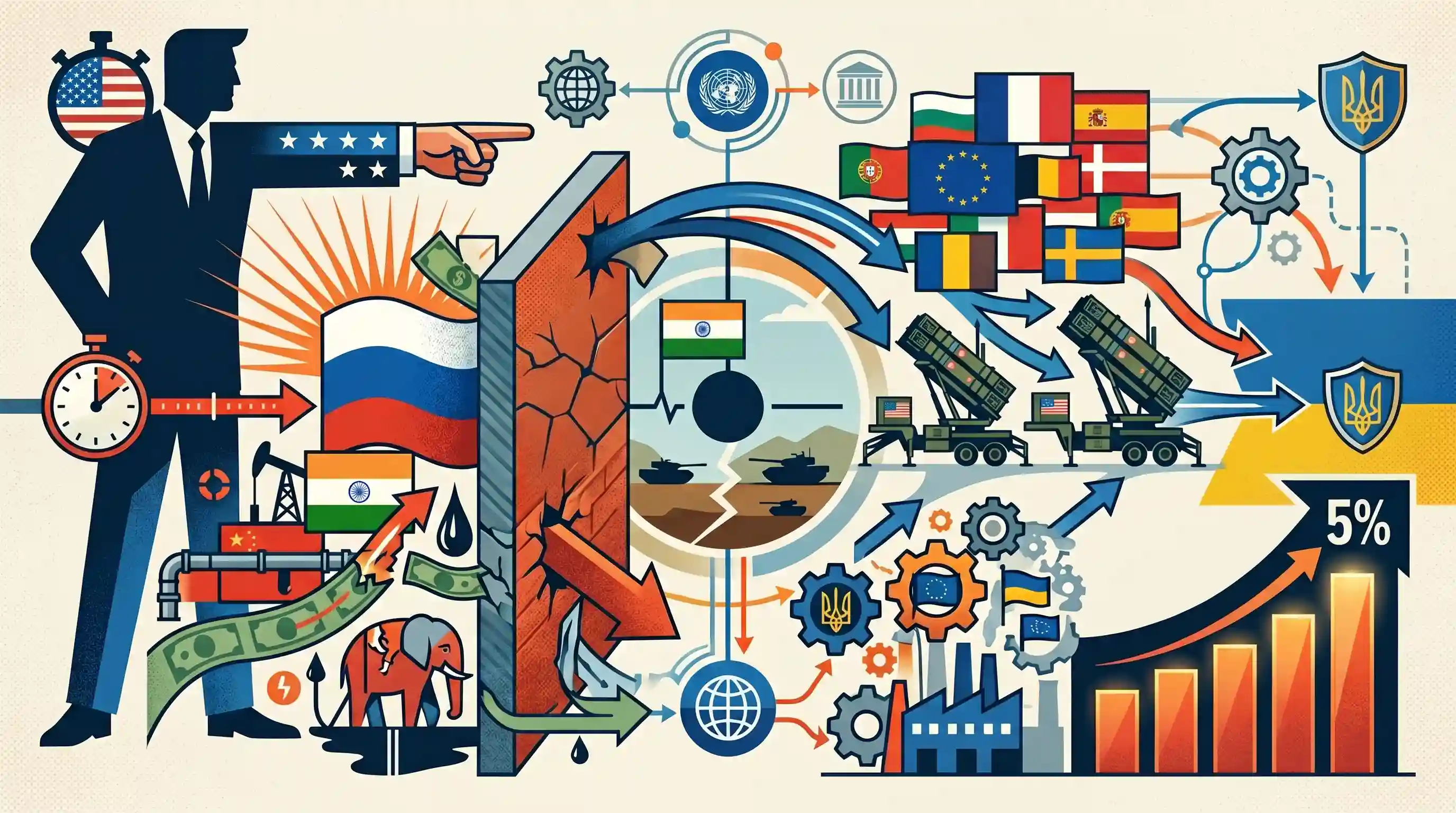
US President-elect Donald Trump has issued a 50-day ultimatum for a ceasefire in the Russia-Ukraine war, threatening comprehensive 100% primary and secondary tariffs on Russia and its trading partners if the conflict continues. This aggressive trade posture aims to leverage economic pressure on nations buying Russian oil, which holds significant implications for countries like India. Concurrently, Trump announced that NATO allies will procure advanced US weaponry, such as Patriot missile systems, to arm Ukraine before the deal's deadline, as European countries agree to a massive hike in defense spending to 5% of GDP.
Key Points
- US President-elect Donald Trump has set a 50-day deadline after taking office for Russia and Ukraine to agree on a ceasefire.
- Trump threatened imposing 100% tariffs on Russian exports if no deal is reached, aiming to severely restrict Russian trade revenues.
- The tariff threat includes 'secondary tariffs' on third-party countries that purchase oil or maintain significant business ties with Russia.
- Trump stated that NATO countries will purchase billions of dollars in US weaponry, including Patriot missile systems, to supply Ukraine ahead of the proposed deal.
- In response to the shifting US posture, European nations have committed to increasing their defense spending to 5% of GDP.
Important Terms
NATO (North Atlantic Treaty Organization)

An intergovernmental military alliance between North American and European countries, established in 1949 for collective defense. Members recently committed to a significant defense spending increase toward a 5% GDP target by 2035.
UPSC context
GS Paper II: International relations/institutions; crucial for understanding global security architecture and US-Europe strategic dynamics.
Secondary Tariffs
A trade penalty imposed on a third-party country (e.g., India) to pressure it into stopping trade with a sanctioned adversary (e.g., Russia), effectively weaponizing market access to achieve foreign policy goals.
UPSC context
GS Paper II: Effect of policies of developed countries on India's interests; tests economic diplomacy and trade sovereignty.
Patriot Missile System
The MIM-104 'Phased Array Tracking Radar for Intercept on Target' is a mobile, all-weather, long-range surface-to-air missile defense system used to intercept ballistic missiles, cruise missiles, and advanced aircraft.
UPSC context
GS Paper III: Science and Tech/Security; relevant for defense technology and international arms transfers.
Strategic Autonomy
A foreign policy framework where a nation pursues its interests and makes independent decisions without being constrained by the military or economic pressures of other global powers.
UPSC context
GS Paper II: India’s foreign policy; tests the ability to balance relations between major powers like Russia and the US.
GDP Defense Spending Target
A policy objective for NATO members, recently increased from 2% to a total of 5% (3.5% core, 1.5% related), to ensure military readiness and reduce reliance on US defense contributions.
UPSC context
GS Paper II: International Relations; tests knowledge of burden-sharing and military budgeting within global alliances.
Prelims Trap
Secondary sanctions and tariffs imposed by the US are legally binding under international law for all UN member states.
Aspirants confuse unilateral US sanctions with UN Security Council resolutions. US secondary tariffs/sanctions are domestic extraterritorial tools, not legally binding under international law.
Static Concepts Connected
What is the difference between Primary and Secondary Sanctions or Tariffs?
- Primary measures: Prohibit direct domestic individuals and companies from engaging in trade or financial transactions with a targeted foreign nation.
- Secondary measures: Threaten third-party countries or foreign entities with penalties (like market exclusion) if they continue to trade with the targeted nation.
- Extraterritorial reach: They apply a country's domestic laws to foreign entities, frequently leading to sovereignty disputes and potential WTO norm violations.
What are the key global surface-to-air missile (SAM) defense systems?
- Patriot (US): Advanced long-range system used extensively by the US and NATO to intercept ballistic missiles, cruise missiles, and advanced aircraft.
- S-400 Triumf (Russia): Highly advanced mobile system procured by India; capable of engaging multiple targets simultaneously at much longer ranges than the Patriot.
- Iron Dome (Israel): Specialized short-range air defense system designed specifically to intercept unguided rockets and artillery shells.
Cross-Topic Patterns
Energy Security vs Strategic Autonomy
The US threat of 100% secondary tariffs directly tests India's strategic autonomy, as heavily discounted Russian crude now forms ~40% of India's total oil imports.
Secondary Tariffs & De-dollarisation
US weaponisation of trade via secondary tariffs accelerates developing nations' push for de-dollarisation, bypassing SWIFT, and utilizing Rupee Vostro accounts to shield vital imports.

Secondary extraterritorial tariffs bypassing WTO norms, paired with Rupee-Rouble trade mechanisms, will likely form an Economy/IR question.
Linked PYQs · 3
Linked PYQs · 3
- 2023MainsGS2
‘The expansion and strengthening of NATO and a stronger US-Europe strategic partnership works well for India.’ What is your opinion about this statement ? Give reasons and examples to support your answer.
- 2012MainsGS2
How have the US sanctions against Iran affected India's bilateral relations with Iran?
- 2025PrelimsGS1
Consider the following countries : I. Austria II. Bulgaria III. Croatia IV. Serbia V. Sweden VI. North Macedonia How many of the above are members of the North Atlantic Treaty Organization?
