US Warning of Intervention Amid Iranian Economic Crisis and Protests
Source:The Hindu ↗
Why It Matters
The escalating tensions between the US, Iran, and Israel highlight the persistent volatility in the Middle East. For India, this regional instability directly impacts energy security, trade relationships, strategic investments like the Chabahar port, and the safety of the massive Indian diaspora in the Gulf region. Understanding the geopolitical consequences of sanctions and proxy wars is essential for analyzing India's foreign policy maneuvers.
Summary
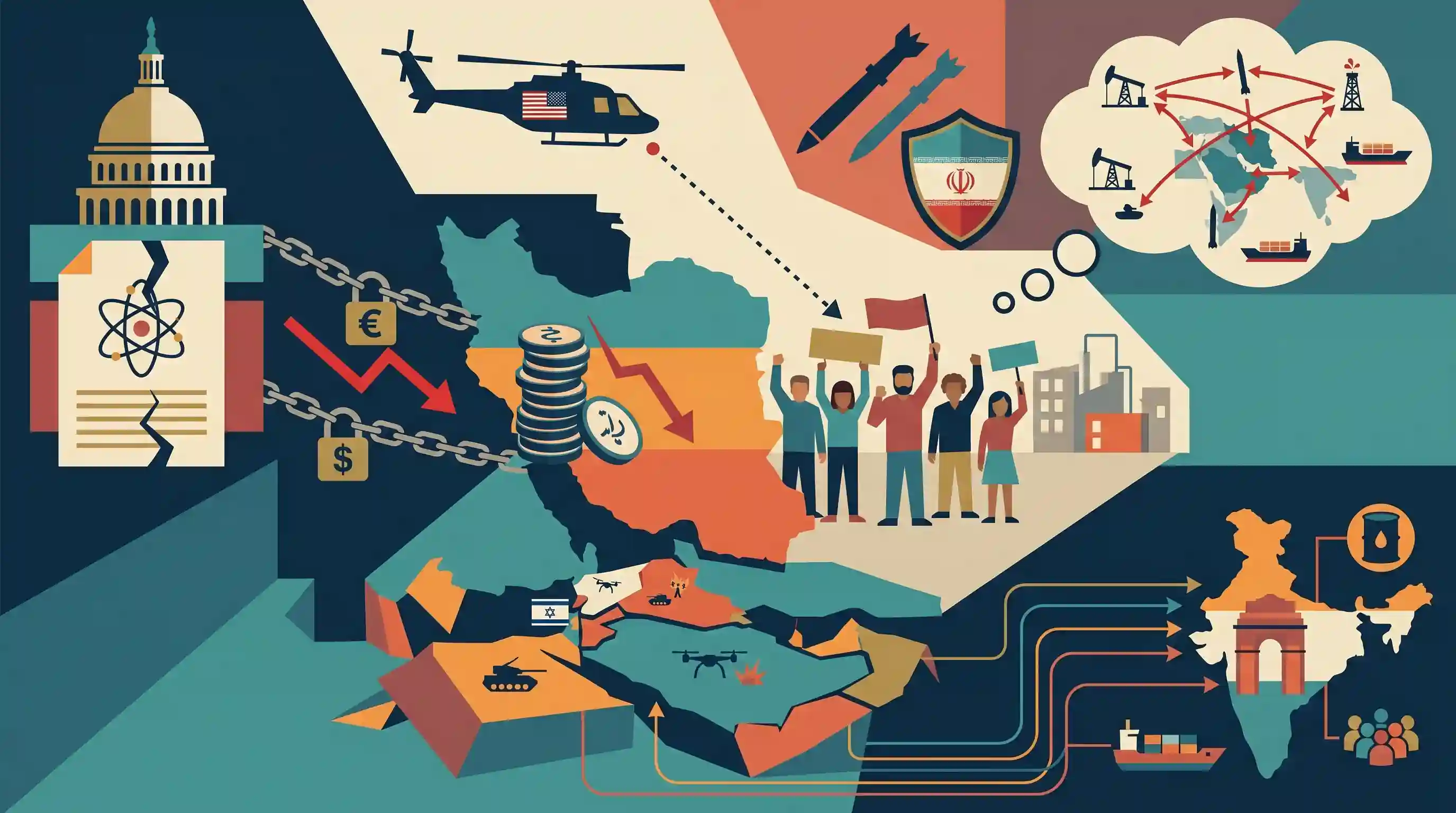
Amid severe economic turmoil and sharp currency devaluation exacerbated by US sanctions, mass protests have broken out in Iran. US President Donald Trump warned of potential military intervention if the Iranian regime violently suppresses the peaceful protests. In response, Iranian officials cautioned that US involvement would dangerously escalate tensions and threaten American assets in the region. The crisis underscores the fragile geopolitical stability in the Middle East, deeply influenced by the fallout of the US withdrawal from the 2015 nuclear deal and ongoing proxy conflicts involving Israel.
Key Points
- Protests erupted in Iran driven by severe economic hardship, including extreme food inflation (64.2%) and a sharp depreciation of the Iranian rial.
- The economic crisis has been severely exacerbated by the US withdrawal from the 2015 JCPOA (nuclear deal) and the reimposition of stringent sanctions.
- US President Donald Trump issued a stern warning, stating the US is 'locked and loaded' and will intervene if Iran uses lethal force to violently suppress peaceful protests.
- Iranian officials warned that any US military intervention would severely destabilize the region and turn American troops and bases in the Middle East into legitimate targets.
- The regional instability is further complicated by Israeli intelligence agency Mossad reportedly encouraging the protests, following recent military engagements between Israel and Iran.
Important Terms
2015 Nuclear Deal (JCPOA)

A 2015 agreement between Iran and the P5+1 nations to curb Iran's nuclear program in exchange for the lifting of economic sanctions.
UPSC context
GS Paper 2 (International Relations); impacts India's energy security and strategic investments like Chabahar port.
Economic Sanctions
Financial and trade penalties imposed by states or international bodies to pressure a country into changing its policies or behavior.
UPSC context
GS Paper 2 (International Relations); explores non-military tools of coercion and their impact on global trade.
Mossad
Israel's national intelligence agency, responsible for foreign intelligence collection, covert operations, and counterterrorism beyond its borders.
UPSC context
GS Paper 2 (International Relations); relevant to West Asian security dynamics and India-Israel strategic cooperation.
West Asia Geopolitics
The strategic interactions in the Middle East, driven by energy resources, regional rivalries, and the influence of external powers.
UPSC context
GS Paper 2; vital for India's Link West policy, energy imports, and large diaspora.
Proxy Warfare
A conflict where rival powers support third parties to fight on their behalf to avoid direct military confrontation.
UPSC context
GS Paper 2 (International Relations); key to understanding regional instability in Yemen, Syria, and Iraq.
Prelims Trap
The JCPOA is a legally binding UN treaty currently enforced by the US and European allies.
The US unilaterally withdrew from the JCPOA in 2018. It is a political agreement, not a legally binding treaty, and US secondary sanctions operate independently of UN mandates.
Static Concepts Connected
What is the JCPOA and its monitoring mechanism?
- P5+1 Agreement: Signed in 2015 between Iran and the UN Security Council permanent members plus Germany to curb Iran's nuclear ambitions.
- IAEA Oversight: Mandated strict monitoring by the International Atomic Energy Agency, including the implementation of the Additional Protocol for snap inspections.
- Enrichment Caps: Limited Iran's uranium enrichment to 3.67%, well below weapons-grade levels, in exchange for lifting international economic sanctions.
What makes the Strait of Hormuz geostrategically vital?
- Strategic Chokepoint: A narrow maritime transit route connecting the Persian Gulf to the Gulf of Oman and the Arabian Sea.
- Bordering Nations: It is bounded by Iran on the northern coast and by Oman and the United Arab Emirates to the south.
- Global Oil Artery: Facilitates the transit of roughly 20% of global traded petroleum, making its stability crucial for India's macroeconomic and energy security.
Cross-Topic Patterns
CAATSA vs. Strategic Autonomy
US secondary sanctions on Iran historically forced India to halt Iranian oil imports. This mirrors pressures over Russian defense deals, testing India's multi-alignment strategy.
West Asian Proxy Geopolitics
The Israel-Iran shadow war frequently links to GS-2 themes on how non-state actors (Hezbollah, Hamas) disrupt global supply chains and threaten regional stability.

Expect a 2026 Prelims map-based question combining West Asian chokepoints (Hormuz, Bab-el-Mandeb) with current zones of proxy conflicts.
Linked PYQs · 4
Linked PYQs · 4
- 2018MainsGS2
In what ways would the ongoing US-Iran Nuclear Pact Controversy affect the national interest of India? How should India respond to this situation?
- 2012MainsGS2
How have the US sanctions against Iran affected India's bilateral relations with Iran?
- 2022PrelimsGS1
The term "Levant" often heard in the news roughly corresponds to which of the following regions?
- 2023PrelimsGS1
Consider the following statements: Statement-I: Israel has established diplomatic relations with some Arab States. Statement-II: The 'Arab Peace Initiative' mediated by Saudi Arabia was signed by Israel and Arab League. Which one of the following is correct in respect of the above statements?
