US Boycott of G20 Summit and Multilateral Governance Challenges
Source:The Hindu ↗
Why It Matters
This incident demonstrates a critical contemporary challenge to multilateralism. The U.S. boycott and push to expel a member state reflect growing 'sovereign nationalism' that can paralyze global governance mechanisms like the G-20, a forum pivotal to global economic stability and one in which India holds significant stakes.
Summary
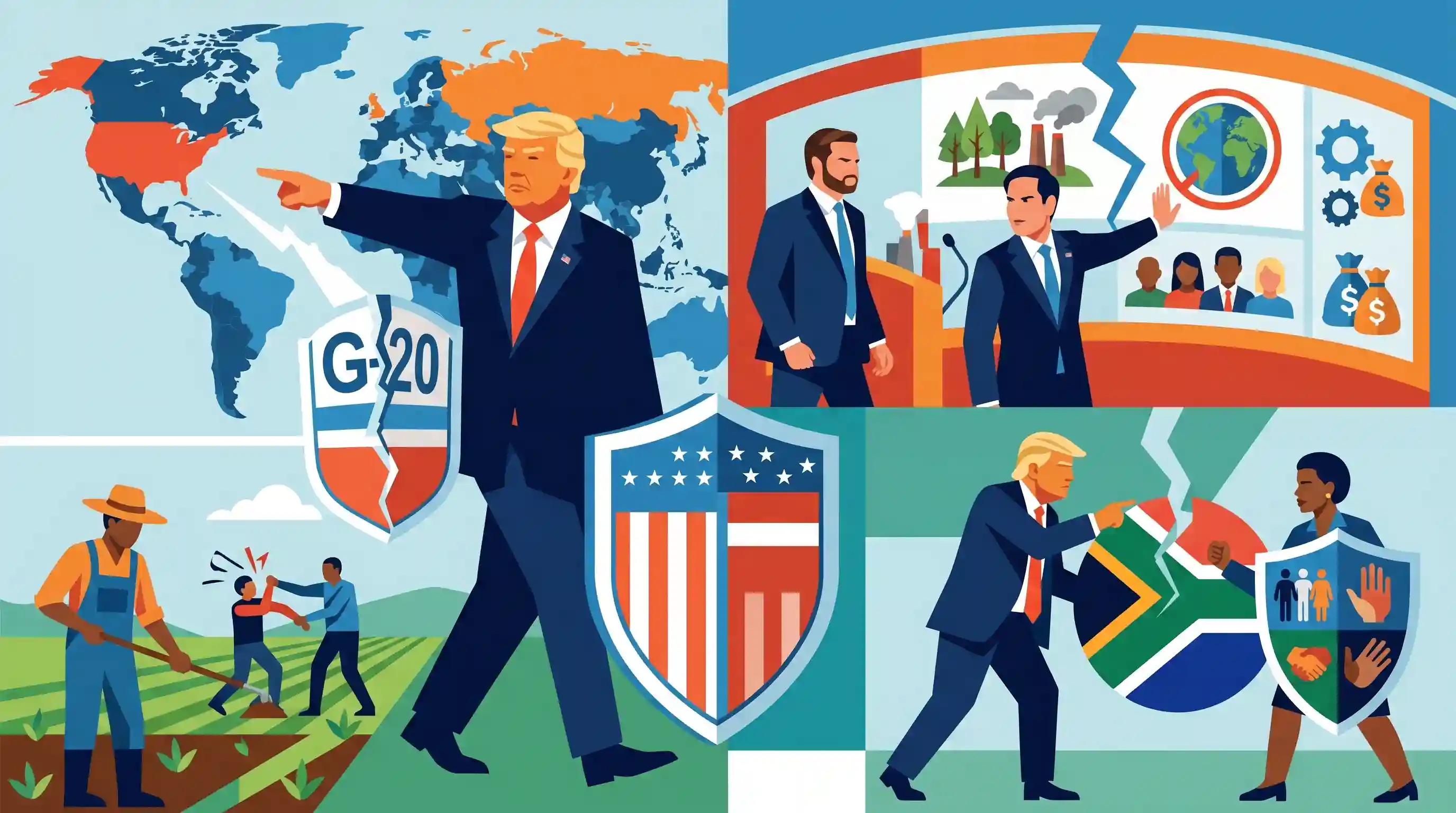
U.S. President Donald Trump announced that the United States will boycott the upcoming G-20 summit hosted by South Africa, citing allegations regarding the systemic mistreatment of white farmers. Key U.S. officials, including Vice President J.D. Vance and Secretary of State Marco Rubio, have also withdrawn from related engagements, with Rubio accusing the forum of straying from its core economic mandate to focus excessively on climate change and diversity. Trump’s call to expel South Africa from the G-20 was swiftly rejected by the South African government, which emphasized its constitutional commitment to racial equality. This unilateral withdrawal signals rising American sovereign nationalism, posing significant risks to the effectiveness and unity of multilateral institutions like the G-20 in addressing global economic challenges.
Key Points
- U.S. President Donald Trump announced a boycott of the upcoming G-20 summit in South Africa over allegations concerning the mistreatment of white Afrikaner farmers.
- Vice President J.D. Vance and Secretary of State Marco Rubio withdrew from G-20 events, with Rubio criticizing the forum's recent focus on climate change, diversity, equity, and inclusion instead of core economic issues.
- Trump proposed expelling South Africa from the G-20, a demand that threatens the structural integrity of the multilateral forum.
- The South African government, led by Cyril Ramaphosa, strongly rejected the allegations, maintaining that its laws ensure equality for all citizens regardless of race.
- The boycott highlights a shift in U.S. foreign policy toward 'America First' unilateralism, raising concerns about the future viability and relevance of global governance platforms like the G-20.
Important Terms
G-20 (Group of Twenty)

An intergovernmental forum of 19 countries, the EU, and the African Union (since 2023), representing 85% of global GDP and 75% of international trade.
UPSC context
GS Paper II: Global groupings/agreements. Focuses on global governance, India's leadership, and international financial stability.
Multilateralism
An international cooperation framework where three or more states collaborate based on shared norms and values to address transborder challenges like climate change.
UPSC context
GS Paper II: International institutions. Essential for analyzing the liberal world order versus rising unilateralism and minilateralism.
Sovereign Nationalism
A political trend where states prioritize national interests, strategic autonomy, and identity over international cooperation and global integration.
UPSC context
GS Paper II: Effect of policies of developed countries. Critical for evaluating the "America First" doctrine's impact on India.
Global South
A collective term for developing and emerging economies, primarily in Africa, Asia, and Latin America, focusing on shared developmental and post-colonial challenges.
UPSC context
GS Paper II: India's interests. Relevant to India's role as a champion for developing nations in global forums.
Diplomatic Boycott
The official refusal by a state to attend summits or events to protest a host country's policies, signaling severe diplomatic disapproval.
UPSC context
GS Paper II: Bilateral relations. Tests knowledge of non-military instruments used in foreign policy to exert pressure.
Expropriation without Compensation (EWC)
A South African policy allowing the state to seize land for public purpose without financial reimbursement to the owner, often to rectify historical inequalities.
UPSC context
GS Paper II: Politics of developing countries. Provides context for the specific human rights allegations mentioned in the article.
Prelims Trap
The G-20 operates under a formal Charter that allows for the expulsion of non-compliant member states.
The G-20 is an informal forum. It lacks a founding treaty, charter, permanent secretariat, or any legally binding mechanism to formally expel members.
Static Concepts Connected
How is the G-20 structured and what is its mandate?
- Informal forum: Lacks a charter, permanent secretariat, or legally binding enforcement; operates purely on consensus.
- Troika system: Leadership rotates annually, managed by the past, present, and future host countries.
- Mandate evolution: Originally founded in 1999 for macro-economic stability, elevated to leaders' level in 2008, expanding over time into climate, health, and development.
What is the status of African representation in the G-20?
- Individual member: South Africa is the only individual African sovereign nation with full membership.
- Regional bloc: The African Union (AU) was granted permanent regional bloc member status at the 2023 New Delhi Summit.
- Global South voice: This dual representation structurally strengthens the Global South's negotiating power in the global financial architecture.
Cross-Topic Patterns
Mission Creep in Economic Forums
The US critique of G-20's focus on climate and diversity mirrors ongoing debates at the World Bank and IMF regarding 'mission creep' beyond core macroeconomic stability.
Sovereign Nationalism vs Multilateralism
The US boycotting the G-20 mirrors its past unilateral actions like paralyzing the WTO Appellate Body, showcasing the vulnerability of consensus-driven global governance to domestic political shifts.

Mains 2026 will likely test the structural vulnerability of informal groups (G-20, Quad) to domestic shifts in dominant member states.
Linked PYQs · 3
Linked PYQs · 3
- 2020PrelimsGS1
In which one of the following groups are all the four countries members of G20?
- 2023PrelimsGS1
Consider the following statements about G-20: 1. The G-20 group was originally established as a platform for the Finance Ministers and Central Bank Governors to discuss the international economic and financial issues. 2. Digital public infrastructure is one of India's G-20 priorities. Which of the statements given above is/are correct?
- 2025MainsGS2
"With the waning of globalization, post-Cold War world is becoming a site of sovereign nationalism.” Elucidate.
