ट्रंप के ग्रीनलैंड दावों से आर्कटिक सुरक्षा में भू-राजनीतिक तनाव बढ़ा
स्रोत:द हिंदू ↗
क्यों मायने रखता है
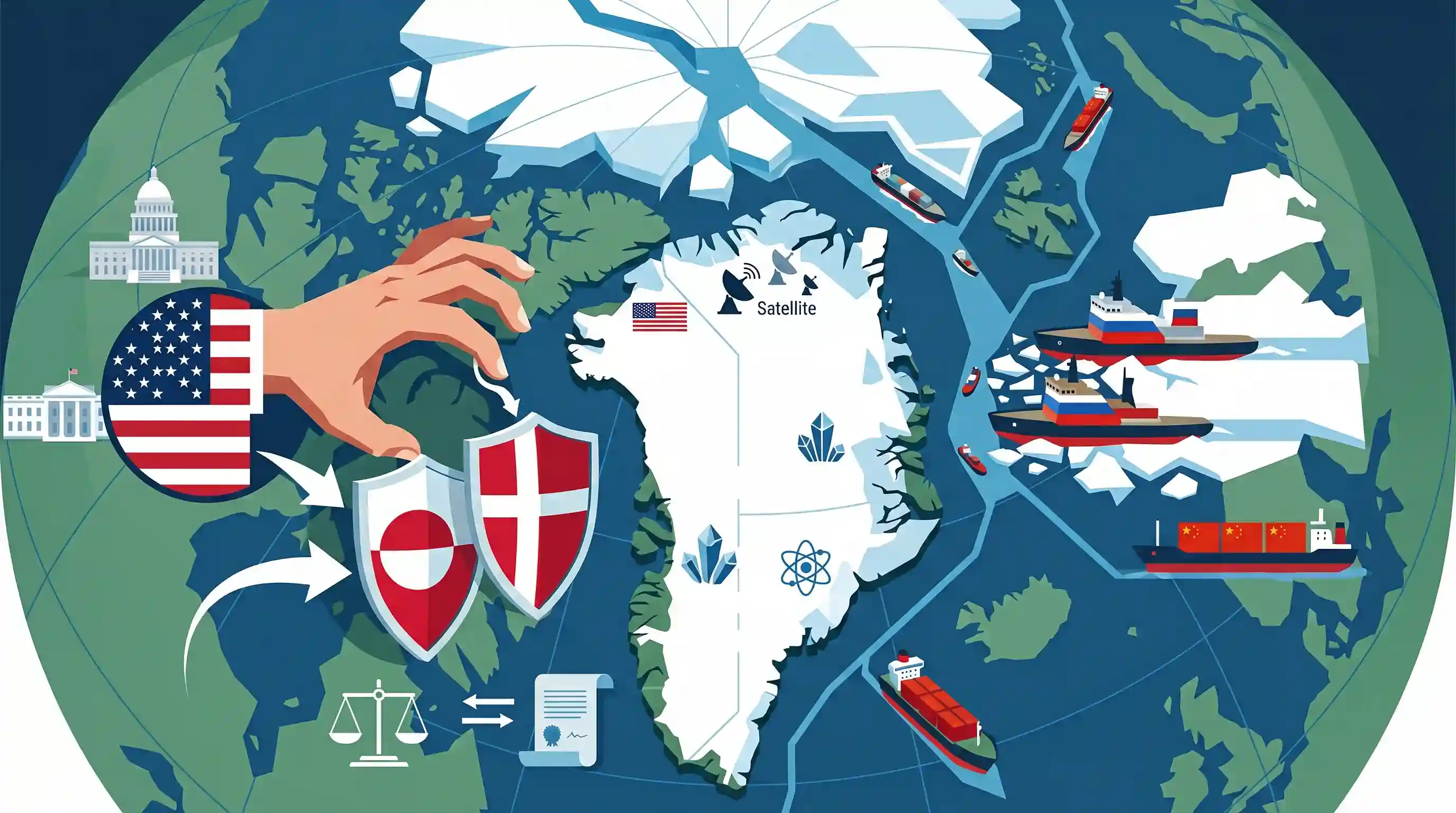
Highlights the shifting global geopolitical focus toward the Arctic region, driven by climate change (melting ice), competition for rare earth minerals, and strategic military posturing between global powers (US, Russia, China). It also raises core IR themes regarding state sovereignty and international law.
सारांश
US President Donald Trump's assertion that the United States needs to acquire Greenland for national security has sparked a diplomatic row with Denmark and the European Union. Emphasizing the territory's strategic importance amid growing Russian and Chinese presence, Trump appointed a special envoy to the island. Denmark and Greenland's leadership swiftly rejected the proposition, citing international law, sovereignty, and territorial integrity. Greenland's geopolitical significance stems from its location in the rapidly melting Arctic, potential new shipping routes, vast reserves of rare earth minerals, and its critical position for missile defense, hosting the US Pituffik military base.
मुख्य बिंदु
- US President Donald Trump stated the US needs Greenland for 'national security' and appointed a special envoy to the autonomous Danish territory, aiming to counter Russian and Chinese influence.
- The move was strongly condemned by Denmark, Greenland, and the European Union as a violation of sovereignty and territorial integrity.
- Greenland holds immense strategic value due to untapped rare earth minerals, emerging shipping routes resulting from melting polar ice, and its proximity to the US and Russia.
- अमेरिका पहले से ही ग्रीनलैंड में पिटुफ़िक (Pituffik) सैन्य अड्डे का संचालन करता है और आर्कटिक में भू-राजनीतिक तथा आर्थिक प्रभुत्व बनाए रखने के लिए इस क्षेत्र को महत्वपूर्ण मानता है।
महत्वपूर्ण शब्द
Sovereignty

The supreme authority of a state over its territory and domestic affairs, ensuring freedom from external interference. It is a core principle of the UN Charter (Article 2).
UPSC context
GS-II: Important for topics on Statehood, Territorial Integrity, and International Relations (UN Charter principles).
NATO
An intergovernmental military alliance of 32 member states. It operates on the principle of collective defense (Article 5), where an attack against one is an attack against all.
UPSC context
GS-II: International Institutions; crucial for understanding India’s strategic environment and global security architectures.
Rare Earth Minerals
A group of 17 chemical elements (e.g., Neodymium, Dysprosium) vital for high-tech products, clean energy, and defense systems. Greenland holds some of the world's largest untapped reserves.
UPSC context
GS-I: Geography (Resources); GS-III: Economy and Science (Supply chain security and critical technology).
अंतरराष्ट्रीय कानून
The legal framework governing relations between states, including the UN Charter (prohibiting the use of force) and UNCLOS (governing maritime rights and shipping routes).
UPSC context
GS-II: International Treaties and Agreements; tests knowledge of the rules-based global order.
Pituffik Space Base
The northernmost U.S. military installation (formerly Thule Air Base). It is essential for global missile warning, space surveillance, and monitoring the strategic GIUK maritime gap.
UPSC context
GS-III: Internal and Global Security; tests awareness of strategic geographical locations and defense infrastructure.
यूरोपीय संघ (EU)
A political and economic union of 27 European countries. Denmark is a member, while Greenland is associated as an Overseas Country and Territory (OCT).
UPSC context
GS-II: Regional Groupings; important for India-EU relations and global trade policy.
Arctic Council
The leading intergovernmental forum promoting cooperation among Arctic states (including USA, Russia, and Denmark/Greenland) on environmental protection and sustainable development.
UPSC context
GS-II: Global Groupings; relevant for India’s Arctic Policy and climate change diplomacy.
प्रारंभिक ट्रैप
ग्रीनलैंड एक पूर्णतः संप्रभु स्वतंत्र राष्ट्र है और आर्कटिक काउंसिल में सीधे तौर पर एक सीट रखता है।
भौगोलिक रूप से उत्तरी अमेरिका में स्थित, ग्रीनलैंड राजनीतिक रूप से डेनमार्क का एक स्वायत्त क्षेत्र है। डेनमार्क इसके विदेशी/सुरक्षा मामलों को संभालता है और आर्कटिक काउंसिल (Arctic Council) में इसकी सीट रखता है।
संबंधित अवधारणाएँ
आर्कटिक काउंसिल क्या है और इसके स्थायी सदस्य देश कौन हैं?
- Origin: Established by the 1996 Ottawa Declaration as a high-level intergovernmental forum.
- Member States: Eight states whose territories lie within the Arctic: Canada, Denmark, Finland, Iceland, Norway, Russia, Sweden, and the US.
- Core Mandate: Focuses on environmental protection and sustainable development in the Arctic. Crucially, its mandate explicitly excludes military security issues.
What makes Rare Earth Elements (REEs) strategically significant?
- Composition: A set of 17 metallic elements (15 lanthanides plus scandium and yttrium) with unique magnetic and electrochemical properties.
- अनुप्रयोग: Essential for modern technology, including electric vehicles, wind turbines, smartphone displays, and defense systems like missile guidance.
- Supply Chain Monopoly: China currently dominates the global extraction and refining of REEs, creating a strategic vulnerability for other global powers.
अंतर-विषय पैटर्न
जलवायु परिवर्तन एवं आर्कटिक समुद्री मार्ग
आर्कटिक की पिघलती बर्फ नॉर्थवेस्ट पैसेज (Northwest Passage) को खोलती है, जो पारंपरिक शिपिंग चोकपॉइंट्स (shipping chokepoints) को दरकिनार करते हुए वैकल्पिक वैश्विक व्यापार मार्ग प्रदान कर जलवायु परिवर्तन को सीधे तौर पर समुद्री भू-राजनीति (maritime geopolitics) से जोड़ती है।
Critical Minerals & Supply Chain Resilience
ग्रीनलैंड के रेयर अर्थ्स (rare earths) में अमेरिका की रुचि, मिनरल सिक्योरिटी पार्टनरशिप (जिसमें भारत 2023 में शामिल हुआ) के उन व्यापक उद्देश्यों को दर्शाती है, जिनका लक्ष्य महत्वपूर्ण खनिज आपूर्ति श्रृंखलाओं को चीन से अलग (decouple) करना है।

Expect a Prelims question mapping Arctic Council membership, Greenland's political status, and the geopolitics of Rare Earth Elements.
संबद्ध PYQ · 4
संबद्ध PYQ · 4
- 2025MainsGS2
"With the waning of globalization, post-Cold War world is becoming a site of sovereign nationalism.” Elucidate.
- 2011MainsGS2
As regards the increasing rates of melting of Arctic Sea ice, the interests of the Arctic Council nations may not coincide with those of the wider world." Explain.
- 2021MainsGS1
How do the melting of the Arctic ice and glaciers of the Antarctic differently affect the weather patterns and human activities on the Earth? Explain.
- 2014MainsGS1
Critically evaluate the various resources of the oceans which can be harnessed to meet the resource crisis in the world.
