Trump Greenland Claims Spark Geopolitical Tension In Arctic Security
Source:The Hindu ↗
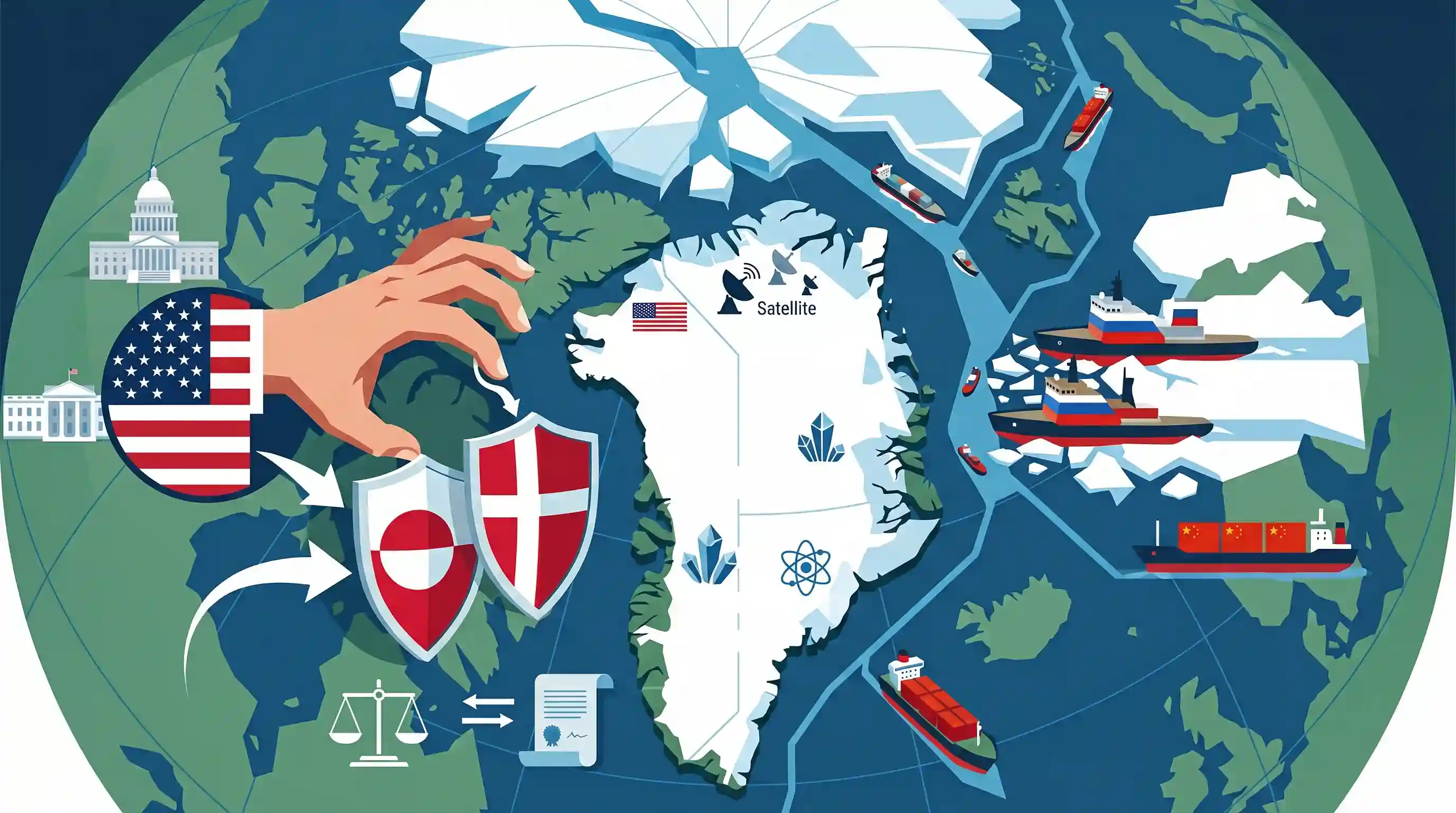
Why It Matters
Highlights the shifting global geopolitical focus toward the Arctic region, driven by climate change (melting ice), competition for rare earth minerals, and strategic military posturing between global powers (US, Russia, China). It also raises core IR themes regarding state sovereignty and international law.
Summary
US President Donald Trump's assertion that the United States needs to acquire Greenland for national security has sparked a diplomatic row with Denmark and the European Union. Emphasizing the territory's strategic importance amid growing Russian and Chinese presence, Trump appointed a special envoy to the island. Denmark and Greenland's leadership swiftly rejected the proposition, citing international law, sovereignty, and territorial integrity. Greenland's geopolitical significance stems from its location in the rapidly melting Arctic, potential new shipping routes, vast reserves of rare earth minerals, and its critical position for missile defense, hosting the US Pituffik military base.
Key Points
- US President Donald Trump stated the US needs Greenland for 'national security' and appointed a special envoy to the autonomous Danish territory, aiming to counter Russian and Chinese influence.
- The move was strongly condemned by Denmark, Greenland, and the European Union as a violation of sovereignty and territorial integrity.
- Greenland holds immense strategic value due to untapped rare earth minerals, emerging shipping routes resulting from melting polar ice, and its proximity to the US and Russia.
- The US already operates the Pituffik military base in Greenland, viewing the territory as crucial for maintaining geopolitical and economic dominance in the Arctic.
Important Terms
Sovereignty

The supreme authority of a state over its territory and domestic affairs, ensuring freedom from external interference. It is a core principle of the UN Charter (Article 2).
UPSC context
GS-II: Important for topics on Statehood, Territorial Integrity, and International Relations (UN Charter principles).
NATO
An intergovernmental military alliance of 32 member states. It operates on the principle of collective defense (Article 5), where an attack against one is an attack against all.
UPSC context
GS-II: International Institutions; crucial for understanding India’s strategic environment and global security architectures.
Rare Earth Minerals
A group of 17 chemical elements (e.g., Neodymium, Dysprosium) vital for high-tech products, clean energy, and defense systems. Greenland holds some of the world's largest untapped reserves.
UPSC context
GS-I: Geography (Resources); GS-III: Economy and Science (Supply chain security and critical technology).
International Law
The legal framework governing relations between states, including the UN Charter (prohibiting the use of force) and UNCLOS (governing maritime rights and shipping routes).
UPSC context
GS-II: International Treaties and Agreements; tests knowledge of the rules-based global order.
Pituffik Space Base
The northernmost U.S. military installation (formerly Thule Air Base). It is essential for global missile warning, space surveillance, and monitoring the strategic GIUK maritime gap.
UPSC context
GS-III: Internal and Global Security; tests awareness of strategic geographical locations and defense infrastructure.
European Union (EU)
A political and economic union of 27 European countries. Denmark is a member, while Greenland is associated as an Overseas Country and Territory (OCT).
UPSC context
GS-II: Regional Groupings; important for India-EU relations and global trade policy.
Arctic Council
The leading intergovernmental forum promoting cooperation among Arctic states (including USA, Russia, and Denmark/Greenland) on environmental protection and sustainable development.
UPSC context
GS-II: Global Groupings; relevant for India’s Arctic Policy and climate change diplomacy.
Prelims Trap
Greenland is a fully sovereign independent nation and holds a direct seat at the Arctic Council.
Geographically in North America, Greenland is politically an autonomous territory of Denmark. Denmark handles its foreign/security affairs and holds its Arctic Council seat.
Static Concepts Connected
What is the Arctic Council and who are its permanent member states?
- Origin: Established by the 1996 Ottawa Declaration as a high-level intergovernmental forum.
- Member States: Eight states whose territories lie within the Arctic: Canada, Denmark, Finland, Iceland, Norway, Russia, Sweden, and the US.
- Core Mandate: Focuses on environmental protection and sustainable development in the Arctic. Crucially, its mandate explicitly excludes military security issues.
What makes Rare Earth Elements (REEs) strategically significant?
- Composition: A set of 17 metallic elements (15 lanthanides plus scandium and yttrium) with unique magnetic and electrochemical properties.
- Applications: Essential for modern technology, including electric vehicles, wind turbines, smartphone displays, and defense systems like missile guidance.
- Supply Chain Monopoly: China currently dominates the global extraction and refining of REEs, creating a strategic vulnerability for other global powers.
Cross-Topic Patterns
Climate change & Arctic maritime routes
Melting Arctic ice opens the Northwest Passage, linking climate change directly to maritime geopolitics by offering alternative global trade routes that bypass traditional shipping chokepoints.
Critical Minerals & Supply Chain Resilience
US interest in Greenland's rare earths mirrors the broader objectives of the Mineral Security Partnership (which India joined in 2023) to decouple critical mineral supply chains from China.

Expect a Prelims question mapping Arctic Council membership, Greenland's political status, and the geopolitics of Rare Earth Elements.
Linked PYQs · 4
Linked PYQs · 4
- 2025MainsGS2
"With the waning of globalization, post-Cold War world is becoming a site of sovereign nationalism.” Elucidate.
- 2011MainsGS2
As regards the increasing rates of melting of Arctic Sea ice, the interests of the Arctic Council nations may not coincide with those of the wider world." Explain.
- 2021MainsGS1
How do the melting of the Arctic ice and glaciers of the Antarctic differently affect the weather patterns and human activities on the Earth? Explain.
- 2014MainsGS1
Critically evaluate the various resources of the oceans which can be harnessed to meet the resource crisis in the world.
