US Iran Standoff Intensifies Over Strait of Hormuz Blockade
Source:The Hindu ↗
Why It Matters
The Strait of Hormuz is the world's most critical oil chokepoint. Its closure, coupled with a direct US-Iran military confrontation, deeply threatens global energy flows. For India, which is highly dependent on West Asian hydrocarbon imports, this crisis directly impacts national energy security, domestic inflation, and strategic interests in the Indian Ocean region.
Summary
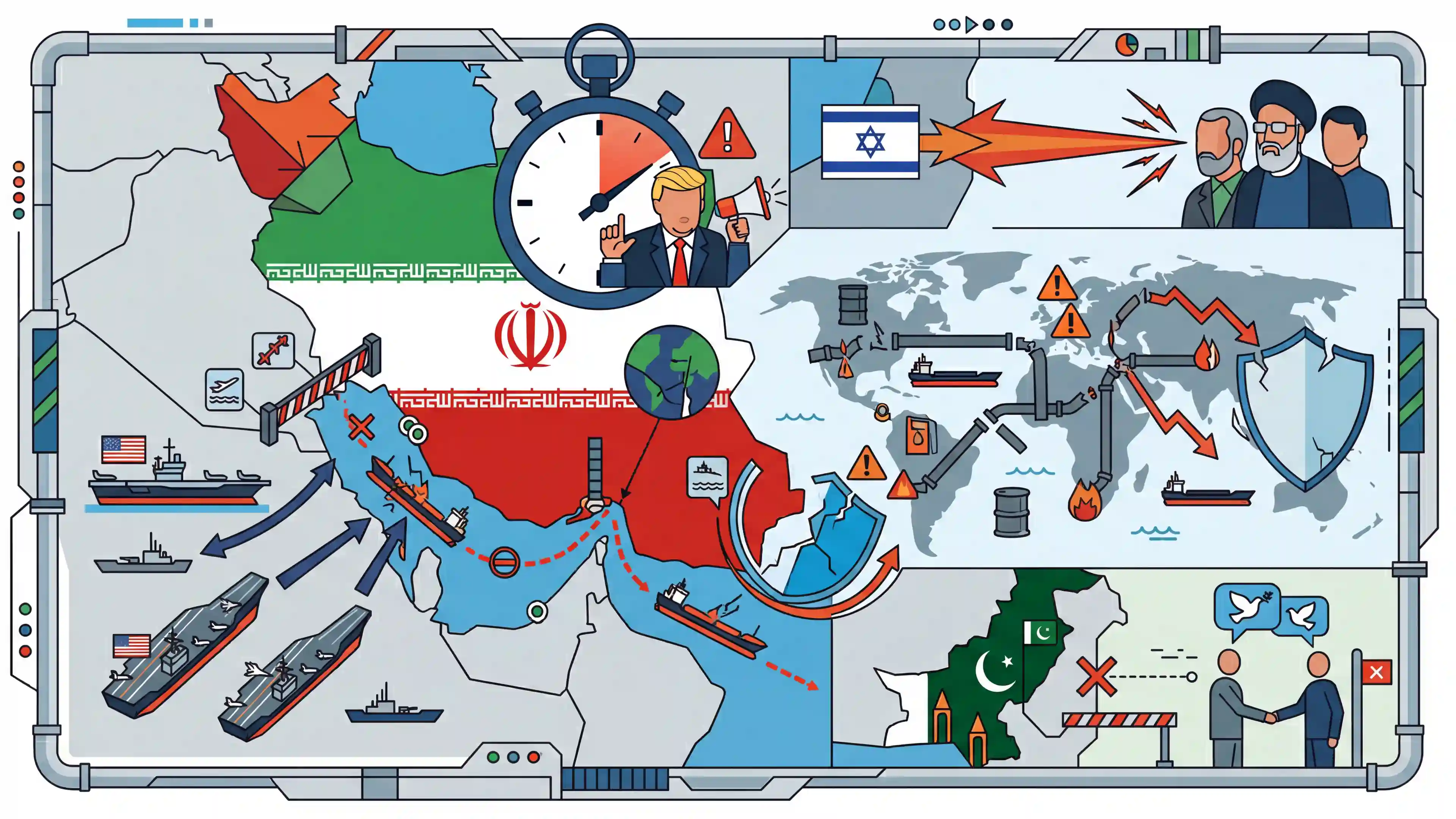
The United States and Iran are locked in a severe military and economic standoff over the closure of the Strait of Hormuz, a vital maritime route for global energy shipments. Following the suspension of normal shipping, the US deployed three aircraft carriers to West Asia and initiated a blockade of Iranian ports, with President Donald Trump warning that the 'clock is ticking' for Iran. Tensions are further complicated by Israeli threats against Iran's new leadership and US interceptions of Iranian oil shipments. The escalating conflict threatens global energy security and supply chains, even as tentative hopes for peace talks in Pakistan remain stalled.
Key Points
- The Strait of Hormuz, a critical chokepoint handling a fifth of global oil and LNG exports, has been effectively closed by Iran in retaliation to the ongoing Middle East conflict.
- In response, the US has deployed three aircraft carriers (including the USS George H.W. Bush) to the region and imposed a blockade on Iranian ports.
- US President Donald Trump stated the 'clock is ticking' for Iran and authorized the US Navy to destroy any Iranian boats found laying mines in the strait.
- Iran claims to have collected its first tolls from ships attempting to cross the Strait, while the US Navy intercepted a stateless vessel transporting Iranian oil in the Indian Ocean.
- Israel's Defense Minister expressed readiness to target Iran's new Supreme Leader, Mojtaba Khamenei, further exacerbating the geopolitical crisis.
- Prospective diplomatic talks between the US and Iran in Islamabad, Pakistan, remain highly uncertain amid the military escalation.
Important Terms
Strait of Hormuz

A strategic maritime chokepoint connecting the Persian Gulf to the Gulf of Oman. It handles roughly 20-30% of global oil and LNG shipments, making it a critical artery for international trade.
UPSC context
GS Paper 1 (Geography) & GS Paper 2 (IR); vital for India's energy security as ~50% of its crude imports transit this route.
CENTCOM (U.S. Central Command)
A unified combatant command of the U.S. Department of Defense responsible for military operations in 21 nations across the Middle East, Central Asia, and parts of South Asia.
UPSC context
GS Paper 2 (IR); relevant for U.S.-India security cooperation (e.g., 2+2 dialogues) and West Asian regional stability.
Islamic Revolutionary Guard Corps (IRGC)
An elite branch of the Iranian Armed Forces established to protect the country's Islamic system. It operates its own navy, army, and aerospace forces, independent of the regular military.
UPSC context
GS Paper 2 (IR); tests understanding of regional power dynamics and non-traditional military actors influencing India's interests in West Asia.
Energy Security
The reliable availability of energy sources at an affordable price. For India, this primarily involves maintaining steady crude oil and LNG imports despite geopolitical disruptions.
UPSC context
GS Paper 3 (Economy/Infrastructure); critical for India due to its ~85% import dependency and the role of Strategic Petroleum Reserves (SPR).
Maritime Blockade
A military operation where a belligerent prevents all vessels (neutral or enemy) from entering or leaving a specified coast or port. It is governed by international laws like the San Remo Manual.
UPSC context
GS Paper 2 (IR/International Law); relevant for understanding the legalities of maritime conflict and freedom of navigation (UNCLOS).
U.S. Fifth Fleet
The U.S. Navy's regional command headquartered in Bahrain. It oversees maritime security in the Persian Gulf, Red Sea, and Arabian Sea, often coordinating with India on anti-piracy operations.
UPSC context
GS Paper 2 (IR/Bilateral Relations); signifies U.S. maritime dominance and security architecture in the Indian Ocean Region (IOR).
Prelims Trap
"Coastal states like Iran have the right to levy tolls or suspend passage through the Strait of Hormuz under UNCLOS."
The Strait of Hormuz operates under a 'transit passage' regime under UNCLOS. Bordering states cannot suspend navigation or arbitrarily levy tolls solely for passage.
Static Concepts Connected
How does 'Transit Passage' differ from 'Innocent Passage' under UNCLOS?
- Transit Passage: Applies specifically to straits used for international navigation. Coastal states cannot suspend this passage, and submarines may navigate submerged.
- Innocent Passage: Applies to territorial waters. Coastal states can temporarily suspend it for security reasons, and submarines must navigate on the surface showing their flag.
How does India buffer against Middle East oil chokepoint disruptions?
- Strategic Petroleum Reserves: Phase I facilities at Visakhapatnam, Mangaluru, and Padur hold ~5.33 MMT of crude oil, managed by Indian Strategic Petroleum Reserves Limited (ISPRL).
- Buffer Capacity: The SPR network provides approximately 9.5 days of crude oil coverage, designed to shield the economy from sudden supply shocks like a Hormuz closure.
Cross-Topic Patterns
Hormuz Blockade + Chabahar Port Viability
U.S. blockades of Iranian ports directly jeopardize India's operations at Shahid Beheshti terminal (Chabahar), testing India's strategic autonomy and the viability of the INSTC to bypass Pakistan.
Multi-front Chokepoint Disruptions
Simultaneous instability in the Red Sea and Strait of Hormuz compounds the maritime supply-chain crisis, forcing vessels to the Cape of Good Hope and inflating India's freight and insurance costs.

Map questions linking the Strait of Hormuz to INSTC/Chabahar and UNCLOS 'transit passage' rules are highly probable in 2026 Prelims.
Linked PYQs · 4
Linked PYQs · 4
- 2025MainsGS2
"Energy security constitutes the dominant kingpin of India's foreign policy, and is linked with India's overarching influence in Middle Eastern countries.” How would you integrate energy security with India's foreign policy trajectories in the coming years?
- 2018MainsGS2
In what ways would the ongoing US-Iran Nuclear Pact Controversy affect the national interest of India? How should India respond to this situation?
- 2017MainsGS2
The question of India's Energy Security constitutes the most important part of India's economic progress. Analyze India's energy policy cooperation with West Asian countries.
- 2024MainsGS2
Discuss the geopolitical and geostrategic importance of Maldives for India with a focus on global trade and energy flows. Further also discuss how this relationship affects India's maritime security and regional stability amidst international competition ?
