Escalating US China tariff retaliations test global economic stability
Source:The Hindu ↗
Why It Matters
This development is highly relevant for the UPSC syllabus as it highlights the implications of deglobalization and protectionism on the global economic order. It provides a real-world case study of how the US-China trade war affects multilateralism (WTO), impacts India's macroeconomic stability and trade diplomacy, and influences global financial markets (inflation, currency, bond yields).
Summary
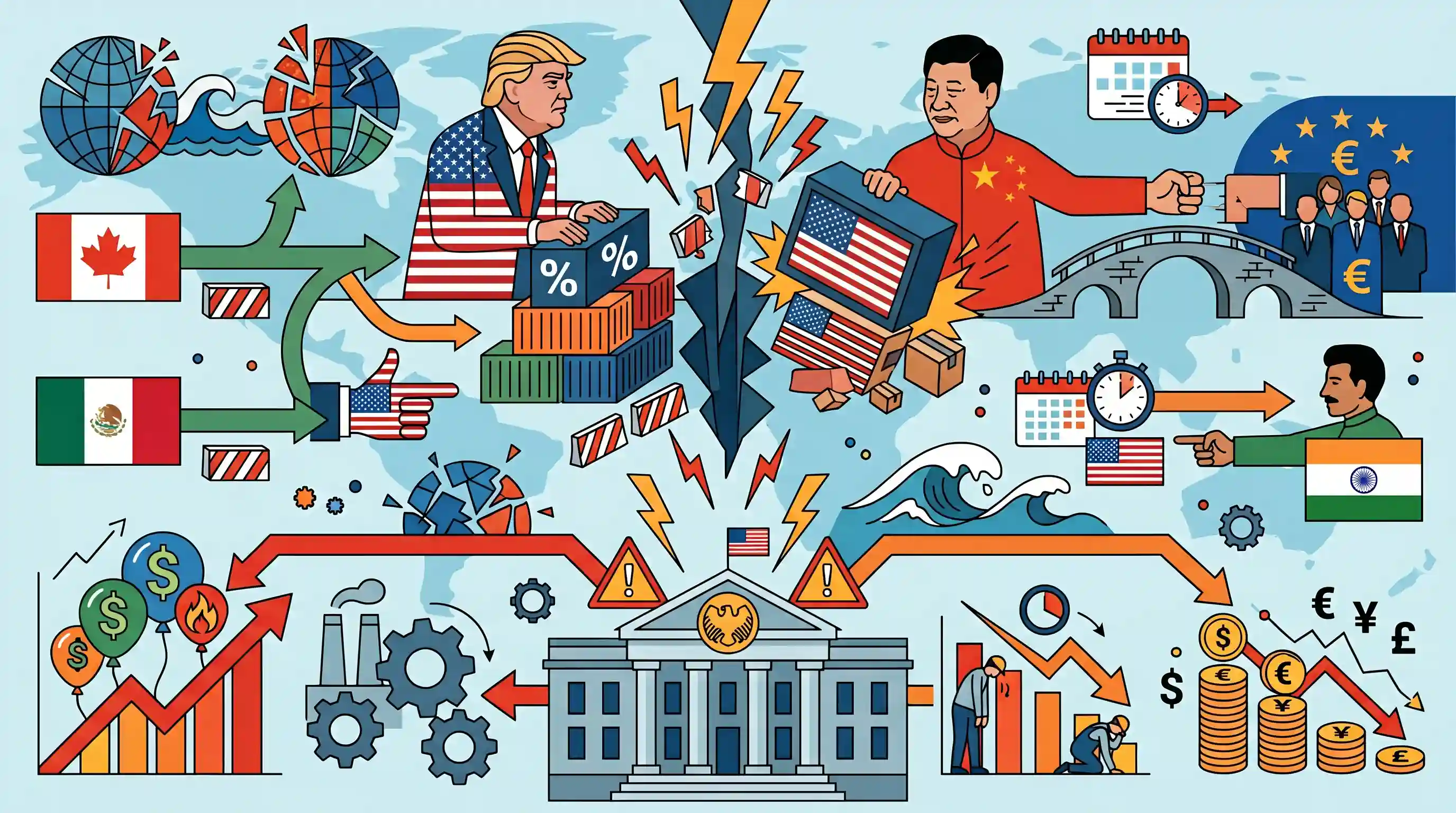
The article highlights the intensifying trade conflict between the US and China. Following strict US tariff measures, China retaliated with a 125% tariff on US goods. US President Donald Trump defended his tariff strategy, while the US temporarily reduced tariffs on allies like Canada and Mexico. In response, Chinese President Xi Jinping called on the European Union to collaborate against "unilateral bullying." Amidst this geopolitical tension, India is seeking a rapid trade agreement with the US during the 90-day tariff pause. However, the US Federal Reserve cautioned that protectionist policies could trigger global inflation, slow economic growth, and adversely affect currency and bond markets.
Key Points
- The trade war between the US and China has escalated, with China imposing retaliatory 125% tariffs on US imports following US protectionist measures.
- The US has temporarily reduced tariffs on Canada and Mexico to 10% for 90 days but has maintained its strict tariff regime against China.
- Chinese President Xi Jinping has urged the EU to jointly resist "unilateral bullying" and protectionism.
- India is actively pursuing a quick trade deal with the US, looking to capitalize on the 90-day tariff suspension window.
- The US Federal Reserve has warned that reciprocal tariffs could lead to higher inflation and slower global economic growth, which has already caused a drop in the US dollar and bond yields.
Important Terms
World Trade Organization (WTO)

An international organization regulating global trade. It provides a forum for negotiating trade agreements and a legal mechanism for resolving disputes among its 164 member nations.
UPSC context
GS Paper II (International Institutions). Tests knowledge of rule-based global order, dispute settlement, and impacts on developing economies like India.
Protectionism
The economic policy of restraining trade through tariffs, quotas, and subsidies to shield domestic industries from foreign competition and safeguard local jobs.
UPSC context
GS Paper III (Economy). Relevant for themes of globalization, trade wars, and the balance between 'Make in India' and free trade.
Federal Reserve (Fed)
The central bank of the United States. Its monetary policy decisions, particularly interest rate changes, significantly influence global capital flows and currency valuations.
UPSC context
GS Paper III (Economy). Tests understanding of global macro-economic linkages, specifically how US interest rates affect FPI flows and the Indian Rupee.
Tariff
A tax or duty imposed by a government on imported goods or services. It increases the cost to consumers, making domestic products more competitive.
UPSC context
GS Paper III (Economy). Fundamental for trade policy analysis, inflation tracking, and understanding fiscal tools used in international trade conflicts.
Unilateralism
An international actor’s strategy of taking independent action in foreign policy without seeking consensus or cooperation from other nations or multilateral organizations.
UPSC context
GS Paper II (International Relations). Pertains to the shift from multilateralism to a power-based global order and its impact on Indian strategic autonomy.
European Union (EU)
A unique supranational political and economic union of 27 European member states that operates an internal single market through a standardized system of laws.
UPSC context
GS Paper II (International Relations). Focuses on India-EU bilateral ties, free trade agreement (FTA) negotiations, and the EU's role as a global normative power.
Prelims Trap
The WTO's MFN principle strictly prohibits the US from selectively reducing tariffs for neighboring allies like Canada and Mexico.
GATT Article XXIV explicitly exempts Regional Trade Agreements (RTAs) and Free Trade Agreements (FTAs) from the MFN rule, allowing preferential lower tariffs for partners like Canada and Mexico.
Static Concepts Connected
What are the primary trade remedy measures permitted under the WTO?
- Anti-Dumping Duties: Imposed when a foreign company exports a product at a price lower than its normal home market value, causing injury to domestic industry.
- Countervailing Duties: Tariffs levied by an importing country to offset massive subsidies given by a foreign government to its exporters.
- Safeguard Measures: Temporary restrictions, such as tariffs or quotas, used to protect a specific domestic industry from an unforeseen, sudden surge in imports.
What is the Most-Favoured-Nation (MFN) principle and what are its key exceptions?
- MFN Rule: A core WTO rule requiring members to apply the same tariff rate and trade conditions equally to all other WTO members without discrimination.
- RTA Exception: Countries can establish Free Trade Agreements (FTAs) or Customs Unions that grant preferential, lower tariffs exclusively to member nations.
- Developing Nations Exception: Developed countries can provide special, non-reciprocal market access and lower tariffs to developing nations (e.g., Generalized System of Preferences).
Cross-Topic Patterns
Tariff Wars and Imported Inflation
Trade barriers disrupt supply chains and raise import costs, forcing central banks like the Fed or RBI to maintain hawkish interest rates to curb imported inflation, threatening global growth.
China's "Wedge Strategy" in Europe
China leverages US unilateral tariffs to draw the EU closer, testing Europe's quest for "strategic autonomy" and its complex balancing act between the US security umbrella and Chinese economic markets.
Strategic Opportunism via Bilateral FTAs
While major powers engage in punitive trade wars, emerging middle powers like India use the geopolitical friction as strategic leverage to negotiate rapid, favorable bilateral trade pacts.

Expect a 2026 Prelims multi-statement question linking WTO MFN exceptions (Article XXIV), retaliatory tariffs, and imported inflation.
Linked PYQs · 4
Linked PYQs · 4
- 2018MainsGS3
How would the recent phenomena of protectionism and currency manipulations in world trade affect macroeconomic stability of India?
- 2018MainsGS2
What are the key areas of reform if the WTO has to survive in the present context of "Trade War', especially keeping in mind the interest of India?
- 2025MainsGS2
"With the waning of globalization, post-Cold War world is becoming a site of sovereign nationalism.” Elucidate.
- 2021MainsGS2
“The USA is facing an existential threat in the form of a China, that is much more challenging than the erstwhile Soviet Union.” Explain.
