Extraterritorial Sanctions and Energy Geopolitics in Latin America
Source:The Hindu ↗
Why It Matters
The article serves as a prime example of how superpowers utilize economic tools, such as tariffs and extraterritorial (secondary) sanctions, to enforce foreign policy objectives globally. For UPSC aspirants, this illustrates the challenges sovereign nations face against unilateral protectionist measures and economic blockades, which is highly relevant for GS Paper 2 (International Relations).
Summary
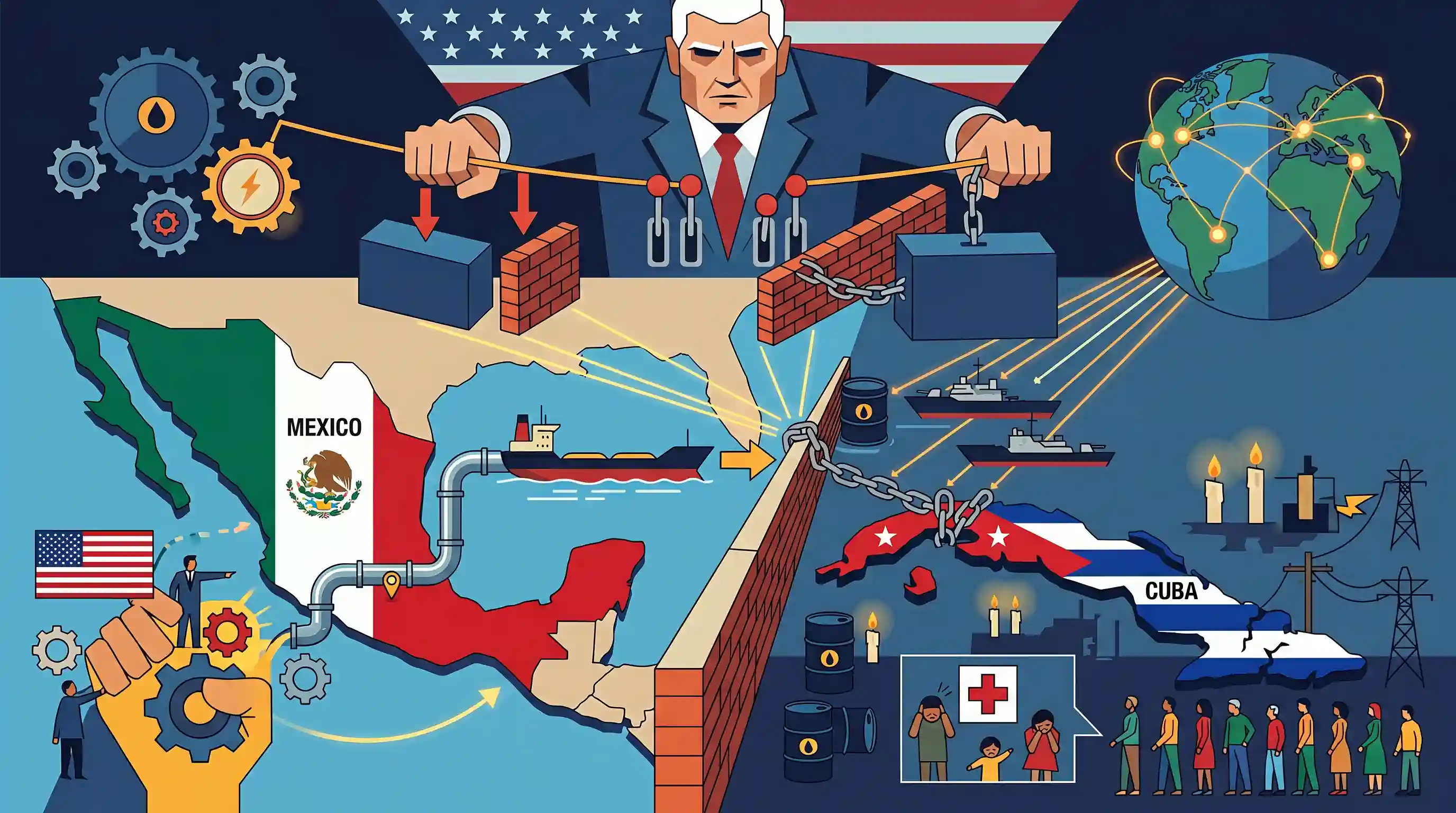
U.S. President Donald Trump has asserted that Mexico will halt its oil shipments to Cuba amid a U.S. pressure campaign threatening tariffs on any nation supplying oil to the island. Cuba, heavily reliant on Mexican oil, faces acute energy shortages exacerbated by an economic crisis and long-standing U.S. sanctions. This development highlights the geopolitical use of secondary sanctions, protectionist trade policies, and economic blockades, impacting the sovereign bilateral relations of third-party nations (Mexico and Cuba) and raising significant humanitarian concerns.
Key Points
- U.S. President Donald Trump announced that Mexico will cease sending oil to Cuba due to a U.S. pressure campaign that threatens tariffs on exports from any nation supplying oil to the island.
- Cuba is experiencing a severe energy crisis and widespread blackouts, heavily relying on Mexico as its single-largest supplier of fuel amid an economic downturn and existing U.S. sanctions.
- The U.S. has designated Cuba an "unusual and extraordinary threat" to its national security, a move following heightened tensions over the U.S. capture of Venezuelan leader Nicolas Maduro.
- Mexican President Claudia Sheinbaum previously stated that Mexico's oil shipments to Cuba were for humanitarian reasons, highlighting a clash between sovereign diplomatic initiatives and U.S. secondary sanctions.
- The situation demonstrates the extraterritorial application of U.S. trade policy and tariffs to enforce economic blockades and influence the bilateral relations of third-party countries.
Important Terms
Secondary Sanctions

Punitive measures targeting third-party nations or entities to prevent them from trading with a country already under primary sanctions, effectively using market access as leverage.
UPSC context
GS Paper II (International Relations); tests understanding of global power dynamics and challenges to India's strategic autonomy (e.g., CAATSA).
Extraterritorial Jurisdiction
The legal exercise of a country’s authority beyond its national borders, typically by applying domestic laws to foreign citizens or companies for actions taken abroad.
UPSC context
GS Paper II (International Relations); relevant to sovereignty, international law, and the legal basis of unilateral U.S. sanctions.
Economic Blockade
A coercive measure designed to isolate a nation by cutting off its trade, supplies, or communications, often to force political change or regime collapse.
UPSC context
GS Paper II (International Relations); covers humanitarian consequences of unilateral coercive measures and international legal violations.
Energy Security
The reliable and affordable availability of energy sources, often treated as a core element of national security and a tool in geopolitical negotiations.
UPSC context
GS Paper III (Economy/Energy) and II (IR); critical for India's high import dependency and West Asian diplomacy.
Trade Protectionism
Economic policies that restrict international trade through tariffs or regulations to protect domestic industries or exert political pressure on other nations.
UPSC context
GS Paper III (Indian Economy) and II (IR); tests knowledge of trade wars and the weaponization of economic policy.
Strategic Autonomy
The ability of a nation to pursue its national interests and foreign policy independently, without being coerced by other states' unilateral measures or alliances.
UPSC context
GS Paper II (International Relations); central theme in Indian foreign policy regarding relations with the U.S., Russia, and Iran.
Prelims Trap
U.S. secondary sanctions on Cuba are legally backed and enforced by United Nations Security Council (UNSC) resolutions.
The US blockade on Cuba is a unilateral extraterritorial measure. The UN General Assembly actually votes overwhelmingly every year to condemn this specific US embargo, lacking any UNSC backing.
Static Concepts Connected
What distinguishes primary from secondary unilateral sanctions?
- Primary Sanctions: Restrict entities within the sanctioning country from engaging in trade, investment, or financial transactions with the targeted nation.
- Secondary Sanctions: Coercive measures penalizing third-party countries or foreign entities for trading with the target, leveraging access to the sanctioner's financial markets.
- Extraterritoriality: Applying a nation's domestic laws globally. Under international law, this is widely considered an infringement on third-party state sovereignty.
How do nations legally counter extraterritorial secondary sanctions?
- Blocking Statutes: Legal frameworks (like the EU's Regulation 2271/96) that proactively shield domestic companies from complying with a third country’s extraterritorial sanctions.
- Non-recognition: Such statutes nullify foreign court rulings based on unilateral sanctions and explicitly prohibit domestic firms from obeying the foreign embargo.
- Alternative Mechanisms: Countries also utilize Special Purpose Vehicles (e.g., INSTEX), currency swaps, and local-currency trade to bypass the weaponized dollar-clearing system.
Cross-Topic Patterns
Secondary Sanctions & Rupee Vostro Accounts
India's push for INR trade settlement and Vostro accounts historically connects to bypassing secondary sanctions, mirroring the struggle of targeted nations against weaponized global financial systems.
Weaponisation of Trade & Strategic Autonomy
The use of punitive tariffs to dictate a third-party's (Mexico) foreign policy highlights the erosion of WTO norms, posing a direct challenge to the strategic autonomy of developing nations.

Expect a multi-statement question contrasting UN-mandated sanctions with unilateral extraterritorial laws like CAATSA or Helms-Burton Act.
Linked PYQs · 3
Linked PYQs · 3
- 2012MainsGS2
How have the US sanctions against Iran affected India's bilateral relations with Iran?
- 2025MainsGS2
"Energy security constitutes the dominant kingpin of India's foreign policy, and is linked with India's overarching influence in Middle Eastern countries.” How would you integrate energy security with India's foreign policy trajectories in the coming years?
- 2012MainsGS2
Discuss the likely negative impact of the protectionist measures proposed by the US on India's software industry.
