Iran Nuclear Program Escalation and Middle East Security Risks
Source:The Hindu ↗
Why It Matters
The escalation of military threats and sanctions surrounding Iran's nuclear program poses severe risks to Middle Eastern stability. For India, a conflict involving major regional players like Israel and Iran could disrupt global energy supplies, impact the diaspora, and complicate its delicate balancing act in West Asian diplomacy.
Summary
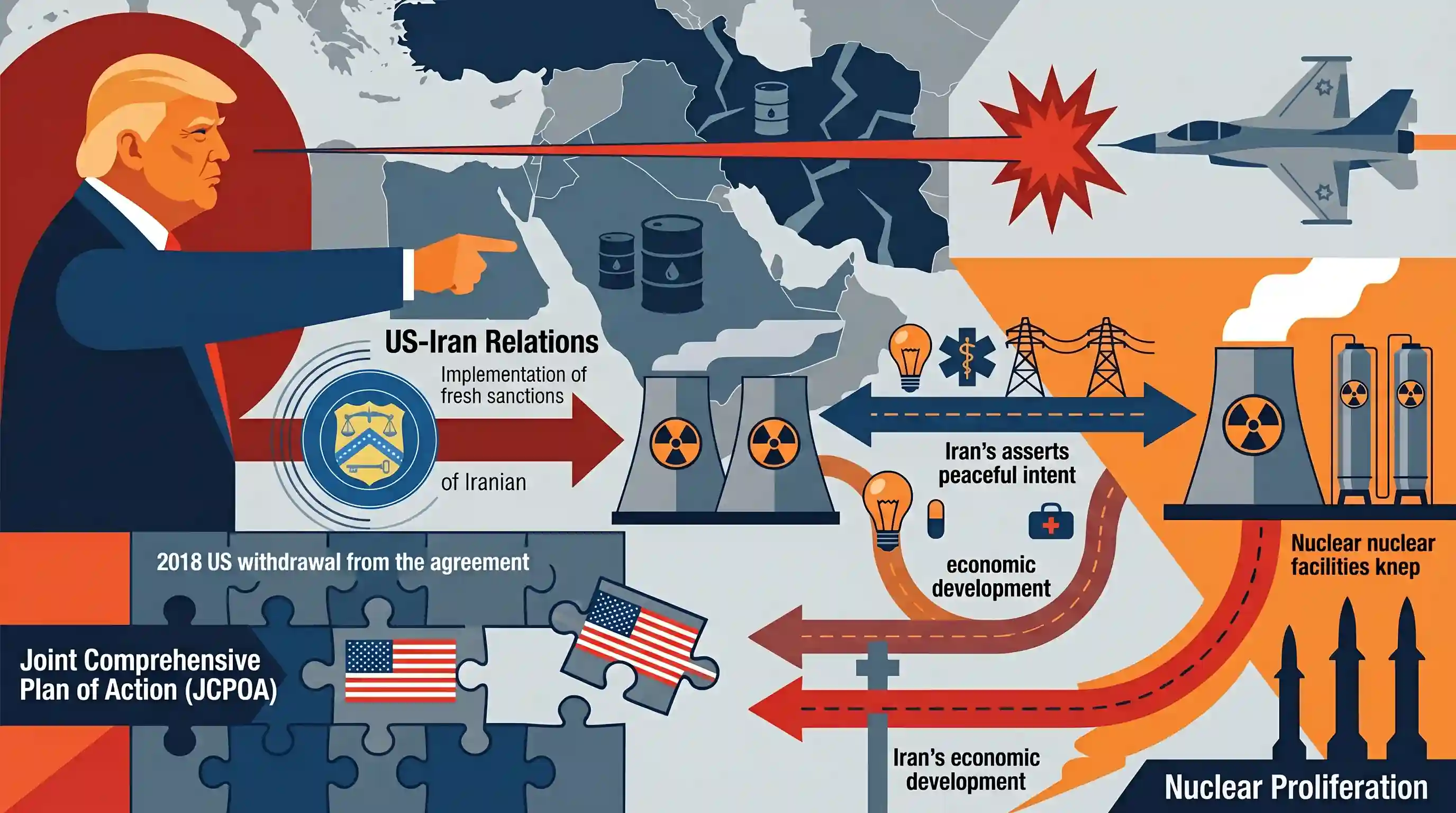
Donald Trump has warned that Israel would lead a potential military strike against Iran if Tehran does not dismantle its nuclear weapons program. These remarks coincide with fresh US Treasury sanctions targeting key Iranian nuclear organizations. The ongoing geopolitical friction is rooted in the 2018 US withdrawal from the JCPOA, although Iranian leadership continues to assert that their nuclear ambitions are strictly peaceful and focused on economic development.
Key Points
- Former US President Donald Trump stated that Israel would spearhead a military strike on Iran if Tehran refuses to abandon its nuclear weapons program.
- The US Treasury recently imposed new sanctions on several entities linked to Iran's nuclear infrastructure, including the Atomic Energy Organization of Iran.
- Current tensions are heavily influenced by the 2018 US withdrawal from the Joint Comprehensive Plan of Action (JCPOA), which had previously curtailed Iran's nuclear activities.
- Iranian President Masoud Pezeshkian reiterated that Iran's nuclear program is for peaceful purposes and denied any intention of developing a nuclear bomb.
Important Terms
Joint Comprehensive Plan of Action (JCPOA)

A 2015 multilateral agreement (P5+1) to limit Iran's nuclear program in exchange for sanctions relief. The US's 2018 withdrawal remains a central driver of current Middle East tensions.
UPSC context
GS-II: International Relations. Tests understanding of nuclear diplomacy and the impact of Western policies on regional stability and India’s energy security.
International Atomic Energy Agency (IAEA)
The autonomous UN-linked body (est. 1957) that promotes peaceful nuclear technology and conducts inspections to ensure compliance with non-proliferation treaties. India is a founding member.
UPSC context
GS-II: Important International Institutions. Focuses on global governance, nuclear safeguards, and India's specific safeguards agreements.
Atomic Energy Organization of Iran (AEOI)
The primary Iranian government body responsible for nuclear research, fuel cycle operations, and infrastructure. It is the main target of international sanctions regarding Iran's enrichment activities.
UPSC context
GS-II: Bilateral relations and Middle East geopolitics. Relevant for understanding the technical entities involved in nuclear proliferation disputes.
Iran Centrifuge Technology Company (TESA)
A subsidiary of AEOI that manufactures components for uranium enrichment centrifuges. It is frequently sanctioned by the US for its role in Iran's proliferation-sensitive nuclear activities.
UPSC context
GS-II/III: Security and International Relations. Illustrates how specific technological entities are targeted to curb WMD proliferation through economic statecraft.
US Treasury (Sanctions)
Specifically via its Office of Foreign Assets Control (OFAC), it implements US economic sanctions to achieve foreign policy goals, such as blocking financial access for nuclear proliferators.
UPSC context
GS-III: Security challenges. Tests knowledge of 'economic warfare' and the global impact of unilateral sanctions on trade and diplomacy.
Prelims Trap
"India was a signatory to the original Joint Comprehensive Plan of Action (JCPOA)."
The JCPOA was negotiated exclusively between Iran, the P5+1 (US, UK, France, Russia, China, Germany), and the EU. India is heavily impacted but is not a party.
Static Concepts Connected
What is the significance of the IAEA 'Additional Protocol'?
- Intrusive inspections: Grants IAEA inspectors broader, short-notice access to all parts of a state's nuclear fuel cycle, including undeclared sites.
- Civilian verification: Ensures that a nation's nuclear materials are not being clandestinely diverted toward military weapons development.
- India's status: India signed an 'India-specific' Additional Protocol in 2009, covering only its civilian facilities under IAEA safeguards.
How do US secondary sanctions on Iran impact India?
- Energy security: The threat of US CAATSA sanctions forced India to drastically cut its once-robust, cheap crude oil imports from Iran.
- Strategic connectivity: Sanctions deter global logistics and crane companies from supplying heavy equipment for India's strategic Chabahar Port project.
Cross-Topic Patterns
Energy security + Imported inflation
Military escalation involving Iran threatens maritime chokepoints like the Strait of Hormuz, directly impacting India's 85% crude import reliance and risking macroeconomic inflation.
Chabahar Port + INSTC connectivity
US sanctions on Iran's economy repeatedly stall India's strategic connectivity ambitions via Chabahar, which serves as India's gateway to Central Asia bypassing Pakistan.

Expect a 2026 Prelims question mixing the IAEA's 'Additional Protocol' mandate with Middle East maritime chokepoints (Strait of Hormuz).
Linked PYQs · 4
Linked PYQs · 4
- 2018PrelimsGS1
In the Indian context, what is the implication of ratifying the 'Additional Protocol' with the 'International Atomic Energy Agency (IAEA)'?
- 2020PrelimsGS1
In India, why are some nuclear reactors kept under "IAEA Safeguards" while others are not?
- 2023PrelimsGS1
Consider the following statements: Statement-I: India, despite having uranium deposits, depends on coal for most of its electricity production. Statement-II: Uranium, enriched to the extent of at least 60%, is required for the production of electricity. Which one of the following is correct in respect of the above statements?
- 2018MainsGS2
“India’s relations with Israel have, of late, acquired a depth and diversity, which cannot be rolled back.” Discuss.
