Israel and Iran Agree to Complete Ceasefire Mediated by Qatar
Source:The Hindu ↗
Why It Matters
Direct military engagement between the US and Iran over nuclear facilities marks a significant escalation in West Asian geopolitics. For UPSC aspirants, understanding the strategic dynamics, the role of international mediators like Qatar, and the implications for global energy security and nuclear non-proliferation is crucial for International Relations (GS Paper 2).
Summary
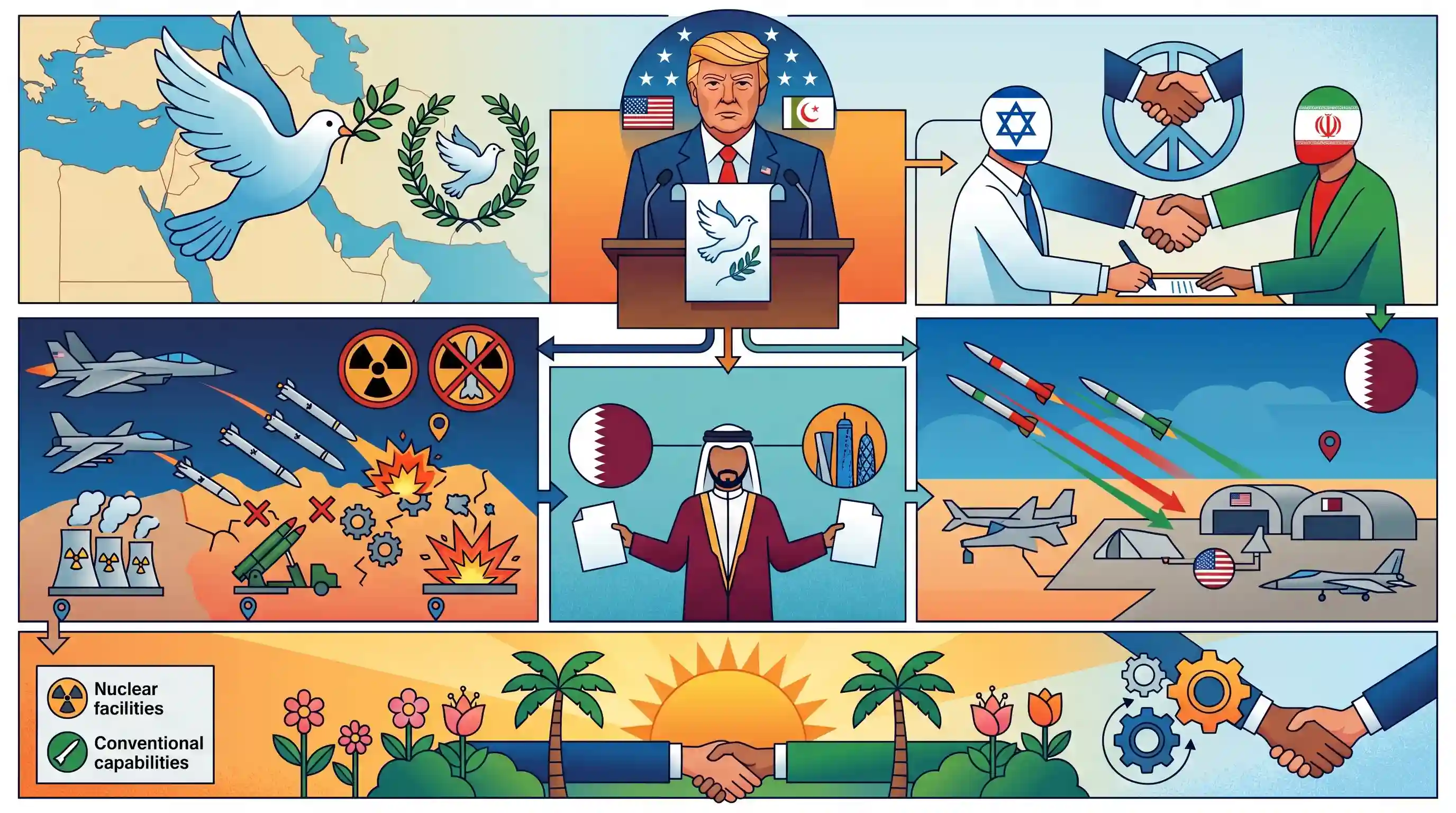
U.S. President Donald Trump has announced a 'total and complete ceasefire' between Israel and Iran, officially ending a '12-day war' that involved direct military confrontation between Washington and Tehran. The agreement, proposed by the U.S. and mediated by Qatar, followed a major escalation where the U.S. launched airstrikes on Iranian nuclear facilities in Fordow, Natanz, and Isfahan. Iran retaliated with missile strikes on the American al-Udeid air base in Qatar. U.S. officials claim the strikes successfully incapacitated Iran's nuclear and conventional missile capabilities, framing the ceasefire as a critical reset for peace and stability in the Middle East.
Key Points
- US President Donald Trump announced a 'total and complete ceasefire' between Israel and Iran, ending a conflict he termed the '12-day war'.
- The ceasefire, proposed by the US, was successfully mediated by Qatar, highlighting Doha's growing diplomatic role in the Middle East.
- The escalation involved US military strikes using B2 bombers and Tomahawk missiles on Iranian nuclear facilities at Fordow, Natanz, and Isfahan.
- Iran retaliated by launching missiles at the al-Udeid military base in Qatar, which houses approximately 10,000 American soldiers, though no casualties were reported.
- US Vice-President J.D. Vance stated the strikes effectively destroyed Iran's nuclear program and conventional missile capabilities, marking a major reset for regional security without explicitly seeking regime change.
Important Terms
International Atomic Energy Agency (IAEA)

An autonomous international organization established in 1957 to promote the peaceful use of nuclear energy and prevent its military misuse through a system of safeguards and inspections.
UPSC context
GS Paper 2 (International Institutions). Tests knowledge of global governance bodies and their role in maintaining international security and nuclear non-proliferation.
Nuclear Proliferation
The spread of nuclear weapons, fissionable material, and weapon-applicable nuclear technology and information to nations which are not recognized as "Nuclear Weapon States" under the Non-Proliferation Treaty.
UPSC context
GS Paper 2 & 3. Critical for understanding global arms control treaties and India's strategic nuclear policy in a volatile neighborhood.
Al-Udeid Air Base
A strategic military facility in Qatar serving as the forward headquarters of the U.S. Central Command (CENTCOM) and the largest U.S. airbase in the Middle East.
UPSC context
GS Paper 2 (International Relations). Relevant for understanding the U.S. military footprint in West Asia and its impact on regional security.
West Asia Geopolitics
The study of political and strategic relationships in the Middle East, characterized by energy security, sectarian rivalries, and the influence of global powers like the U.S. and Russia.
UPSC context
GS Paper 2. Vital for analyzing regional stability and India's "Connect West" policy, affecting energy security and diaspora interests.
Fordow and Natanz
Primary Iranian nuclear facilities; Natanz serves as the main uranium enrichment site, while Fordow is a highly fortified underground enrichment plant located near Qom.
UPSC context
GS Paper 2 & Prelims (Places in news). Important for tracking regional security threats and diplomatic developments related to Iranian nuclear enrichment.
Mediation
A diplomatic tool where a neutral third party, such as Qatar, facilitates negotiations between conflicting parties to reach a mutually acceptable agreement or ceasefire.
UPSC context
GS Paper 2. Tests understanding of diplomatic instruments and the role of "middle powers" in resolving complex regional conflicts.
Prelims Trap
Al-Udeid airbase, the largest US military base in West Asia, is located in Saudi Arabia.
UPSC frequently swaps geographic locations of strategic bases to confuse candidates. Al-Udeid is located in Qatar, not Saudi Arabia or the UAE.
Static Concepts Connected
Where are Iran's key nuclear facilities located?
- Natanz: Located in central Iran, it is the country's primary and most well-known uranium enrichment facility.
- Fordow: A heavily fortified underground uranium enrichment plant situated near the holy city of Qom.
- Isfahan: Serves as the central hub for uranium conversion, turning yellowcake into uranium hexafluoride (UF6) gas for enrichment.
What is the IAEA Additional Protocol?
- Expanded Mandate: A voluntary agreement granting the IAEA expanded rights to access information and locations to verify that all nuclear material is for peaceful use.
- Intrusive Inspections: It allows inspectors to conduct short-notice, 'snap' inspections of both declared and undeclared nuclear facilities.
- India's Status: India signed a customized version of the Additional Protocol in 2009 as a byproduct of the Indo-US nuclear deal.
Cross-Topic Patterns
Strait of Hormuz & India's CAD
Conflict involving Iran directly threatens the Strait of Hormuz chokepoint. This risks a sudden spike in crude/LNG prices, widening India's Current Account Deficit and threatening Gulf diaspora remittances.
Qatar's Geopolitical Hedging Strategy
Qatar showcases small-state 'strategic hedging' by hosting the US CENTCOM at Al-Udeid while simultaneously acting as the primary mediator for US adversaries like Iran, Hamas, and the Taliban.

Map-based pairing of West Asian bases (Al-Udeid) and Iran's nuclear sites (Natanz, Fordow) alongside IAEA protocols is highly likely.
Linked PYQs · 3
Linked PYQs · 3
- 2018MainsGS2
“India’s relations with Israel have, of late, acquired a depth and diversity, which cannot be rolled back.” Discuss.
- 2018PrelimsGS1
In the Indian context, what is the implication of ratifying the 'Additional Protocol' with the 'International Atomic Energy Agency (IAEA)'?
- 2020PrelimsGS1
In India, why are some nuclear reactors kept under "IAEA Safeguards" while others are not?
