US Iran Ceasefire Ends Following Maritime Clashes
Source:The Hindu ↗
Why It Matters
The Strait of Hormuz is the world's most critical maritime oil transit chokepoint. Escalating conflicts and the collapse of U.S.-Iran understandings directly impact global oil volatility, directly threatening India's energy security, crude imports, and inflationary balance. It also demands tricky diplomatic maneuvering from India given its bilateral ties with Iran (e.g., Chabahar Port), Arab Gulf partners, and the United States.
Summary
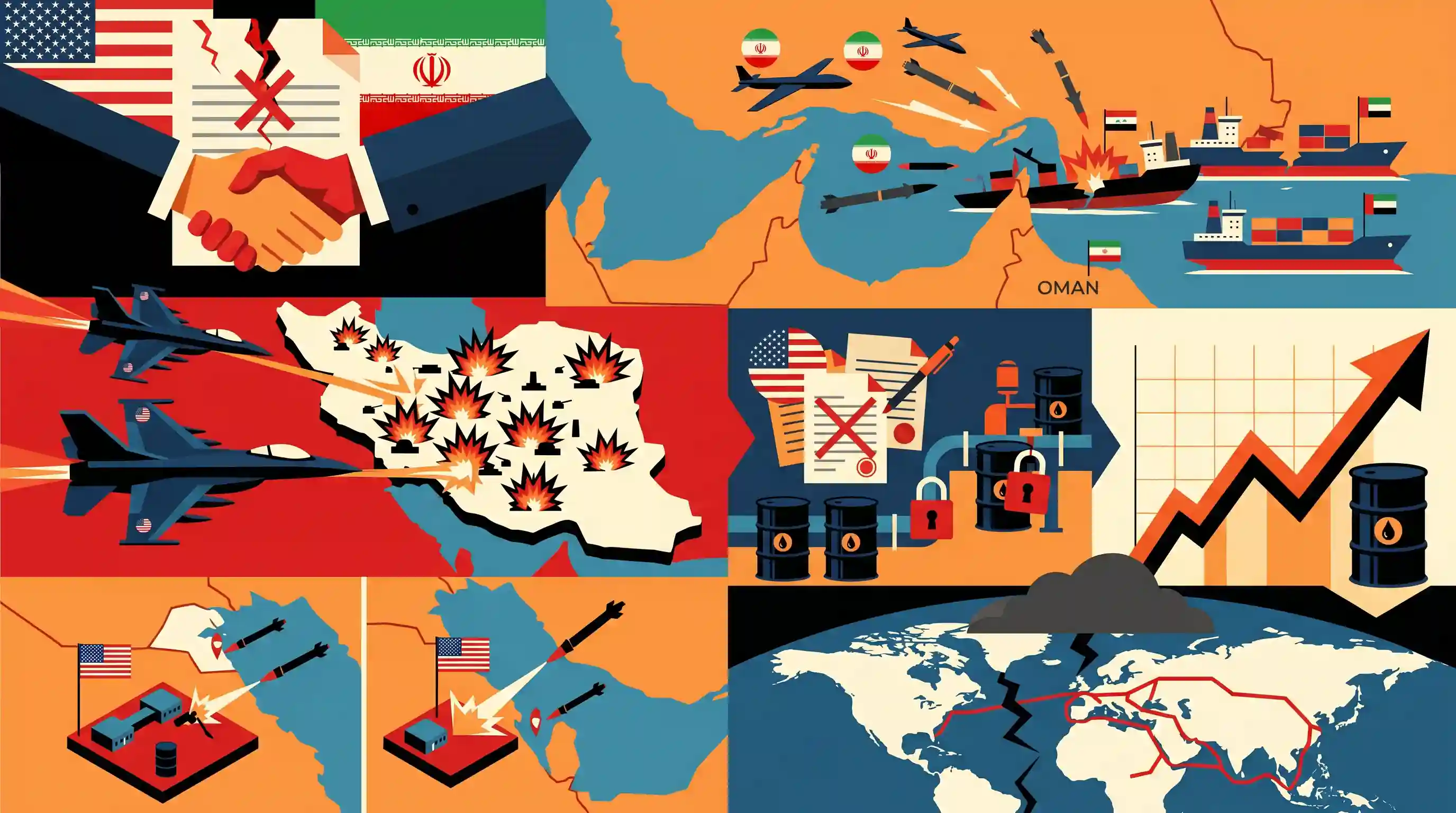
U.S. President Donald Trump declared the temporary ceasefire with Iran 'over' after a violent flare-up in the Strait of Hormuz. Following Iranian drone and missile strikes on three international cargo ships near Oman, U.S. forces launched retaliatory airstrikes on more than 80 military targets across Iran. Iran countered by attacking U.S. military bases in Kuwait and Bahrain, while Washington retaliated economically by cancelling vital oil sanctions waivers. The collapse of the bilateral interim agreement sparked a 5% surge in international crude prices, pointing to severe disruption in West Asian geopolitics and global energy corridors.
Key Points
- U.S. President Donald Trump announced the end of the temporary ceasefire with Iran following fresh military flare-ups sparked by maritime attacks in the Strait of Hormuz.
- The conflict escalated after Iranian forces targeted three commercial vessels—the Al Rekayyat (Qatari owned, Marshall Islands-flagged), Wedyan (Saudi), and Cyprus Prosperity (Liberian-flagged)—near Oman, opposing Oman's proposed alternative transit corridor.
- Iran is attempting to impose unilateral control over the Strait of Hormuz, threatening vessels that bypass its authorized paths and demanding transit fees/tolls.
- U.S. CENTCOM conducted extensive airstrikes hitting over 80 Iranian targets, including coastal radar sites, air defenses, and 60 IRGC small boats in Qeshm, Sirik, Bandar Abbas, and Bushehr.
- Iran retaliated by targeting U.S. military facilities located in Kuwait and Bahrain, activating local air defense systems.
- The U.S. Treasury Department reinstated strict oil sanctions by revoking a performance-based license that allowed Iranian oil sales through August 21, 2026, causing a sudden 5% jump in global crude oil prices.
- The collapse of the performance-based 14-point U.S.-Iran MoU threatens maritime stability in one of the world's most vital energy corridors.
Important Terms
Islamic Revolutionary Guard Corps (IRGC)

An elite branch of the Iranian Armed Forces established after the 1979 revolution, tasked with defending the Islamic regime, running ideological programs, and commanding substantial regional proxy operations.
UPSC context
GS Paper II (International Relations) & Paper III (Security); tests knowledge of Middle East geopolitics and asymmetric maritime warfare.
United Kingdom Maritime Trade Operations (UKMTO)
A Royal Navy-managed organization acting as the primary information hub and point of contact for merchant ships navigating high-risk maritime areas like the Red Sea, Gulf of Aden, and Persian Gulf.
UPSC context
GS Paper III (Maritime Security); tests understanding of global sea lane protection, trade corridors, and piracy/security alert mechanisms.
U.S. Central Command (CENTCOM)
A unified combatant command of the United States Department of Defense responsible for military operations across 21 nations in the Middle East, Central Asia, and parts of South Asia.
UPSC context
GS Paper II (Bilateral & Global Groupings); crucial for analyzing US strategic presence, military footprints, and power projection in West Asia.
U.S.-Iran Memorandum of Understanding (MoU)
A bilateral framework designed to establish a temporary ceasefire, resolve maritime blockades, and reopen the strategic Strait of Hormuz to commercial shipping before subsequent implementation.
UPSC context
GS Paper II (Global Agreements); tests understanding of diplomatic conflict resolution and its energy security implications for global oil corridors.
U.S. Oil Sanctions License
Official authorizations issued by the U.S. government allowing specific foreign entities or nations to purchase Iranian crude oil temporarily without facing secondary economic sanctions.
UPSC context
GS Paper II (Policies of Developed Countries); directly impacts India's crude import strategies, pricing, and strategic autonomy in energy security.
Prelims Trap
The sudden flare-up directly threatens India's ongoing bilateral crude oil import trade with Iran.
India ceased importing crude oil from Iran in 2019 due to CAATSA and the expiry of US sanctions waivers. The current crude price spike impacts India systemically, not through direct bilateral oil trade with Iran.
Static Concepts Connected
What are the geographical boundaries and strategic maritime importance of the Strait of Hormuz?
- Geographical boundaries: It connects the Persian Gulf to the Gulf of Oman, bounded by Iran to the north and Oman's Musandam Peninsula exclave to the south.
- Strategic choke point: It is the sole sea passage from the Persian Gulf to the open ocean, carrying a massive percentage of global petroleum shipments.
- Regional dependence: Landlocked gulf states like Iraq, Kuwait, Qatar, Bahrain, and UAE rely entirely on this strait for maritime commerce.
What is Operation Sankalp and its relevance to Persian Gulf security?
- Origin and mandate: Launched by the Indian Navy in 2019 following tanker attacks to ensure safe passage of Indian-flagged merchant vessels through the Gulf region.
- Operational mechanism: Involves deployment of stealth frigates, aerial surveillance, and close coordination with the Information Fusion Centre-Indian Ocean Region (IFC-IOR).
Cross-Topic Patterns
Strait of Hormuz vs. Bab-el-Mandeb
Maritime security disruptions in West Asia require India to balance dual-chokepoint vulnerabilities—the Strait of Hormuz for energy security and the Bab-el-Mandeb/Red Sea for merchandise trade routes to Europe.
Strategic Autonomy and Sanctions
India's compliance with US unilateral sanctions on Iran since 2019 contrasts with its ongoing purchase of discounted Russian oil, illustrating evolution in India's strategic autonomy.

West Asian maritime chokepoints and US sanctions’ historical impact on India’s energy import mix will likely be tested together in 2026.
Linked PYQs · 5
Linked PYQs · 5
- 2025MainsGS2
"Energy security constitutes the dominant kingpin of India's foreign policy, and is linked with India's overarching influence in Middle Eastern countries.” How would you integrate energy security with India's foreign policy trajectories in the coming years?
- 2017MainsGS2
The question of India's Energy Security constitutes the most important part of India's economic progress. Analyze India's energy policy cooperation with West Asian countries.
- 2018MainsGS2
In what ways would the ongoing US-Iran Nuclear Pact Controversy affect the national interest of India? How should India respond to this situation?
- 2012MainsGS2
How have the US sanctions against Iran affected India's bilateral relations with Iran?
- 2026PrelimsGS1
Ships from which of the following countries have to cross the Strait of Hormuz to reach out to the Indian Ocean ? 1. Bahrain 2. Syria 3. Qatar 4. Egypt Select the answer using the code given below :
