US Tariff Threats Over Russian Oil Purchases and Trade Disputes
Source:The Hindu ↗
Why It Matters
This development highlights the friction between India's pursuit of strategic autonomy and energy security and the US's broader geopolitical objectives regarding Russia, serving as a critical case study in India-US bilateral relations and trade diplomacy.
Summary
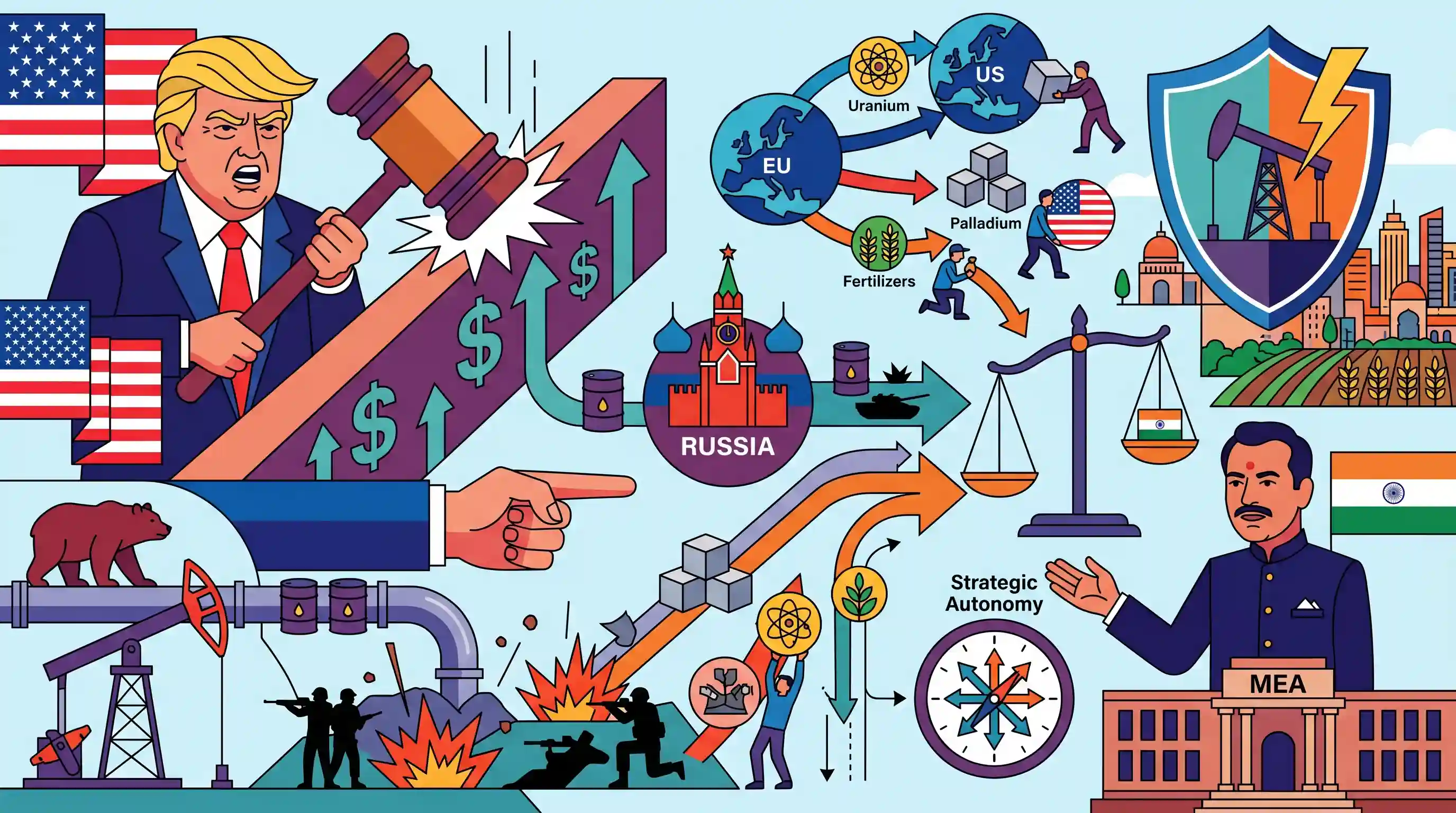
US President Donald Trump announced plans to raise tariffs on India "very substantially," citing its continued purchase of Russian oil and military equipment, which he claims fuels the Ukraine war, as well as India's allegedly high import tariffs. The Ministry of External Affairs (MEA) strongly rebuked the US, pointing out the double standards of both the US and the EU for their ongoing imports of Russian resources like uranium, palladium, and fertilizers. The MEA defended India's actions as a vital national compulsion to secure economic and energy security, highlighting tensions between US sanctions policy and India's strategic autonomy.
Key Points
- US President Donald Trump threatened a significant tariff hike on India in retaliation for its large-scale imports of Russian oil and military equipment.
- Trump previously signed an executive order to impose a 25% tariff on Indian goods, citing India's own protectionist policies and trade imbalance.
- India's Ministry of External Affairs rejected the criticism, accusing the US and the EU of hypocrisy for continuing to import critical Russian commodities like uranium, palladium, and chemicals.
- New Delhi emphasized that its energy imports are a matter of vital economic security, reaffirming its strategic autonomy in foreign policy amid Western pressure.
Important Terms
Strategic Autonomy

A foreign policy doctrine where a state makes independent decisions based on national interest without being coerced by external powers or military alliances.
UPSC context
Crucial for GS Paper II (International Relations). Tests understanding of India's balancing act between major powers like the US and Russia.
Reciprocal Tariff
A trade policy where a country matches the import duty rates imposed by a trading partner on its own exports, aiming to ensure trade fairness.
UPSC context
Relevant for GS Paper III (Indian Economy). Tests knowledge of protectionism and its impact on bilateral trade.
International Emergency Economic Powers Act (IEEPA)
A U.S. federal law authorizing the President to regulate international commerce after declaring a national emergency to address extraordinary threats.
UPSC context
Important for GS Paper II (Effect of policies of developed countries). Explains the legal mechanism behind US trade sanctions.
Secondary Tariffs
Additional duties imposed on a third-party country to coerce it into stopping trade or financial dealings with a sanctioned adversary.
UPSC context
Advanced IR/Economy concept. Relevant for understanding 'sanctions overreach' and its impact on India's energy ties.
Energy Security
The uninterrupted availability of energy sources at an affordable price to meet a nation's economic and social needs.
UPSC context
Key for GS Paper III. Involves understanding India's oil import diversification and resilience against global supply shocks.
Ministry of External Affairs (MEA)
The Indian government department responsible for the conduct of foreign relations, implementing foreign policy, and representing India in international forums.
UPSC context
Basic governance term for GS Paper II. Tests awareness of the institutional framework for Indian diplomacy.
Prelims Trap
The US penalizes India's import of Russian crude oil under the CAATSA framework.
CAATSA specifically targets significant transactions with Russia's defense and intelligence sectors. The US is using unilateral executive tariffs, not CAATSA, to penalize oil imports.
Static Concepts Connected
What are the major exceptions to the WTO's Most-Favored-Nation (MFN) principle?
- Free Trade Agreements: Members of regional arrangements (like FTAs or Customs Unions) can offer preferential tariffs to each other while excluding outside members.
- Generalized System of Preferences: Developed nations can offer lower tariffs or duty-free access to developing nations (e.g., the US GSP program) without extending the same to wealthy nations.
- National Security Exception: Under GATT Article XXI, a member can breach MFN to restrict trade if it is deemed necessary for the protection of its essential security interests.
What makes Palladium a critical strategic mineral?
- Catalytic Converters: It is heavily used in automotive exhaust systems to convert toxic gases into less harmful emissions.
- Electronics & Green Tech: It is essential for manufacturing multilayer ceramic capacitors, semiconductor components, and hydrogen fuel cells.
- Oligopolistic Global Supply: Russia and South Africa account for roughly 70-80% of global mine production, creating severe supply chain vulnerabilities for Western tech and auto industries.
Cross-Topic Patterns
Mineral monopolies shape sanction regimes
The West's exemption of Russian uranium and palladium from sanctions mirrors China's leverage over rare earths, highlighting how critical mineral monopolies dictate foreign policy and sanction regimes.
Weaponization of trade & WTO paralysis
Unilateral US tariff threats exploit the ongoing paralysis of the WTO's Appellate Body, signaling a shift from multilateral rules-based trade to "sovereign nationalism" and bilateral arm-twisting.

Expect a 2026 multi-statement question on Palladium's applications (catalytic converters/fuel cells) mapped against production monopolies.
Linked PYQs · 3
Linked PYQs · 3
- 2012MainsGS2
Discuss the likely negative impact of the protectionist measures proposed by the US on India's software industry.
- 2020MainsGS2
What is the significance of Indo-US defence deals over Indo-Russian defence deals? Discuss with reference to stability in the Indo-Pacific region.
- 2025MainsGS2
"Energy security constitutes the dominant kingpin of India's foreign policy, and is linked with India's overarching influence in Middle Eastern countries.” How would you integrate energy security with India's foreign policy trajectories in the coming years?
