अमेरिका और ब्रिटेन के बीच द्विपक्षीय व्यापार वार्ता
स्रोत:इंडियन एक्सप्रेस ↗
क्यों मायने रखता है
The article serves as a contemporary example of major global economies prioritizing bilateral trade agreements over multilateral trade frameworks like the WTO. Resolving sectoral tariffs (like steel, aluminum, aerospace, and automobiles) reflects the broader geopolitical shift towards protectionism and bilateralism. This is important for understanding the changing dynamics of global trade, which directly impacts India's strategy for negotiating its own Free Trade Agreements (FTAs).
सारांश
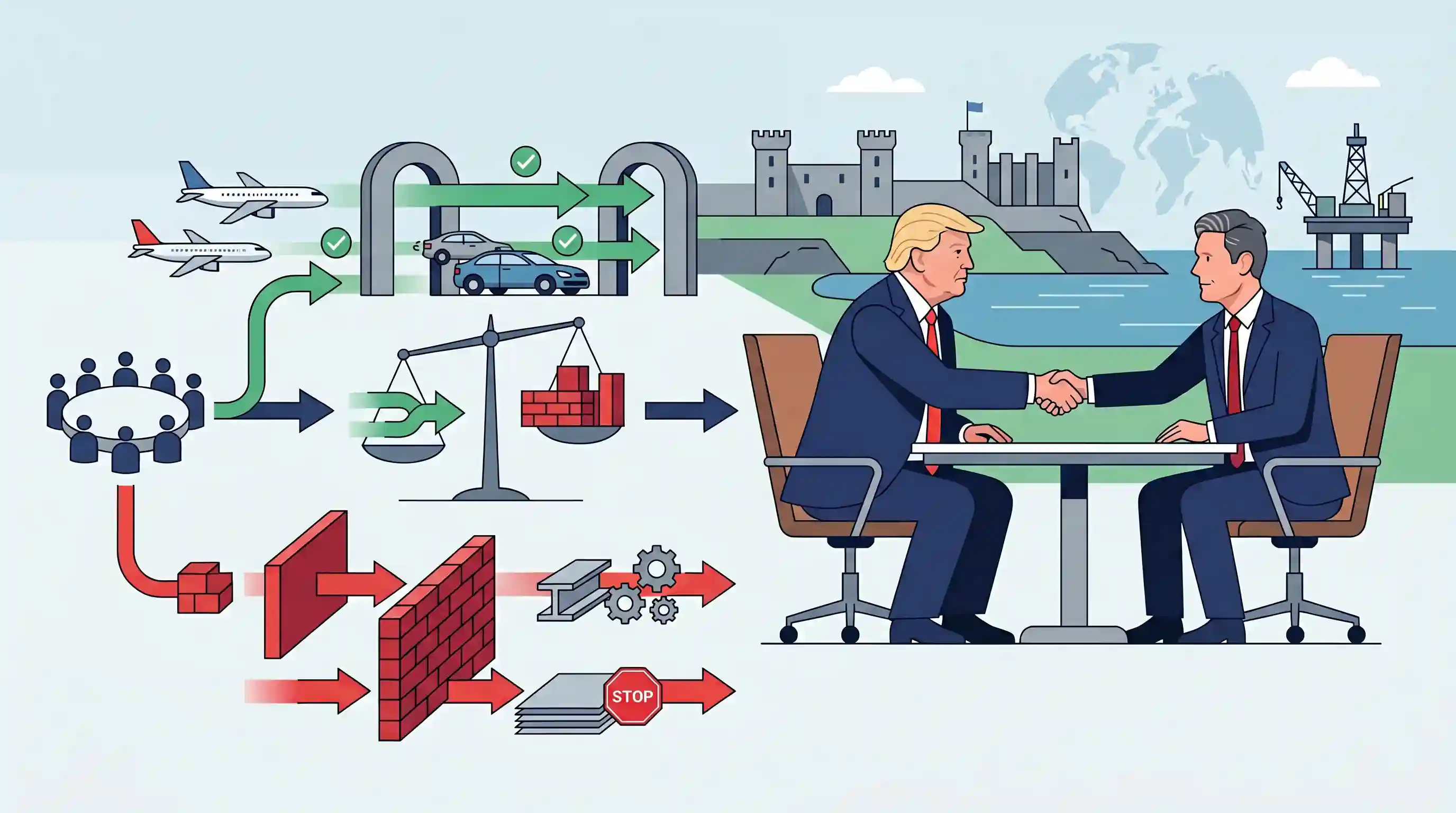
US President Donald Trump is scheduled to meet British Prime Minister Keir Starmer in Aberdeen, Scotland, to continue negotiations on a US-UK bilateral trade deal. The meeting seeks to build upon a preliminary agreement reached on the sidelines of the recent G7 Summit in Canada, which successfully addressed tariffs and quotas on the aerospace and automobile sectors. However, significant trade issues, particularly concerning steel and aluminum tariffs, remain unresolved. The engagement highlights the ongoing focus on bilateral trade agreements among major economies outside multilateral frameworks.
मुख्य बिंदु
- अमेरिकी राष्ट्रपति डोनाल्ड ट्रंप और ब्रिटेन के प्रधानमंत्री कीर स्टार्मर एक द्विपक्षीय व्यापार समझौते को परिष्कृत करने के लिए स्कॉटलैंड के एबर्डीन में मुलाकात करेंगे।
- The meeting builds on an initial trade pact announced recently on the sidelines of the G7 Summit in Canada.
- The preliminary deal eliminated tariffs on the UK aerospace sector and settled quotas and tariff rates on British automobiles.
- Negotiations remain unresolved regarding tariffs on steel and aluminum.
- यह यात्रा सितंबर में विंडसर कैसल में किंग चार्ल्स के अतिथि के रूप में ट्रंप की UK की नियोजित राजकीय यात्रा से पहले हो रही है।
महत्वपूर्ण शब्द
Bilateral Trade Agreement

An agreement between two nations to reduce or eliminate trade barriers like tariffs and quotas to enhance market access and economic cooperation.
UPSC context
GS Paper II/III: Crucial for topics like 'Bilateral, Regional and Global Groupings' and 'Effects of liberalization on the economy'.
G7 (ग्रुप ऑफ सेवन)
An informal forum of seven advanced economies—US, UK, France, Germany, Italy, Japan, and Canada—addressing global security, economic governance, and climate issues.
UPSC context
GS Paper II: Important for 'International Institutions' and 'Global Groupings' involving major powers.
Tariffs
A tax or duty imposed by a government on imported goods, increasing their landed cost to protect domestic industries or generate revenue.
UPSC context
GS Paper III: Relevant to 'Indian Economy' and trade-related issues like protectionism and WTO compliance.
Protectionism
Economic policies and measures, such as tariffs and quotas, used by a government to restrict imports and protect domestic industries from foreign competition.
UPSC context
GS Paper II/III: Tests understanding of global trade shifts and 'Effect of policies of developed countries'.
कोटा
A non-tariff barrier that sets a specific quantitative limit on the amount of a particular good that can be imported during a given period.
UPSC context
GS Paper III: Part of 'Trade Barriers' and their impact on market access and domestic manufacturing.
Multilateralism
Economic or political coordination among three or more nations, typically conducted through international organizations like the WTO to promote global trade rules.
UPSC context
GS पेपर II: 'द्विपक्षीय बनाम बहुपक्षीय' कूटनीतिक रणनीतियों और 'नियम-आधारित अंतरराष्ट्रीय व्यवस्था' से संबंधित है।
प्रारंभिक ट्रैप
Free Trade Agreements automatically eliminate all tariffs and quotas between participating nations.
FTAs शायद ही कभी सभी व्यापारिक बाधाओं को समाप्त करते हैं। वे अक्सर टैरिफ-रेट कोटा (TRQs) का उपयोग करते हैं और स्टील और कृषि जैसे संवेदनशील क्षेत्रों पर सुरक्षात्मक टैरिफ (protective tariffs) बनाए रखते हैं।
संबंधित अवधारणाएँ
How do Tariff-Rate Quotas (TRQs) differ from Absolute Quotas in international trade?
- Tariff-Rate Quotas: Allows a specified quantity of goods to be imported at a lower or zero tariff rate. Quantities exceeding this threshold face much higher tariffs.
- Absolute Quotas: Places a strict, non-negotiable physical limit on the total volume of a specific good that can be imported over a designated time period.
Why are major economies increasingly preferring bilateral FTAs over WTO-led multilateral frameworks?
- Faster Consensus: Bilateral deals bypass the consensus-based gridlock and structural paralysis characteristic of the WTO's long-stalled Doha Development Round.
- Sector-Specific Tailoring: Allows nations to shield domestic strategic industries (e.g., metals) while selectively opening other markets (e.g., aerospace).
- Dispute Resolution: With the WTO Appellate Body practically defunct, bilateral FTAs allow countries to create custom, enforceable dispute resolution mechanisms.
अंतर-विषय पैटर्न
Global Protectionism & India's Exports
The US-UK friction over steel and aluminum tariffs mirrors India's ongoing challenges with US Section 232 tariffs and the EU's Carbon Border Adjustment Mechanism (CBAM) regarding strategic metal exports.
Minilaterals bypassing WTO multilateralism
Finalizing trade pacts on the G7 sidelines highlights how informal advanced-economy groupings are increasingly replacing stalled WTO mechanisms as practical platforms for standard-setting and bilateral economic deals.

Expect a GS-3 mains question linking WTO's paralysis with the rise of sector-specific FTAs and protectionist TRQs among developed nations.
संबद्ध PYQ · 3
संबद्ध PYQ · 3
- 2025MainsGS3
What are the challenges before the Indian economy when the world is moving away from free trade and multilateralism to protectionism and bilateralism? How can these challenges be met?
- 2018MainsGS2
What are the key areas of reform if the WTO has to survive in the present context of "Trade War', especially keeping in mind the interest of India?
- 2012MainsGS2
What is meant by the G8 + 5 group?
