US Tariff Appeal and Supreme Court Executive Power Review
Source:The Hindu ↗
Why It Matters
The article is highly relevant for understanding the global shift towards protectionism and 'trade wars,' which directly impact India's macroeconomic stability and exports. It also serves as a practical example of judicial review and the limits of executive authority in the U.S. constitutional setup, useful for comparative polity in GS-II.
Summary
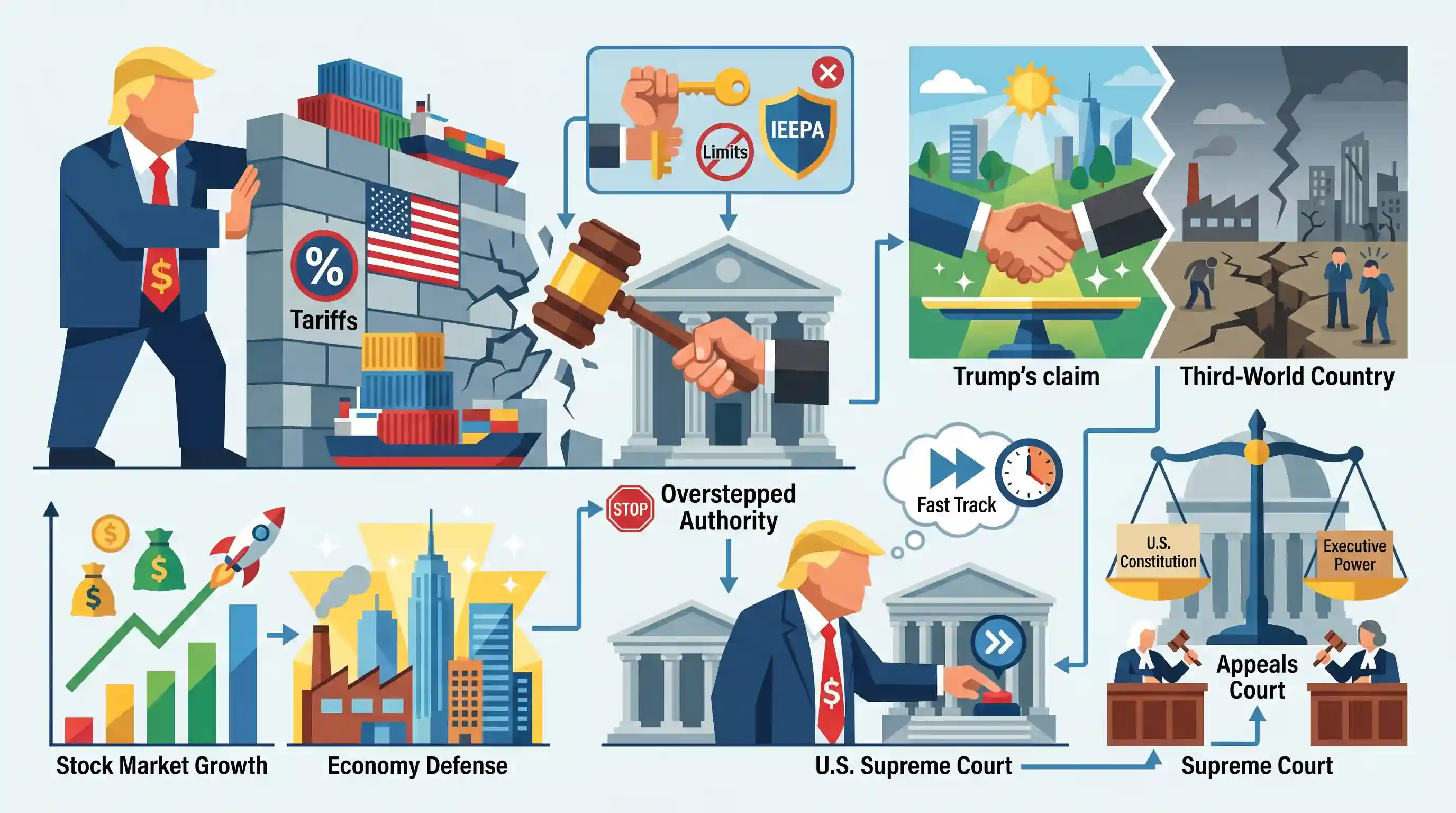
U.S. President Donald Trump announced plans to ask the U.S. Supreme Court for an expedited ruling after an appeals court struck down his widespread reciprocal tariffs. The lower court ruled that Trump had overstepped his authority under the International Emergency Economic Powers Act. Trump defended the tariffs as vital for the U.S. stock market and economy, arguing that removing them would turn the U.S. into a "third-world country." This judicial challenge highlights the ongoing tensions surrounding protectionist trade policies and the limits of executive power in the United States.
Key Points
- U.S. President Donald Trump is seeking an expedited Supreme Court ruling to reinstate his global tariffs.
- An appeals court ruled that Trump exceeded his executive authority under the International Emergency Economic Powers Act by unilaterally imposing these tariffs.
- Trump argues that tariffs are essential for the U.S. stock market and to prevent the country from economic decline.
- The ruling affects broad reciprocal tariffs aimed at major U.S. trading partners including the EU, Japan, Mexico, Canada, and China.
- The situation exemplifies rising protectionist policies in developed nations and the constitutional checks on executive power regarding trade policy in the U.S.
Important Terms
International Emergency Economic Powers Act (IEEPA)

A 1977 U.S. law granting the President broad authority to regulate economic transactions during declared national emergencies involving foreign threats.
UPSC context
GS2: Comparison of Constitutions. Tests executive-legislative power dynamics and emergency legislation limits.
U.S. Court of Appeals for the Federal Circuit
A specialized U.S. appellate court with exclusive nationwide jurisdiction over trade and customs cases, including appeals from the Court of International Trade.
UPSC context
GS2: Judiciary. Relevant for understanding specialized judicial hierarchies and trade dispute resolution mechanisms.
Reciprocal Tariffs
Protectionist trade policy where import duties are matched to the specific rates charged by trading partners on the home country's exports.
UPSC context
GS2: International Relations. Relates to global trade wars, protectionism, and their impact on India's exports.
Major Questions Doctrine
A judicial principle requiring clear congressional intent for executive actions involving matters of "vast economic and political significance."
UPSC context
GS2: Separation of Powers. Important for comparing checks on delegated legislation and executive overreach.
Section 232 (Trade Expansion Act)
A U.S. provision allowing tariffs on imports deemed a threat to national security, traditionally used for steel and aluminum.
UPSC context
GS3: Economy. Essential for understanding non-tariff barriers and trade friction affecting Indian industry.
Prelims Trap
The Indian Executive cannot alter customs tariff rates without a prior legislative amendment passed by Parliament.
Under Section 8A of the Customs Tariff Act 1975, the Central Government holds delegated authority to increase import duties during emergencies, requiring subsequent (not prior) parliamentary approval.
Static Concepts Connected
How does tariff-levying authority compare between the US and Indian constitutional schemes?
- Constitutional Mandate: The US Constitution's Article I vests taxation and tariff powers exclusively in Congress. Similarly, India's Article 265 dictates that no tax shall be levied except by authority of law.
- Delegated Legislation: India's Customs Tariff Act allows the Executive to hike emergency tariffs subject to later parliamentary approval. The US President's emergency powers (IEEPA) strictly restrict unilateral taxation.
How do unilateral protectionist tariffs structurally impact developing economies like India?
- Export Competitiveness: High reciprocal tariffs directly inflate the final cost of Indian goods in Western markets, hurting export-heavy sectors like textiles, pharmaceuticals, and gems.
- Currency Volatility: Trade wars trigger foreign portfolio capital flight toward safe-haven assets (like US bonds), leading to severe depreciation and volatility of emerging market currencies.
- Supply Chain Disruptions: Retaliatory tariff structures bypass and distort established global value chains, causing raw material shortages and imported inflation for domestic manufacturing industries.
Cross-Topic Patterns
Protectionism + WTO Dispute Crisis
Unilateral tariff impositions bypass WTO consensus frameworks, rendering its dispute settlement body obsolete and accelerating the global shift from rules-based multilateralism to fragmented protectionist trade wars.
Delegated Legislation + Separation of Powers
The US judicial pushback against executive tariff overreach via the IEEPA contrasts sharply with India's broader delegated legislative powers under the Customs Tariff Act, highlighting different separation-of-powers models.

Expect a GS2 Mains question comparing US-India executive powers on taxation/tariffs, or a GS3 query on protectionism's impact on India.
Linked PYQs · 3
Linked PYQs · 3
- 2025MainsGS3
What are the challenges before the Indian economy when the world is moving away from free trade and multilateralism to protectionism and bilateralism? How can these challenges be met?
- 2018MainsGS3
How would the recent phenomena of protectionism and currency manipulations in world trade affect macroeconomic stability of India?
- 2018MainsGS2
What are the key areas of reform if the WTO has to survive in the present context of "Trade War', especially keeping in mind the interest of India?
