US Iran Diplomatic De-escalation and Strait of Hormuz Stability
Source:The Hindu ↗
Why It Matters
The geopolitical stability of West Asia and the uninterrupted flow of energy through the Strait of Hormuz are intrinsically linked to India's energy security and economic stability. De-escalation between the US and Iran directly influences global crude oil prices, which impacts India's import bill and inflation.
Summary
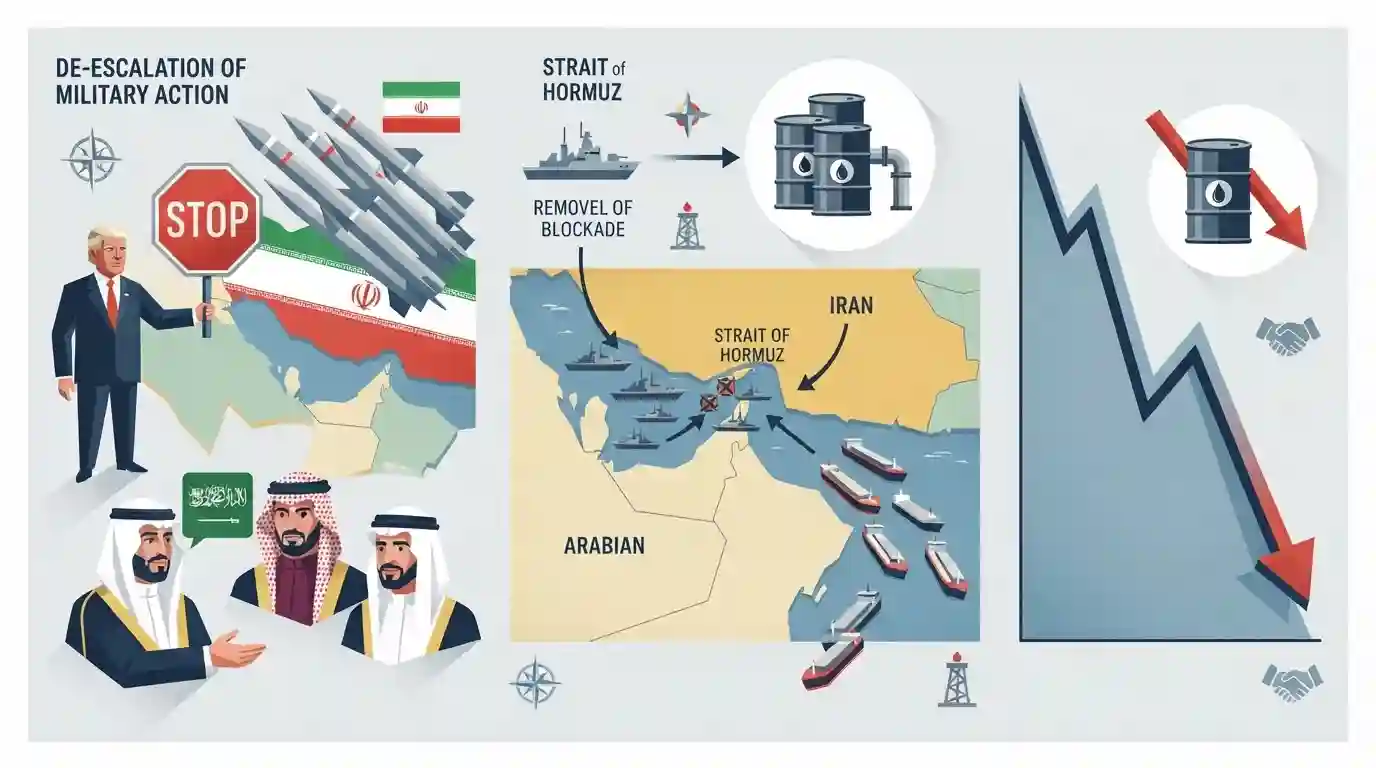
US President Donald Trump postponed planned military strikes against Iran, opting to give diplomatic efforts more time after consultations with leaders from Saudi Arabia, Qatar, and the UAE. The focal point of the potential de-escalation is the reopening of the Strait of Hormuz, a strategic maritime chokepoint that handles about 20% of global energy shipments. Under the proposed arrangement, the US would lift its naval blockade and allow Tehran to export oil in return for Iran reopening the strait. The avoidance of military escalation and the prospect of restored energy flows resulted in a significant drop in global oil prices, highlighting the region's critical role in international energy security.
Key Points
- US President Donald Trump cancelled a planned major military strike on Iran to prioritize a diplomatic resolution.
- The decision to hold off on strikes was heavily influenced by appeals from Gulf allies, including Saudi Arabia, Qatar, and the UAE.
- A proposed deal includes reopening the Strait of Hormuz in exchange for the US ending its naval blockade and allowing Iranian oil exports.
- The Strait of Hormuz is a critical global chokepoint, normally facilitating around 20% of the world's energy flows.
- The possibility of a ceasefire and easing of tensions led to an immediate decline in global oil prices (Brent crude and WTI).
Prelims Trap
The Strait of Hormuz is bordered on its southern shores directly by Saudi Arabia, connecting the Persian Gulf to the Red Sea.
The southern coast of the Strait is controlled by Oman (Musandam exclave) and the UAE, not Saudi Arabia. It connects the Persian Gulf to the Gulf of Oman, not the Red Sea.
Static Concepts Connected
What are the key maritime chokepoints of West Asia?
- Strait of Hormuz: Connects the Persian Gulf to the Gulf of Oman; bordered by Iran, Oman (Musandam Peninsula), and the UAE.
- Bab-el-Mandeb Strait: Connects the Red Sea to the Gulf of Aden; bordered by Yemen, Djibouti, and Eritrea.
- Suez Canal: An artificial sea-level waterway in Egypt connecting the Mediterranean Sea to the Red Sea.
How do crude price shocks affect India's macroeconomy?
- CAD Expansion: Since India imports over 85% of its crude, rising oil prices directly widen the CAD and weaken the Rupee.
- Imported Inflation: Higher fuel prices escalate transport and manufacturing inputs, feeding directly into core and headline CPI inflation.
- Fiscal Strain: Government absorption of oil price spikes through excise duty cuts or subsidies balloons the fiscal deficit.
Cross-Topic Patterns
Energy chokepoints & India's strategic autonomy
Geopolitical easing in Hormuz secures India's energy corridor and Chabahar investments, demonstrating how West Asian stability directly affects India's maritime trade security and Eurasian connectivity.
Sanctions & the petrodollar's vulnerability
US naval blockades and unilateral energy sanctions catalyze regional shifts toward non-dollar bilateral settlement mechanisms, directly testing the resilience of the traditional global petrodollar architecture.

West Asian maritime chokepoints (Hormuz, Bab-el-Mandeb) will likely be paired with India's strategic reserves and CAD in 2026.
Linked PYQs · 4
Linked PYQs · 4
- 2018MainsGS2
In what ways would the ongoing US-Iran Nuclear Pact Controversy affect the national interest of India? How should India respond to this situation?
- 2025MainsGS2
"Energy security constitutes the dominant kingpin of India's foreign policy, and is linked with India's overarching influence in Middle Eastern countries.” How would you integrate energy security with India's foreign policy trajectories in the coming years?
- 2026PrelimsGS1
Ships from which of the following countries have to cross the Strait of Hormuz to reach out to the Indian Ocean ? 1. Bahrain 2. Syria 3. Qatar 4. Egypt Select the answer using the code given below :
- 2017MainsGS2
The question of India's Energy Security constitutes the most important part of India's economic progress. Analyze India's energy policy cooperation with West Asian countries.
