US China Bilateral Relations and Presidential Summit Plans
Source:The Hindu ↗
Why It Matters
The evolving dynamic between the U.S. and China fundamentally shapes global economic stability, supply chains, and international security architecture. For UPSC aspirants, tracking their bilateral engagements, trade disputes, and respective stances on Taiwan and nuclear disarmament is vital for analyzing the changing world order and its strategic implications for India's foreign policy and economic interests.
Summary
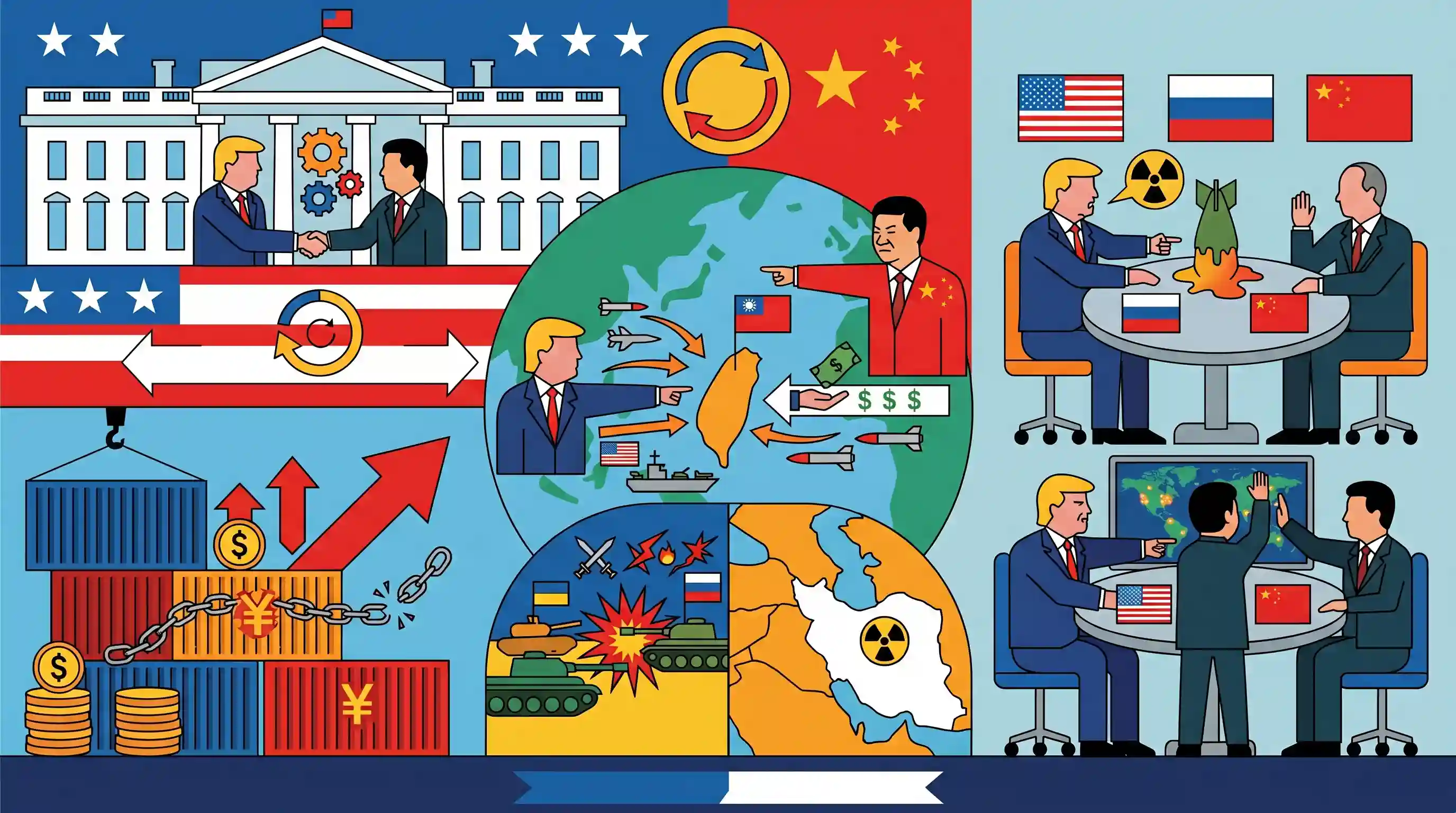
U.S. President Donald Trump announced plans to host Chinese President Xi Jinping at the White House later this year to reset bilateral ties amid ongoing trade tensions. Trump is also expected to visit China in April. The leaders recently discussed a range of geopolitical issues, including trade, Taiwan, the Russia-Ukraine war, and Iran. During the talks, Xi cautioned the U.S. against selling arms to Taiwan. Concurrently, the U.S. has pushed for three-way nuclear disarmament talks with Russia and China, an initiative Beijing has currently rejected.
Key Points
- U.S. President Donald Trump and Chinese President Xi Jinping plan reciprocal visits this year to reset bilateral ties strained by trade disputes and tariffs.
- A recent dialogue between the two leaders covered critical global issues, including trade, Taiwan, the Russia-Ukraine war, and the situation in Iran.
- The U.S. proposed trilateral nuclear disarmament negotiations involving Russia and China, but Beijing has rejected participation at this stage.
- Xi Jinping issued a warning to the U.S. to proceed with caution regarding arms sales to Taiwan, emphasizing China's territorial claims over the self-ruled island.
- Despite U.S. efforts to reduce reliance on Chinese manufacturing via sector-specific tariffs, the two economies remain deeply intertwined.
Important Terms
One China Policy

A diplomatic acknowledgment that there is only one sovereign state called 'China,' represented by the PRC, effectively denying Taiwan's claim to independent statehood.
UPSC context
GS II (International Relations); tests understanding of sovereignty, cross-strait tensions, and India’s strategic diplomatic stance toward Beijing.
Taiwan Issue
A territorial and political dispute between the People’s Republic of China and the Republic of China (Taiwan) over sovereignty, self-governance, and regional control.
UPSC context
GS II; critical for regional security, global semiconductor supply chains, and India’s 'Act East' policy in the Indo-Pacific.
Nuclear Disarmament
The process of reducing or eliminating nuclear weapons through international treaties (like NPT and CTBT) to prevent catastrophic warfare and ensure global security.
UPSC context
GS II & III; focuses on international security regimes, non-proliferation treaties, and India’s 'No First Use' nuclear doctrine.
Trade War
An economic conflict characterized by reciprocal tariffs and trade barriers between nations, often disrupting global supply chains to protect domestic industries.
UPSC context
GS III (Economy); tests impact on global trade stability, 'dumping' of cheap goods, and India's potential as an alternative manufacturing hub.
Bilateral Relations
The conduct of political, economic, or cultural relations specifically between two sovereign independent states, typically managed through direct diplomacy and summits.
UPSC context
GS II; a foundational IR concept testing India's ability to balance partnerships and navigate major power rivalries.
White House
The official residence and workplace of the U.S. President, symbolizing the executive authority of the United States in domestic and foreign policy.
UPSC context
GS II; relevant for studying executive-led diplomacy and the impact of U.S. presidential summits on global geopolitical stability.
Prelims Trap
The US officially recognizes Taiwan as a sovereign nation to legally supply it with defensive arms.
The US maintains "Strategic Ambiguity"—it acknowledges Beijing's position without endorsing it, officially recognizing Beijing, not Taipei, while legally mandated to supply Taiwan with defensive arms.
Static Concepts Connected
What is the difference between China's and the US's official stance on Taiwan?
- One China Principle: Beijing's absolute diplomatic stance that there is only one sovereign state of China, and Taiwan is an inalienable province of it.
- Strategic Ambiguity: US policy of acknowledging Beijing's claim without explicitly endorsing it, intentionally keeping potential US military intervention in a Taiwan conflict unclear.
- Taiwan Relations Act: A 1979 US domestic law requiring Washington to provide Taiwan with defensive arms to maintain regional security, despite lacking formal diplomatic ties.
Why does China reject trilateral nuclear disarmament talks with the US and Russia?
- Arsenal Asymmetry: China's nuclear stockpile is vastly smaller than the thousands of deployed warheads held by the US and Russia under historical bilateral agreements.
- NFU Doctrine: China maintains a strict 'No First Use' policy, arguing the primary disarmament burden lies with the two superpowers holding the most weapons.
- Modernization Push: Beijing views trilateral inclusion as a US strategy to prematurely cap China's ongoing military modernization and secure a strategic advantage.
Cross-Topic Patterns
Trilateral Nuclear Control + Indo-Pacific
As bilateral treaties like New START degrade, US pressure for a trilateral (US-Russia-China) nuclear pact forces India to reassess its own nuclear deterrence amidst China's rapid arsenal expansion.
De-risking vs Decoupling + PLI Schemes
The US shift from total decoupling to targeted "de-risking" in Chinese trade shapes India's export strategies, specifically its push to capture "China Plus One" manufacturing through PLI subsidies.

Expect a Prelims question comparing US 'Strategic Ambiguity' on Taiwan with India's evolving diplomatic stance on the One China policy.
Linked PYQs · 2
Linked PYQs · 2
- 2021MainsGS2
“The USA is facing an existential threat in the form of a China, that is much more challenging than the erstwhile Soviet Union.” Explain.
- 2025MainsGS2
"The reform process in the United Nations remains unresolved, because of the delicate imbalance of East and West and entanglement of the USA vs. Russo-Chinese alliance.” Examine and critically evaluate the East-West policy confrontations in this regard.
