United States Iran Tensions and West Asian Geopolitical Stability
Source:The Hindu ↗
Why It Matters
The stability of West Asia is crucial for India's energy security, trade routes (particularly through the Strait of Hormuz), and the safety of the large Indian diaspora in the region. Escalations involving the U.S., Israel, and Iran can severely impact global oil prices and regional security architecture.
Summary
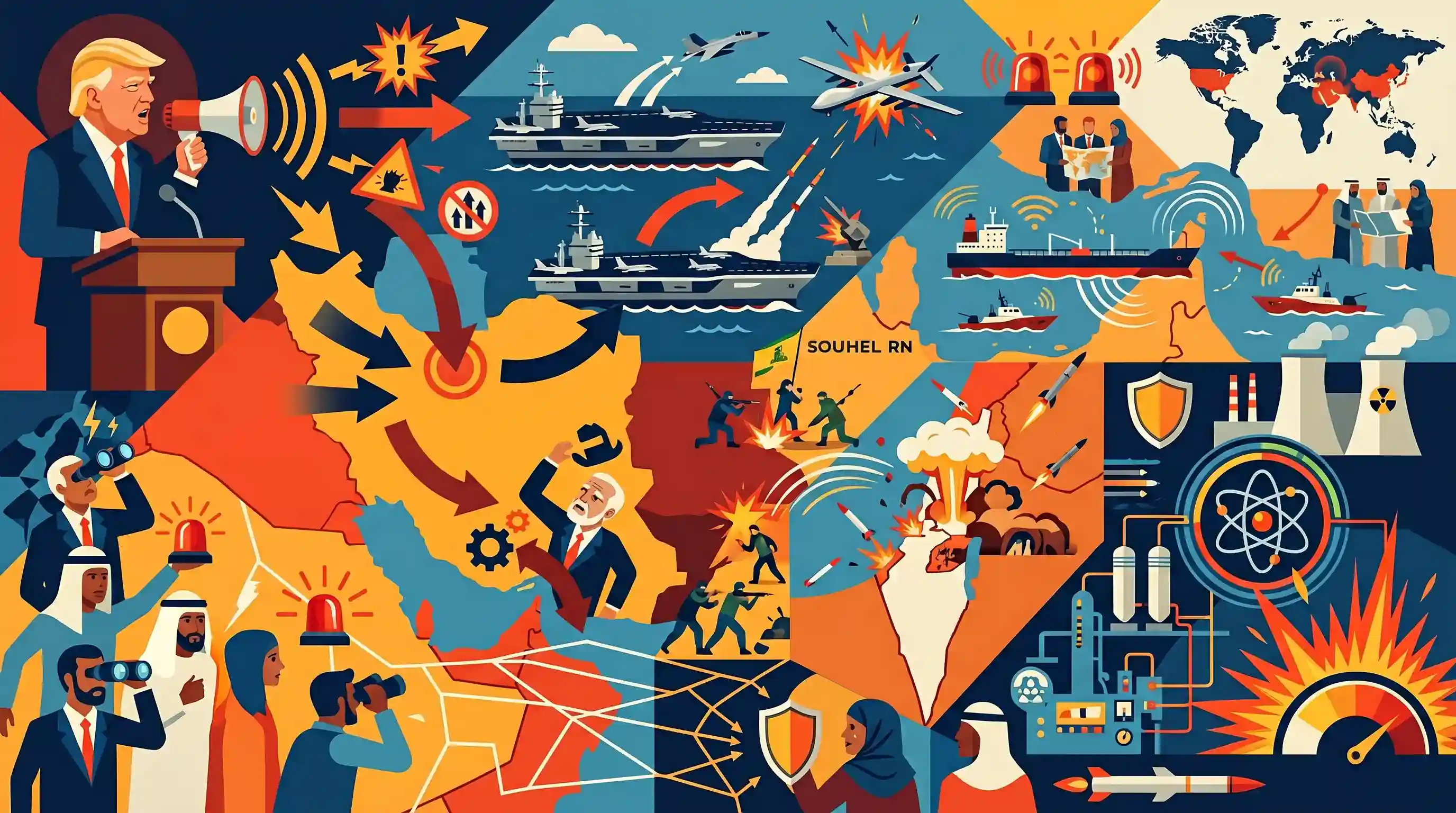
U.S. President Donald Trump stated that a regime change in Iran would be 'the best thing that could happen,' signaling a hardline approach as tensions escalate in West Asia. The United States is contemplating military action and has dispatched a second aircraft carrier, the USS Gerald R. Ford, to the region. The move comes after Iran shot down a U.S. drone and harassed a commercial vessel in the Strait of Hormuz. The situation is further complicated by the ongoing Israel-Hamas war in Gaza, clashes with Hezbollah, and concerns over Iran's nuclear program, which is enriching uranium up to 60% purity. Gulf nations and international observers warn of the risks of a broader regional conflict.
Key Points
- U.S. President Donald Trump publicly endorsed a change in power in Iran, reflecting heightened tensions and consideration of U.S. military action.
- The U.S. military ordered a second aircraft carrier, the USS Gerald R. Ford, to redeploy to the Middle East to join the USS Abraham Lincoln.
- Recent friction includes Iran shooting down a U.S. drone and attempting to intercept a U.S.-flagged commercial ship in the strategic Strait of Hormuz.
- The geopolitical landscape in West Asia is highly volatile due to the ongoing Israel-Hamas war in Gaza, cross-border clashes with Hezbollah, and previous direct Israel-Iran military strikes.
- Iran's nuclear program continues to be a major concern, with uranium being enriched up to 60% purity, prompting Israeli Prime Minister Netanyahu to urge stricter U.S. pressure.
Important Terms
Hamas

A Palestinian Sunni-Islamist political and militant organization that has governed the Gaza Strip since 2007. It advocates for Palestinian independence and maintains a long-standing armed conflict with Israel.
UPSC context
GS Paper II: International Relations. Relevant for understanding regional conflicts, non-state actors, and their impact on India's West Asia policy.
Hezbollah
A Lebanese Shia Islamist militant group and political party backed by Iran. It is a key member of the 'Axis of Resistance' and wields significant military and political influence in Lebanon.
UPSC context
GS Paper II: International Relations. Crucial for analyzing proxy warfare, Iranian regional influence, and stability in the Levant.
Strait of Hormuz
A strategically vital maritime chokepoint between Iran and Oman connecting the Persian Gulf to the Arabian Sea. It facilitates roughly 20-30% of the world's total oil transit.
UPSC context
GS Paper II/III: Geography & Energy Security. Tests knowledge of maritime chokepoints and their role in global trade and India's energy imports.
Uranium Enrichment
The process of increasing the concentration of the fissile isotope U-235. Iran's 60% enrichment is considered 'near weapons-grade,' significantly exceeding the 3.67% limit set by the 2015 JCPOA.
UPSC context
GS Paper III: Science & Technology/Security. Important for topics on nuclear proliferation, IAEA safeguards, and the Iran nuclear deal (JCPOA).
West Asia
A geopolitical region comprising the Arabian Peninsula, the Levant, and Iran. It is central to India's 'Link West' policy due to energy needs and a large Indian diaspora.
UPSC context
GS Paper II: International Relations. A priority region for India's foreign policy, energy security, and remittance inflows.
Maritime Security
The protection of sea lanes of communication from threats like piracy, terrorism, and state-sponsored harassment. It ensures 'freedom of navigation' in critical waterways like the Strait of Hormuz.
UPSC context
GS Paper III: Internal Security/International Relations. Vital for understanding naval diplomacy and safeguarding India's maritime trade and strategic interests.
Prelims Trap
Uranium enriched to 60% purity is classified as weapons-grade material.
60% is highly enriched, but true weapons-grade requires ~90% U-235. However, 60% is a critical redline because the technical breakout time to reach 90% from there is extremely short.
Static Concepts Connected
What are the key maritime chokepoints in West Asia?
- Strait of Hormuz: Connects the Persian Gulf to the Gulf of Oman and Arabian Sea. It is bordered by Iran to the north and Oman/UAE to the south.
- Bab el-Mandeb: Connects the Red Sea to the Gulf of Aden. It is a critical chokepoint for global shipping heading toward the Suez Canal.
What are the key thresholds for Uranium enrichment?
- The Process: Involves increasing the concentration of the fissile U-235 isotope from its natural abundance of just 0.7%.
- Civilian Grade: Low-enriched uranium (LEU), typically capped at 3-5%, is used to fuel commercial nuclear power reactors.
- Weapons Grade: Requires highly enriched uranium (HEU) at 90% or above. Expanding enrichment from 60% to 90% requires much less effort than going from 0.7% to 20%.
Cross-Topic Patterns
Middle East conflict + India's CAD
Escalations in the Strait of Hormuz threaten global oil transit, directly inflating India's import bill, widening the Current Account Deficit (CAD), and risking imported inflation.
Impact on India's connectivity projects
US military posturing and potential sanctions against Iran severely complicate India's strategic investments in Chabahar Port and the operationalization of the INSTC.

Uranium enrichment thresholds + JCPOA collapse likely to form a multi-statement Science/IR crossover question in Prelims 2026.
Linked PYQs · 3
Linked PYQs · 3
- 2018MainsGS2
In what ways would the ongoing US-Iran Nuclear Pact Controversy affect the national interest of India? How should India respond to this situation?
- 2018MainsGS2
“India’s relations with Israel have, of late, acquired a depth and diversity, which cannot be rolled back.” Discuss.
- 2017MainsGS2
The question of India's Energy Security constitutes the most important part of India's economic progress. Analyze India's energy policy cooperation with West Asian countries.
