US Iran Escalation and West Asia Energy Security Risks
Source:The Hindu ↗
Why It Matters
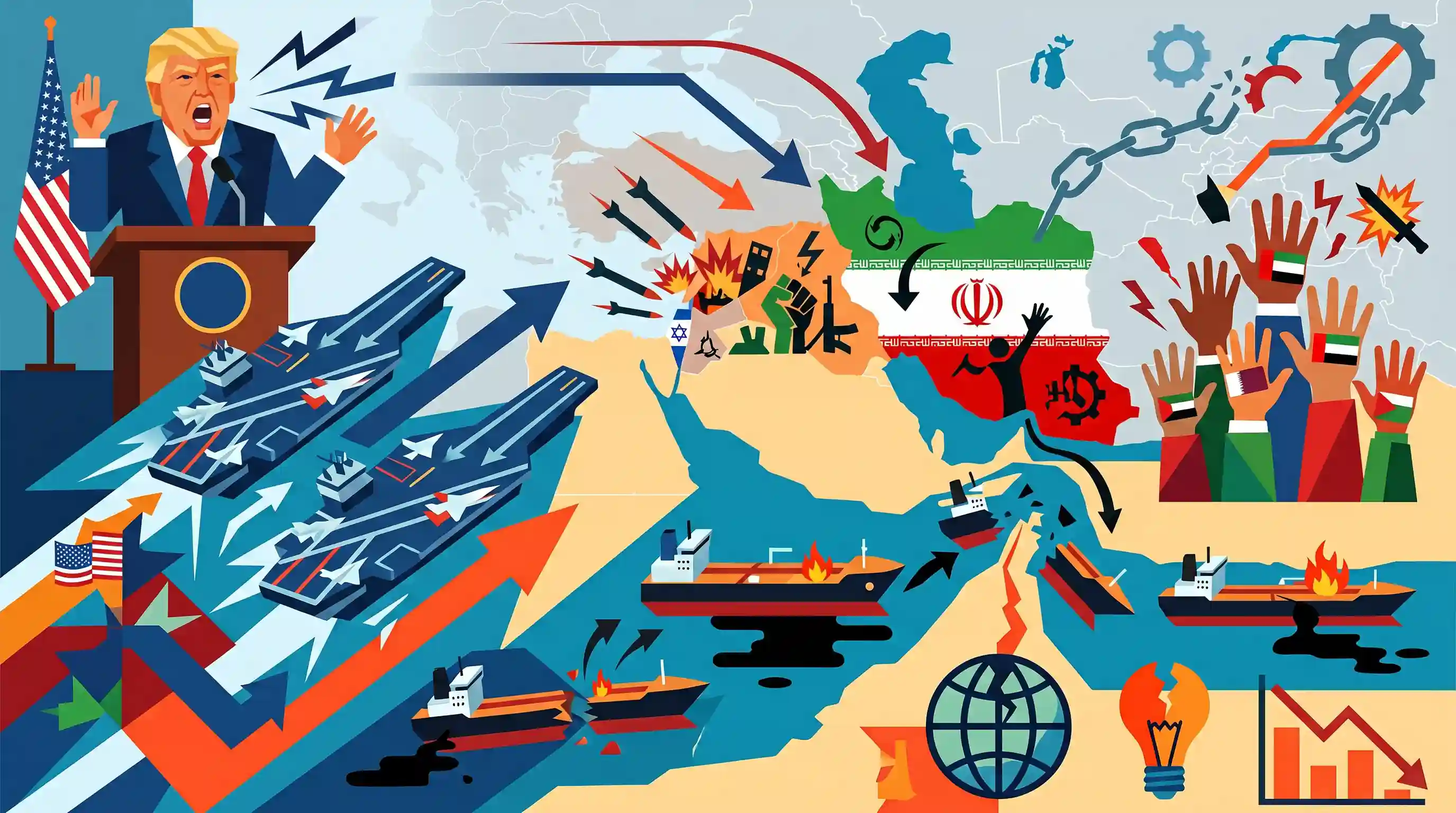
Escalating US-Iran tensions directly threaten the stability of the Middle East, a region vital to India's energy security (oil imports) and home to a large Indian diaspora. Any disruption in the Strait of Hormuz could cause massive shocks to the global economy.
Summary
US President Donald Trump has overtly suggested that a regime change in Iran would be desirable, confirming the deployment of a second aircraft carrier strike group to West Asia. This escalation in US rhetoric and military posturing occurs amidst the ongoing Israel-Hamas conflict and broader regional instability. Gulf Arab nations have expressed alarm that any direct military engagement between the US and Iran could spiral into a devastating regional war. The situation underscores the fragile geopolitical dynamics of the Middle East and poses severe risks to global energy security, particularly concerning critical maritime chokepoints like the Strait of Hormuz.
Key Points
- U.S. President Donald Trump has stated that a change of power in Iran would be highly beneficial, signalling an aggressive US posture.
- The United States has deployed additional naval assets, including an aircraft carrier strike group, to West Asia as a deterrent against Iran.
- Gulf Arab nations have warned that direct US-Iran military confrontation could plunge the entire Middle East into a wider regional war.
- These escalating tensions coincide with the ongoing Israel-Hamas conflict in Gaza and pose a significant threat to global shipping and energy routes, particularly the Strait of Hormuz.
Important Terms
Strait of Hormuz

The world's most critical maritime chokepoint, located between Iran and Oman, through which approximately 20% of the world's total oil consumption and significant LNG volumes pass daily.
UPSC context
GS Paper 1 (Geography) & GS Paper 2 (IR). Tests understanding of maritime trade bottlenecks and India's energy dependency on the Persian Gulf.
West Asia
A strategically vital subregion for India (often called the Middle East) comprising nations like Iran, Saudi Arabia, and Israel; central to India's 'Link West' policy and diaspora interests.
UPSC context
GS Paper 2 (International Relations). Crucial for analyzing regional stability, India's energy security, and the safety of its 9 million-strong expatriate community.
Global Energy Security
The association between national security and the availability of natural resources for energy consumption; in India, it involves diversifying imports and building Strategic Petroleum Reserves (SPR).
UPSC context
GS Paper 3 (Economy/Security). Tests ability to evaluate how geopolitical tensions (like US-Iran rhetoric) impact domestic inflation and the Current Account Deficit.
Hamas
A Palestinian Sunni-Islamic militant organization that has governed the Gaza Strip since 2007. It is a key actor in the ongoing conflict with Israel and is backed by Iran.
UPSC context
GS Paper 2 (International Relations). Relevant for studying non-state actors, regional proxy wars, and India's balanced 'De-hyphenated' stance on the Israel-Palestine issue.
Carrier Strike Group (CSG)
A premier naval formation consisting of an aircraft carrier and several escort vessels (destroyers, cruisers, submarines) used by the US to project power and ensure maritime security.
UPSC context
GS Paper 3 (Security/Defense). Tests knowledge of maritime power projection, naval diplomacy, and the military capabilities of major powers in the Indian Ocean region.
Regime Change
The replacement of one government regime with another, often through external military, economic, or political intervention; a controversial objective in US foreign policy toward Iran.
UPSC context
GS Paper 2 (International Relations). Relates to concepts of sovereignty, non-interference, and the impact of 'Maximum Pressure' policies on global stability.
Prelims Trap
Iran holds exclusive sovereign control over the Strait of Hormuz and can legally deny passage to foreign military vessels.
Hormuz is an international strait governed by UNCLOS 'transit passage' rules. All ships (including military) enjoy continuous, expeditious passage that coastal states cannot arbitrarily suspend.
Static Concepts Connected
What is the 'Transit Passage' regime under UNCLOS for international straits?
- Definition: It allows continuous and expeditious transit of vessels and aircraft through straits used for international navigation between parts of the high seas or EEZs.
- Versus Innocent Passage: Unlike 'innocent passage', transit passage allows submarines to travel submerged and military aircraft to fly over the strait without seeking coastal state permission.
- Strait of Hormuz: The Strait of Hormuz is governed by this regime, rendering Iranian threats to unilaterally and legally 'close' it invalid under international maritime law.
How does Chabahar Port fit into India's strategic and economic calculus?
- Bypassing Pakistan: It provides direct maritime-to-land access to Afghanistan and Central Asia, effectively bypassing overland transit reliance on Pakistan.
- INSTC Node: It serves as a critical southern node for the International North-South Transport Corridor (INSTC), linking the Indian Ocean to Eurasia via Iran.
- Strategic Counter-balance: Its development acts as India's strategic maritime counter-balance to China's presence at the Gwadar port in neighboring Pakistan.
Cross-Topic Patterns
IMEC & I2U2 vs Regional Instability
US-Iran escalation directly jeopardizes the operationalization of emerging geoeconomic corridors like IMEC and minilaterals like I2U2, which fundamentally rely on a stable Arabian Peninsula.
Chokepoints and Macroeconomic Stability
India's reliance on the Strait of Hormuz for 50%+ of crude imports links West Asian geopolitical brinkmanship directly to domestic imported inflation and widening current account deficits.

Expect a 2026 Prelims map-question pairing West Asian maritime chokepoints (Hormuz, Bab-el-Mandeb) with overlapping UNCLOS transit rules.
Linked PYQs · 3
Linked PYQs · 3
- 2025MainsGS2
"Energy security constitutes the dominant kingpin of India's foreign policy, and is linked with India's overarching influence in Middle Eastern countries.” How would you integrate energy security with India's foreign policy trajectories in the coming years?
- 2018MainsGS2
In what ways would the ongoing US-Iran Nuclear Pact Controversy affect the national interest of India? How should India respond to this situation?
- 2017MainsGS2
The question of India's Energy Security constitutes the most important part of India's economic progress. Analyze India's energy policy cooperation with West Asian countries.
