US Revokes Endangerment Finding and Climate Regulations
Source:The Hindu ↗
Why It Matters
As the largest historical emitter of greenhouse gases, the United States' domestic deregulation and withdrawal from international climate treaties fundamentally disrupt global efforts to limit global temperature rise. This will have profound implications for multilateral climate negotiations, climate finance, and the future of the Paris Agreement, which are vital components of the UPSC GS-3 Environment syllabus.
Summary
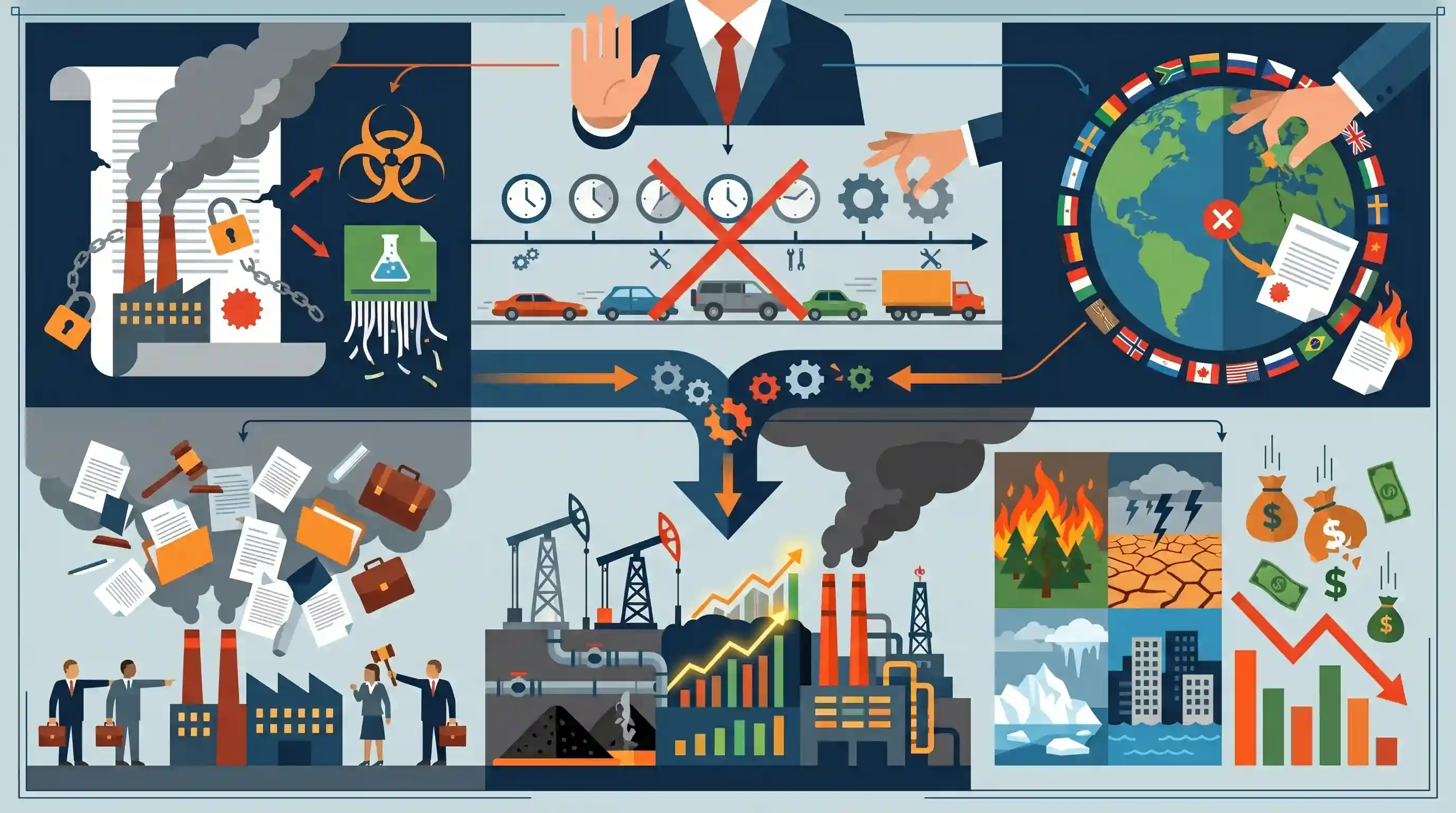
The U.S. administration under President Donald Trump has officially repealed the EPA's "endangerment finding," dismantling the legal mandate to regulate greenhouse gas emissions under the Clean Air Act. The administration also ended vehicle emission standards for the 2012–2027 model years. Paired with the U.S. withdrawal from the Paris Agreement and the UNFCCC, this represents a sweeping rollback of climate policy aimed at bolstering the fossil fuel industry. However, legal experts warn the deregulation could expose polluters to a wave of "public nuisance" lawsuits, while environmental advocates caution against the severe global climate implications and resulting economic costs.
Key Points
- The Trump administration revoked the 2009 "endangerment finding," which served as the scientific and legal foundation for federal climate regulations under the Clean Air Act.
- Federal greenhouse gas emission standards for vehicles and engines (model years 2012 to 2027) have been officially terminated to unfetter fossil fuel development.
- The move complements the U.S. withdrawal from the Paris Agreement and UNFCCC, representing a massive rollback of domestic and international climate change commitments.
- Legal experts suggest the policy reversal could lead to a surge in state-level "public nuisance" lawsuits against polluters, an avenue previously blocked when the EPA was explicitly tasked with greenhouse gas regulation.
- While the EPA claims the rollback will save taxpayers $1.3 trillion, environmental groups warn it will exacerbate extreme weather events and increase long-term costs for consumers.
Important Terms
United Nations Framework Convention on Climate Change (UNFCCC)

An international treaty adopted in 1992 providing the framework for global efforts to stabilize greenhouse gas concentrations and combat climate change.
UPSC context
GS Paper II/III; fundamental for global climate governance, the principle of CBDR, and international environmental diplomacy.
Paris Agreement
A 2015 legally binding treaty aiming to limit global warming to well below 2°C through self-determined national climate targets (NDCs).
UPSC context
GS Paper III; essential for understanding NDCs, climate finance, and the transition from the Kyoto Protocol model.
Endangerment Finding
A 2009 determination that greenhouse gases threaten public health and welfare, establishing the legal mandate for their regulation under the Clean Air Act.
UPSC context
GS Paper III; illustrates the legal basis for climate regulation and the impact of executive shifts on environmental governance.
Environmental Protection Agency (EPA)
The U.S. federal agency responsible for protecting human health and the environment through regulatory enforcement.
UPSC context
GS Paper II/III; provides a comparative study point for India’s Central Pollution Control Board (CPCB) and environmental enforcement.
Nationally Determined Contributions (NDCs)
National climate action plans submitted under the Paris Agreement detailing targets to reduce emissions and enhance climate resilience.
UPSC context
GS Paper III; critical for evaluating global climate progress and comparing India's targets with other major emitters.
Clean Air Act (U.S.)
A comprehensive federal law regulating air emissions from stationary and mobile sources to protect public health.
UPSC context
GS Paper III; relevant for comparative analysis of environmental legislation and legal precedents regarding air pollutants.
Prelims Trap
A country withdrawing from the Paris Agreement is automatically removed from the United Nations Framework Convention on Climate Change (UNFCCC).
Withdrawal from the Paris Agreement does not automatically trigger exit from its parent treaty, the UNFCCC. A state must initiate separate legal withdrawal processes.
Static Concepts Connected
What is the statutory framework governing vehicular emissions and air pollution in India?
- Air Act 1981: Provides the statutory basis for Central and State Pollution Control Boards to enforce strict emission standards for industrial and vehicular sources across India.
- BS-VI Norms: India leapfrogged from BS-IV directly to BS-VI in 2020, mandating an 82% reduction in particulate matter (PM) and a 68% drop in nitrogen oxides (NOx) for diesel cars.
- EV Incentivization: Instead of reversing standards, India heavily subsidizes the transition away from internal combustion engines through schemes like FAME and EMPS.
How is 'Public Nuisance' used as a tool for environmental protection in India?
- IPC Section 268: Recognizes public nuisance as an act causing common injury, danger, or annoyance to the public, forming the traditional tort law basis for environmental litigation.
- CrPC Section 133: Empowers District Magistrates to pass conditional or peremptory orders to immediately halt or remove an environmental nuisance to protect public health.
- Judicial Precedent: Before the National Green Tribunal (NGT) was established, the Supreme Court famously used public nuisance (e.g., Ratlam Municipality case) to enforce citizens' environmental rights.
Cross-Topic Patterns
US Exit vs Global Climate Finance
The US exit from the UNFCCC removes the largest historical emitter from the donor pool, jeopardizing the New Collective Quantified Goal (NCQG) and escalating North-South tensions over climate finance.
CBAM as a trade counter-measure
With the US dismantling vehicle and industrial emission standards, the EU may apply its Carbon Border Adjustment Mechanism (CBAM) aggressively against US exports to prevent carbon leakage, triggering WTO trade disputes.

US withdrawal from UNFCCC and Paris makes the legal mechanisms of treaty exit and climate finance burden a prime 2026 multi-statement MCQ.
Linked PYQs · 4
Linked PYQs · 4
- 2022MainsGS3
Discuss global warming and mention its effects on the global climate. Explain the control measures to bring down the level of greenhouse gases which cause global warming, in the light of the Kyoto Protocol, 1997.
- 2025MainsGS3
Write a review on India's climate commitments under the Paris Agreement (2015) and mention how these have been further strengthened in COP26 (2021). In this direction, how has the first Nationally Determined Contribution intended by India been updated in 2022?
- 2021MainsGS3
Describe the major outcomes of the 26th session of the Conference of the Parties (COP) to the United Nations Framework Convention on Climate Change (UNFCCC). What are the commitments made by India in this conference?
- 2023MainsGS3
The adoption of electric vehicles is rapidly growing worldwide. How do electric vehicles contribute to reducing carbon emissions and what are the key benefits they offer compared to traditional combustion engine vehicles?
