Rollback of Federal Climate Regulations and Emission Standards in US
Source:The Hindu ↗
Why It Matters
The United States is historically one of the largest emitters of greenhouse gases. Domestic rollbacks in US climate regulation and emission standards have profound implications for global climate change mitigation, the viability of the Paris Agreement, and the geopolitical dynamics of global climate action.
Summary
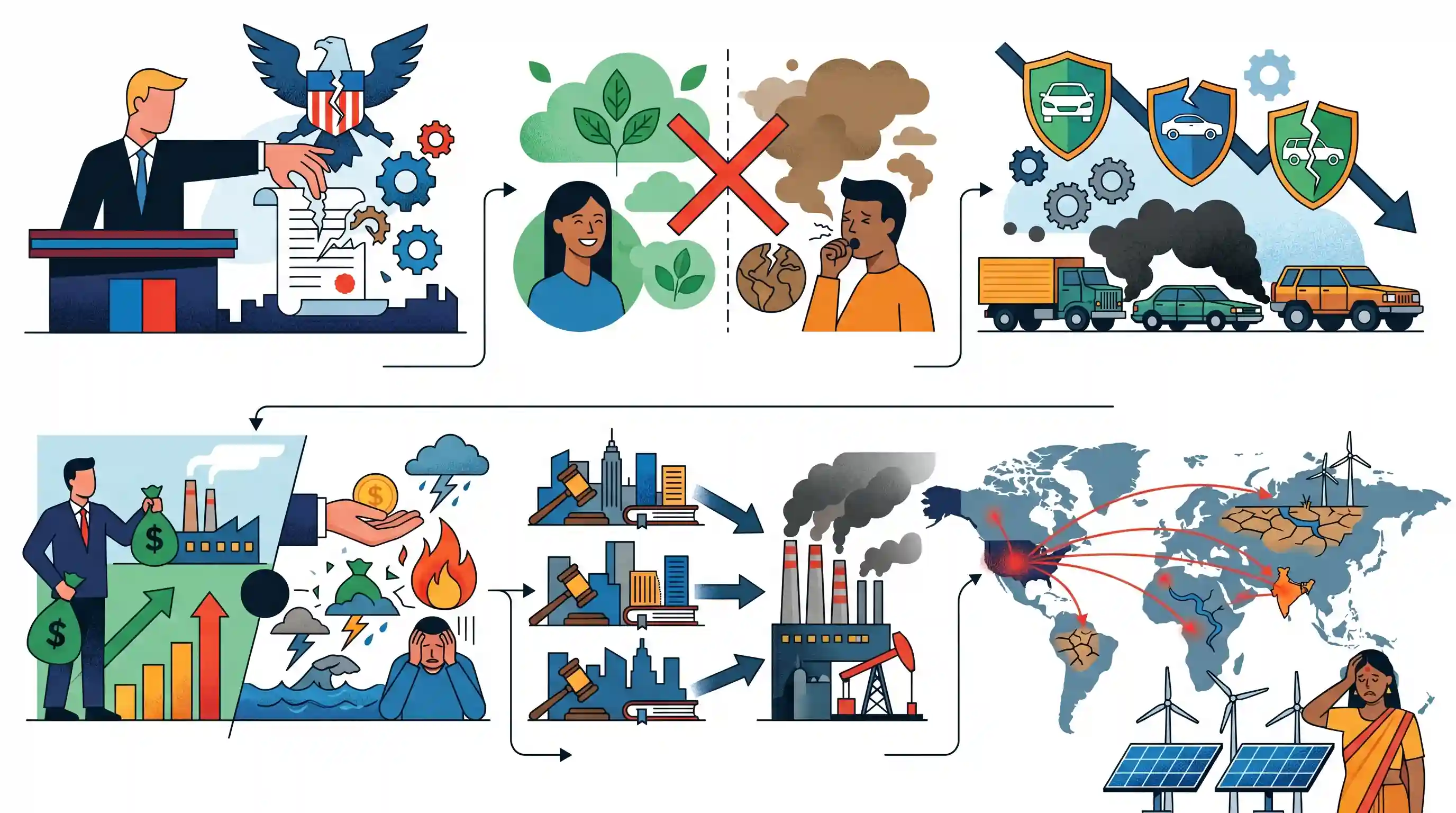
The Trump administration has severely rolled back US climate policies by revoking the foundational 'endangerment finding' under the Clean Air Act, which previously established that greenhouse gases threaten human health. The administration also eliminated federal vehicle emission standards for the 2012-2027 model years. While the EPA argues this deregulation will save $1.3 trillion, critics warn of severe climate consequences and rising economic costs. The federal abdication of climate regulation may also pave the way for states and municipalities to pursue 'public nuisance' lawsuits against major polluters.
Key Points
- The Trump administration has officially revoked the EPA's 'endangerment finding,' which was the scientific foundation for regulating greenhouse gases in the US.
- Federal vehicle emission standards for model years 2012-2027 have been entirely eliminated.
- The EPA claims these deregulations will save US taxpayers $1.3 trillion, while environmental groups warn of exacerbated climate change impacts and rising insurance costs.
- Legal experts suggest the rollback could trigger 'public nuisance' lawsuits by states and cities against fossil fuel companies, as the EPA is no longer regulating emissions.
- The move aligns with Trump's previous actions, including withdrawing from the Paris Agreement and canceling clean energy tax credits.
Important Terms
Clean Air Act (US)

The primary US federal law regulating air emissions from stationary and mobile sources; it mandates the EPA to protect public health by setting National Ambient Air Quality Standards.
UPSC context
GS II/III: Crucial statutory framework showing how national laws underpin global climate targets and affect international environmental obligations.
Endangerment Finding
A 2009 EPA scientific determination that six greenhouse gases endanger public health and welfare, legally triggering the requirement to regulate these emissions under the Clean Air Act.
UPSC context
GS III: Tests understanding of the scientific-legal nexus required for environmental regulation and the consequences of its revocation for global mitigation.
Paris Agreement
A 2015 global treaty aiming to limit global warming to well below 2°C. Its effectiveness is heavily influenced by the participation and financing of major emitters like the US.
UPSC context
GS II/III: Central to International Relations and Environment; US withdrawal affects climate finance and technology transfer crucial for India’s NDCs.
Environmental Protection Agency (EPA)
The independent US federal agency responsible for setting and enforcing national environmental standards. It serves as the primary regulator for air, water, and hazardous waste.
UPSC context
GS II: Comparative study for India's CPCB; illustrates the role of executive agencies in environmental governance and policy volatility.
Public Nuisance
A common-law legal doctrine addressing actions that interfere with public rights, such as health or safety; it is increasingly used in climate litigation to hold polluters accountable.
UPSC context
GS II/III: Relevant for legal remedies in environmental law and the "polluter pays principle" in international climate litigation.
Environmental Defense Fund (EDF)
A major US-based non-profit environmental advocacy group that uses science, economics, and law to defend environmental protections and address climate change globally.
UPSC context
GS III: Illustrates the significant role of NGOs and non-state actors in shaping global environmental policy through strategic litigation.
Prelims Trap
"The Paris Agreement legally mandates strict domestic vehicle emission standards for developed nations."
The Paris Agreement relies on bottom-up, voluntary Nationally Determined Contributions (NDCs). It does not legally dictate exact sector-specific policies like vehicle emission standards.
Static Concepts Connected
How are vehicle and industrial air emissions legally regulated in India?
- Air Act 1981: Empowers the Central and State Pollution Control Boards to lay down standards for ambient air quality and industrial emissions.
- EPA 1986: Acts as an umbrella legislation allowing the Central Government to restrict industries and set overarching national emission standards.
- Motor Vehicles Act: Provides the legal framework for the Ministry of Road Transport to enforce vehicle tailpipe emission norms like Bharat Stage (BS-VI).
What are the core principles of historical climate responsibility under UNFCCC?
- CBDR-RC Principle: Acknowledges that developed nations have higher historical greenhouse gas contributions and therefore a greater responsibility to lead mitigation efforts.
- Climate Finance: Mandates developed countries (Annex II parties) to provide new and additional financial resources to developing nations for mitigation and adaptation.
- Technology Transfer: Requires developed nations to facilitate the transfer of environmentally sound technologies to developing countries to help them achieve climate goals.
Cross-Topic Patterns
Sub-national climate action & Paradiplomacy
US states pursuing 'public nuisance' suits against fossil fuel companies highlights the growing trend of paradiplomacy, where sub-national actors lead climate enforcement despite federal abdication.
Domestic Deregulation vs Climate Finance
US rollbacks shrink its domestic clean energy markets, indirectly threatening its financial contributions to the Green Climate Fund and worsening adaptation burdens for the Global South.

Expect a GS3 question linking developed nations' domestic environmental deregulation to the deepening shortfall in global climate finance.
Linked PYQs · 5
Linked PYQs · 5
- 2022MainsGS3
Discuss global warming and mention its effects on the global climate. Explain the control measures to bring down the level of greenhouse gases which cause global warming, in the light of the Kyoto Protocol, 1997.
- 2025MainsGS3
Write a review on India's climate commitments under the Paris Agreement (2015) and mention how these have been further strengthened in COP26 (2021). In this direction, how has the first Nationally Determined Contribution intended by India been updated in 2022?
- 2019PrelimsGS1
Consider the following statements : The Environment Protection Act, 1986 empowers the Government of India to 1. state the requirement of public participation in the process of environmental protection, and the procedure and manner in which it is sought 2. lay down the standards for emission or discharge of environmental pollutants from various sources Which of the statements given above is/are correct?
- 2022MainsGS2
‘Clean energy is the order of the day.’ Describe briefly India's changing policy towards climate change in various international fora in the context of geopolitics.
- 2019MainsGS2
‘Too little cash, too much politics, leaves UNESCO fighting for life.’ Discuss the statement in the light of US' withdrawal and its accusation of the cultural body as being 'anti-Israel bias'.
