US export controls on advanced AI chips and strategic rivalry
Source:Indian Express ↗
Why It Matters
As semiconductors and Artificial Intelligence dictate modern economic and military supremacy, US-led export controls signify a shift from free trade to strategic containment. This technological fracturing impacts global supply chains, requiring India to navigate complex tech fault lines while aggressively building indigenous semiconductor and AI capabilities.
Summary
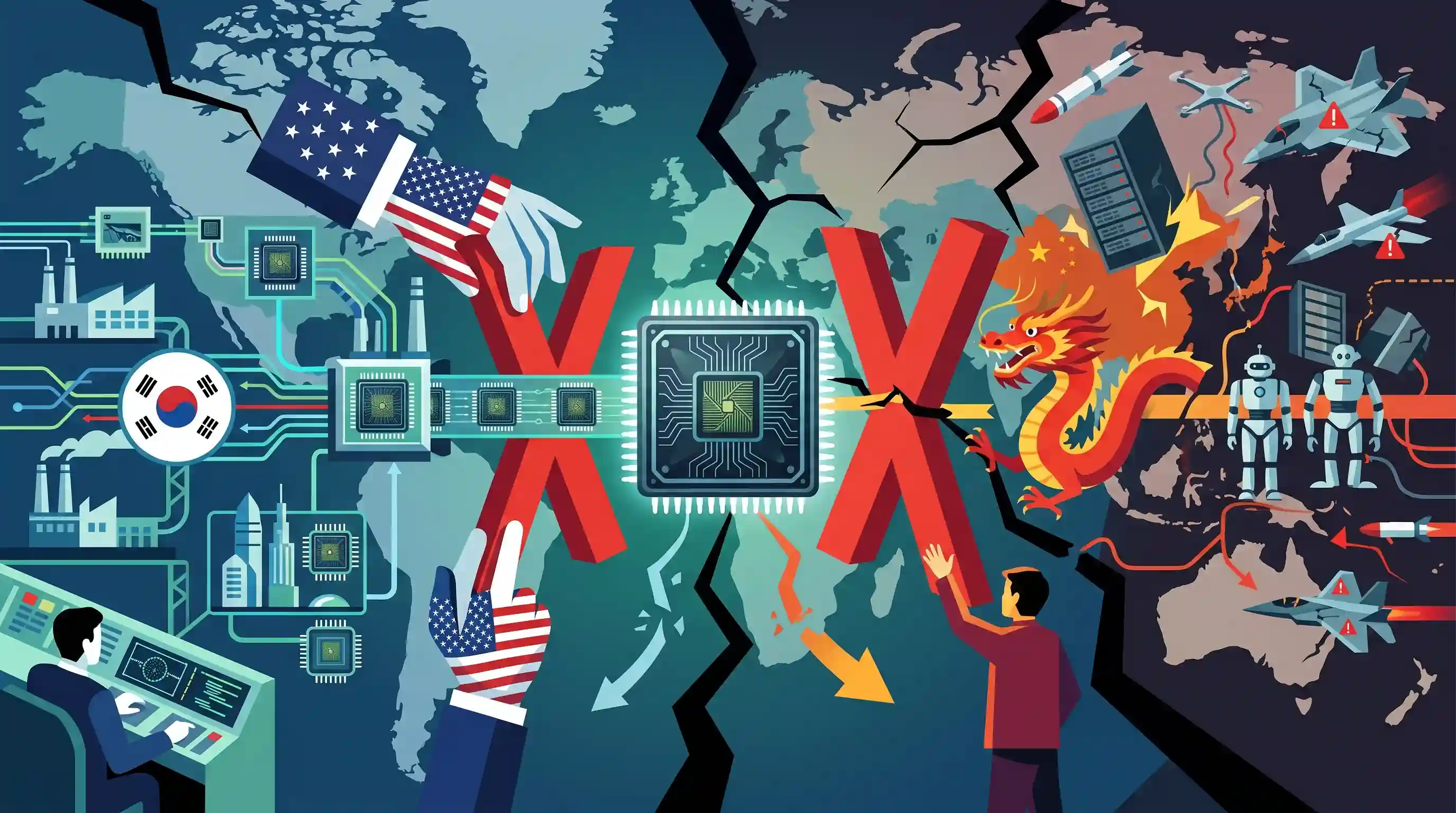
US President Donald Trump announced that Nvidia's advanced Blackwell AI chips will face strict export restrictions, effectively cutting off access for "other people"—a clear reference to concerns regarding China. The move underscores the intensifying strategic competition between Washington and Beijing, as the US seeks to curb China's AI development and military modernization. Meanwhile, allied nations like South Korea and companies like Samsung remain integral to Nvidia's semiconductor supply chain, highlighting the geopolitical fracturing of global technology regimes.
Key Points
- The US plans to restrict overseas access to Nvidia's Blackwell AI chip, signaling intense scrutiny over who acquires next-generation semiconductor technology.
- Washington fears that advanced AI chips could supercharge China's military capabilities, intensifying the US-China strategic rivalry.
- The semiconductor supply chain is increasingly weaponized as export controls become a primary tool for technological containment.
- While restricting adversaries, the US continues to collaborate with strategic allies like South Korea (e.g., Samsung) in the global tech ecosystem.
Important Terms
Semiconductor Geopolitics

The strategic competition between nations to control the manufacturing and supply of semiconductor chips, which are essential for both modern economic stability and advanced military capabilities.
UPSC context
GS Paper 2 (International Relations); key for analyzing US-China strategic rivalry and India's 'Semicon India' mission for technological sovereignty.
Dual-Use Technologies
Innovations—such as high-end AI chips, nuclear technology, and biotechnology—designed for civilian use but possessing significant potential for military or strategic applications.
UPSC context
GS Paper 3 (Internal Security); critical for understanding national security risks and the international regulation of sensitive emerging technologies.
Weaponization of Supply Chains
The strategic use of control over critical supply networks as a tool of geopolitical coercion to exert political pressure or gain tactical advantage over rival nations.
UPSC context
GS Paper 2 (IR) and Paper 3 (Economy); relevant for discussing global trade shocks, de-risking, and the concept of strategic autonomy.
Blackwell Architecture
Nvidia’s high-performance semiconductor architecture specifically engineered to accelerate generative AI workloads, featuring advanced dual-die design to handle trillion-parameter artificial intelligence models.
UPSC context
GS Paper 3 (S&T); represents the 'chokepoint' technology in the global AI race and the target of recent high-end trade restrictions.
Export Controls
Legally mandated regulations and restrictions on the transfer of specific goods, software, or technology to foreign entities to protect a country’s national security interests.
UPSC context
GS Paper 2 (IR/Trade); tests knowledge of trade wars, strategic technology denial regimes, and multilateral agreements like the Wassenaar Arrangement.
Prelims Trap
India is a founding member of the US-led 'Chip 4' alliance aimed at securing global semiconductor supply chains.
India is NOT a member of the Chip 4 alliance (US, Japan, Taiwan, South Korea). India pursues its semiconductor interests separately via the iCET pact with the US.
Static Concepts Connected
What governs the global trade of dual-use technologies like AI microchips?
- Dual-use technology: Items possessing both commercial civilian applications and military utility, such as high-performance AI chips, aerospace components, and advanced cryptography.
- Wassenaar Arrangement: A multilateral export control regime (which India joined in 2017) tracking and restricting the transfer of conventional arms and dual-use goods/technologies.
How are unilateral tech export controls justified under WTO rules?
- Article XXI exception: GATT Article XXI allows member countries to bypass standard free-trade obligations if necessary to protect their essential national security interests.
- Techno-nationalism shift: The US increasingly invokes this security exception to legally shield its unilateral semiconductor blockades against China from standard WTO dispute resolution mechanisms.
Cross-Topic Patterns
iCET & India's Semiconductor Mission
As the US 'friend-shores' tech through alliances like Chip 4, India leverages the bilateral iCET pact to attract fabrication investments and integrate into trusted global supply chains.
AI computing & grid energy transition
Advanced AI models drastically increase data-center power consumption. UPSC can link semiconductor computing power to India's renewable energy targets, carbon footprint concerns, and grid infrastructure strains.

Expect a multi-statement Prelims question mixing 'Chip 4' members, the Wassenaar Arrangement, and India's iCET initiatives in 2026.
Linked PYQs · 4
Linked PYQs · 4
- 2018MainsGS2
What are the key areas of reform if the WTO has to survive in the present context of "Trade War', especially keeping in mind the interest of India?
- 2021MainsGS2
“The USA is facing an existential threat in the form of a China, that is much more challenging than the erstwhile Soviet Union.” Explain.
- 2023MainsGS3
Introduce the concept of Artificial Intelligence (AI). How does Al help clinical diagnosis? Do you perceive any threat to privacy of the individual in the use of Al in healthcare?
- 2020PrelimsGS1
With the present state of development, Artificial Intelligence can effectively do which of the following? 1. Bring down electricity consumption in industrial units 2. Create meaningful short stories and songs 3. Disease diagnosis 4. Text-to-Speech Conversion 5. Wireless transmission of electrical energy Select the correct answer using the code given below:
