US President Repeats Claims of Mediating India Pakistan Ceasefire
Source:Indian Express ↗
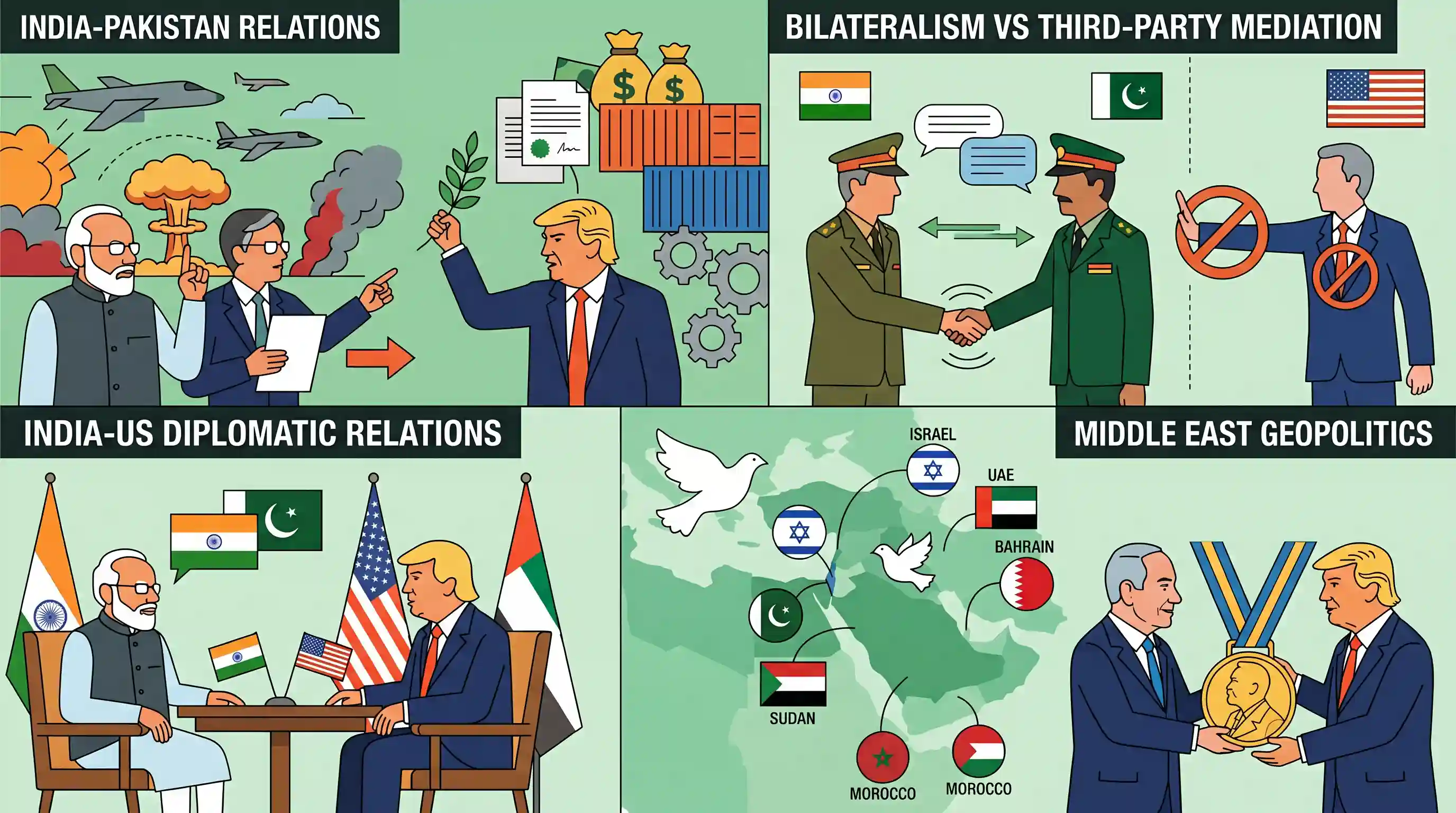
Why It Matters
The incident strongly reaffirms India's core diplomatic doctrine of strict bilateralism, demonstrating a zero-tolerance policy for third-party mediation in its disputes with Pakistan, even when facing narrative pressure from a major strategic partner like the US.
Summary
US President Donald Trump reiterated claims of brokering a ceasefire during the recent India-Pakistan conflict ("Operation Sindoor") by leveraging trade deals. India strongly refuted this narrative, with PM Modi and Foreign Secretary Vikram Misri clarifying that the ceasefire was initiated by Pakistan through direct military channels, reaffirming India's strict policy against third-party mediation. Additionally, the article highlights Israeli PM Netanyahu nominating Trump for the Nobel Peace Prize for his role in the Abraham Accords.
Key Points
- US President Donald Trump claimed his administration brokered a ceasefire during the recent four-day India-Pakistan conflict by leveraging trade deals.
- India firmly rejected the claims, with PM Modi and Foreign Secretary Vikram Misri clarifying that no trade deals or US mediation were discussed.
- The ceasefire for 'Operation Sindoor' was negotiated directly between Indian and Pakistani armed forces at Pakistan's request, reaffirming India's strict bilateralism.
- Israeli PM Benjamin Netanyahu nominated Trump for the Nobel Peace Prize, citing his role in forging the Abraham Accords and wider Middle East peace efforts.
Important Terms
Operation Sindoor

A 2025 Indian military operation targeting terror infrastructure in Pakistan and PoK following the Pahalgam terror attack; noted for first-time usage of cruise missiles and drone warfare in the region.
UPSC context
GS Paper II: India-Pakistan relations, security challenges, and India's evolving 'proactive' defense doctrine regarding cross-border terrorism.
Abraham Accords
A series of 2020 agreements brokered by the US to normalize diplomatic relations between Israel and several Arab nations, including the UAE, Bahrain, and Morocco.
UPSC context
GS Paper II: International relations, Middle East geopolitics, and the impact of major powers on regional stability.
Bilateralism
India’s core diplomatic policy of resolving all outstanding issues with Pakistan exclusively through direct, mutual negotiations, strictly rejecting any external or third-party intervention.
UPSC context
GS Paper II: Fundamental principles of Indian foreign policy and the Shimla Agreement/Lahore Declaration framework.
Third-party Mediation
Intervention by a neutral third party to resolve disputes; India consistently rejects this for the Kashmir issue, maintaining it is an internal or strictly bilateral matter.
UPSC context
GS Paper II: India’s strategic autonomy and its stance against internationalization of the Kashmir dispute.
Vikram Misri
A senior Indian diplomat serving as Foreign Secretary (appointed 2024), previously Deputy NSA, known for articulating India's stance on China and Pakistan during critical escalations.
UPSC context
GS Paper II: Key personalities in Indian foreign policy and the role of the Foreign Secretary in diplomatic messaging.
Track 2 Diplomacy
Unsanctioned, unofficial communication between non-state actors (academics, retired officials) from rival nations intended to build trust and explore peace possibilities when formal ties are frozen.
UPSC context
GS Paper II: Alternative diplomatic channels and conflict resolution strategies in the context of India-Pakistan relations.
Prelims Trap
India accepts third-party mediation in disputes with Pakistan if initiated by strategic partners like the US.
India’s bedrock policy, enshrined in the 1972 Simla Agreement, strictly mandates bilateral resolution of all disputes with Pakistan. No third-party mediation is permitted under any circumstances.
Static Concepts Connected
What is the strategic significance of the 1972 Simla Agreement?
- Bilateralism Framework: Mandates that India and Pakistan resolve their differences strictly through peaceful bilateral negotiations, excluding third parties.
- LoC Establishment: Converted the 1971 UN ceasefire line into the Line of Control (LoC), prohibiting unilateral alteration by force.
- Rejection of Mediation: Forms the institutional bedrock for India's absolute refusal of any foreign intervention or UN mediation in Kashmir.
How did the Abraham Accords strategically benefit India?
- Diplomatic De-hyphenation: Allowed India to pursue robust ties with both Arab nations and Israel simultaneously without zero-sum diplomatic constraints.
- Plurilateral Groupings: Paved the way for new strategic formations like I2U2 (India, Israel, UAE, USA) focusing on economic cooperation.
Cross-Topic Patterns
South Asian bilateralism vs West Asian plurilateralism
India strictly guards its bilateral domain with Pakistan while simultaneously leveraging US-backed plurilateral frameworks (like I2U2) in West Asia.
DGMO hotlines as alternative CBMs
With political dialogues frozen over cross-border terrorism, institutionalized military-to-military channels have become the primary Confidence Building Measures (CBMs) for de-escalation.

Expect a multi-statement Prelims question contrasting the exact mandates on bilateralism in the Simla Agreement (1972) vs Lahore Declaration.
Linked PYQs · 2
Linked PYQs · 2
- 2015MainsGS2
Terrorist activities and mutual distrust have clouded India-Pakistan relations. To what extent the use of soft power like sports and cultural exchanges could help generate goodwill between the two countries? Discuss with suitable examples.
- 2018MainsGS2
“India’s relations with Israel have, of late, acquired a depth and diversity, which cannot be rolled back.” Discuss.
