United States Withdrawal from Paris Climate Accord and IPCC
Source:The Hindu ↗
Why It Matters
The withdrawal of a major global power from crucial international treaties and UN bodies directly impacts global climate governance and multilateral cooperation. It is highly relevant for UPSC aspirants studying international relations, the functioning of global institutions (GS2), and environmental conservation efforts (GS3).
Summary
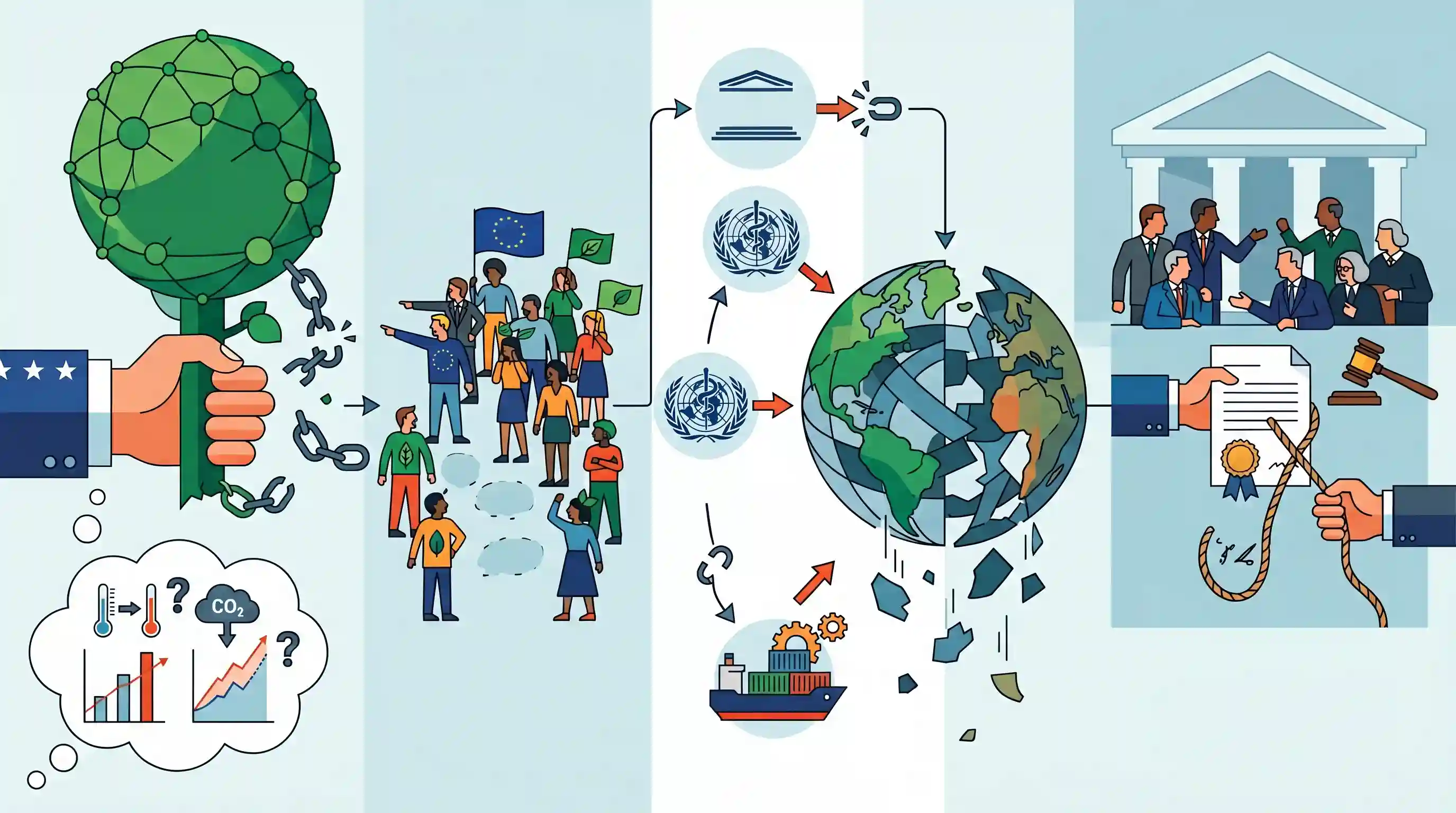
The Trump administration has formally decided to withdraw the United States from the Paris Agreement and distance itself from international climate science bodies like the IPCC. The White House justified the move by questioning the underlying climate science, prompting global condemnation from the EU and environmental groups. This exit is part of a broader pattern of US withdrawal from multilateral organizations, including UNESCO, WHO, and UNCTAD, which critics argue undermines global governance and climate action. Additionally, the move has triggered legal debates domestically over the executive branch's authority to unilaterally terminate treaties ratified by the Senate.
Key Points
- The US administration announced its withdrawal from the Paris Agreement, a landmark international climate accord operating under the UNFCCC.
- The White House justified the exit by criticizing the global scientific consensus on climate change and targeting science bodies like the IPCC.
- This move reflects a broader US policy shift away from multilateralism, following prior withdrawals from UN organizations such as UNESCO, WHO, UNFPA, and UNCTAD.
- European allies and environmental groups have strongly condemned the decision, warning that it undermines global efforts to curb greenhouse gas emissions.
- The unilateral withdrawal raises domestic legal questions regarding the US President's constitutional authority to exit treaties that originally required Senate approval.
Important Terms
Paris Agreement

A legally binding 2015 international treaty aiming to limit global warming to well below 2°C (preferably 1.5°C) above pre-industrial levels through voluntary national climate plans called NDCs.
UPSC context
GS III (Environment); essential for understanding global mitigation targets, NDCs, and international climate governance frameworks.
UNFCCC
The foundational 1992 UN treaty designed to stabilize greenhouse gas concentrations. It is the parent framework for both the Kyoto Protocol and the Paris Agreement.
UPSC context
GS III (Environment); core to international environmental diplomacy, annual COP meetings, and history of climate negotiations.
IPCC
The UN body for assessing climate change science, established by WMO and UNEP in 1988. It produces comprehensive Assessment Reports that form the scientific basis for global climate policy.
UPSC context
GS III (Environment/Science); tests knowledge of scientific consensus and the role of assessment reports in informing global policy.
UNESCO
A UN specialized agency promoting peace through international cooperation in education, sciences, and culture. It manages World Heritage Sites and global literacy programs.
UPSC context
GS II (International Relations); tests understanding of multilateralism and the impact of geopolitical shifts on global cultural/scientific cooperation.
WHO
The primary UN agency responsible for international public health. It leads global efforts to monitor health risks and coordinate responses to health emergencies and pandemics.
UPSC context
GS II (Governance/IR); central to global health security, multilateral governance, and international healthcare standards.
UNCTAD
A permanent UN body (recently rebranded as 'UN Trade and Development') focusing on trade, investment, and development issues to integrate developing countries into the global economy.
UPSC context
GS II (IR) and GS III (Economy); tests trade-development links and representation of Global South interests in international systems.
Prelims Trap
"The IPCC conducts original scientific research to provide foundational reports for UNFCCC negotiations."
The IPCC only assesses and synthesizes published, peer-reviewed scientific literature. It does not conduct its own original research or monitor climate data directly.
Static Concepts Connected
How does treaty-making power in India differ from the United States?
- Executive Power: Under Article 73, entering into and terminating international treaties is an exclusive power of the Union Executive in India.
- Parliamentary Role: Unlike the US Senate, India's Parliament does not ratify treaties. However, Article 253 gives it exclusive power to enact laws implementing those treaties.
- US Contrast: US treaties require a two-thirds Senate ratification, creating domestic legal friction and constitutional debate when a President attempts unilateral withdrawal.
What is the mandate and institutional framework of the IPCC?
- Founding Bodies: Established in 1988 by the World Meteorological Organization (WMO) and the UN Environment Programme (UNEP).
- No Original Research: It provides objective, scientific assessments of climate change but strictly does not conduct its own primary research or independently monitor climate data.
Cross-Topic Patterns
Multilateral Vacuum & China's Rise
US withdrawal from bodies like UNESCO, WHO, and UNFCCC creates a structural funding void and accelerates China's ability to drive institutional influence and global norm-setting.
Defunding the Global South Climate Finance
US disengagement directly defunds the Green Climate Fund (GCF) and the Loss & Damage Fund, forcing Global South nations to rely heavily on Multilateral Development Banks (MDBs).

Expect a multi-statement prelims question mixing IPCC's exact mandate (assessment vs original research) and Article 253 treaty-making.
Linked PYQs · 5
Linked PYQs · 5
- 2010PrelimsGS1
The United Nations Framework Convention on Climate Change (UNFCCC) is an international treaty drawn at
- 2025PrelimsGS1
Consider the following statements : Statement I: Article 6 of the Paris Agreement on climate change is frequently discussed in global discussions on sustainable development and climate change. Statement II: Article 6 of the Paris Agreement on climate change sets out the principles of carbon markets. Statement III : Article 6 of the Paris Agreement on climate change intends to promote inter-country non-market strategies to reach their climate targets. Which one of the following is correct in respect of the above statements?
- 2019MainsGS2
‘Too little cash, too much politics, leaves UNESCO fighting for life.’ Discuss the statement in the light of US' withdrawal and its accusation of the cultural body as being 'anti-Israel bias'.
- 2023MainsGS3
The Intergovernmental Panel on Climate Change (IPCC) has predicted a global sea level rise of about one metre by AD 2100. What would be its impact in India and the other countries in the Indian Ocean region?
- 2025MainsGS3
Write a review on India's climate commitments under the Paris Agreement (2015) and mention how these have been further strengthened in COP26 (2021). In this direction, how has the first Nationally Determined Contribution intended by India been updated in 2022?
