Taiwan Strategic Importance and US China Geopolitical Dynamics
Source:Indian Express ↗
Why It Matters
The potential for conflict over Taiwan is one of the most critical geopolitical flashpoints of the 21st century. For India, a crisis in the Taiwan Strait would disrupt crucial semiconductor supply chains, destabilize the Indo-Pacific, and necessitate complex diplomatic navigation between US and Chinese interests.
Summary
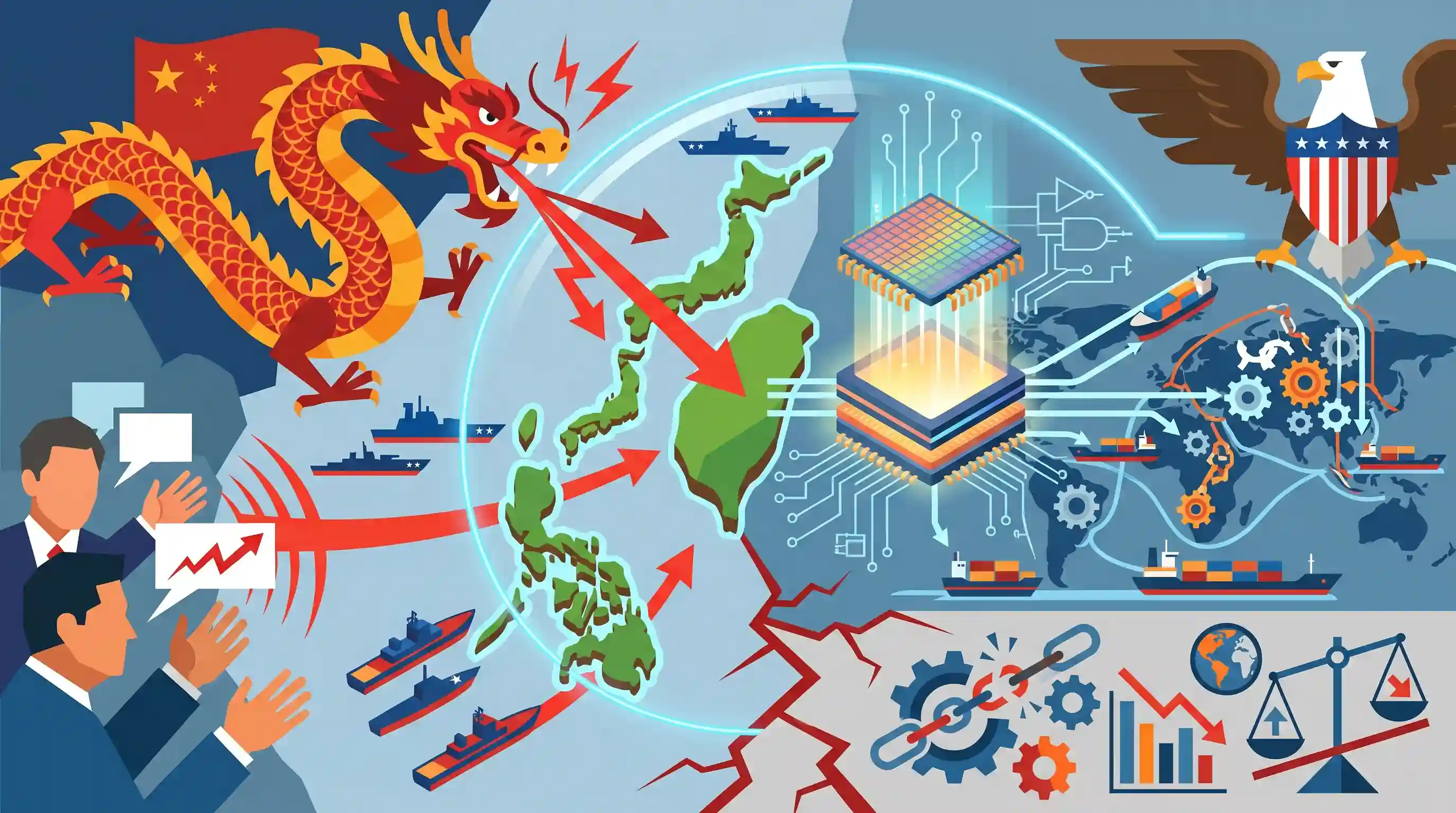
The article analyzes the strategic importance of Taiwan to the United States amidst increasing rhetoric from China and commentary by Donald Trump regarding a potential invasion. Taiwan remains a core US priority due to its critical geographic position in the First Island Chain, which checks Chinese maritime expansion, and its absolute dominance in advanced semiconductor manufacturing. Any alteration in the status quo over Taiwan would have devastating global economic impacts, threaten critical supply chains, and shift the balance of power in the Indo-Pacific region.
Key Points
- Taiwan’s location in the "First Island Chain" is critical for US efforts to contain China's naval reach and maintain dominance in the Indo-Pacific.
- Taiwan is a global linchpin for semiconductor manufacturing (especially via TSMC), making its stability essential for global supply chains and technology sectors.
- A successful Chinese assault on Taiwan would severely disrupt the global economy and undermine the credibility of US security guarantees to its allies in Asia.
- Recent remarks by Donald Trump regarding a potential Chinese attack on Taiwan reflect the complexities and ongoing debates surrounding the long-standing US policy of "strategic ambiguity."
Important Terms
First Island Chain

A strategic maritime perimeter stretching from the Kuril Islands through Japan and Taiwan to the Philippines, acting as a barrier to Chinese naval expansion into the open Pacific.
UPSC context
GS-II (International Relations): Important for understanding Indo-Pacific geopolitics and maritime security strategies of the US and China.
Strategic Ambiguity
The long-standing US policy of being deliberately unclear about whether it would militarily intervene to defend Taiwan, aimed at deterring both Chinese aggression and Taiwanese independence.
UPSC context
GS-II (International Relations): Essential for analyzing US-China-Taiwan relations and diplomatic crisis management in the Indo-Pacific.
Taiwan Relations Act (TRA)
A 1979 US law mandating the provision of defensive arms to Taiwan and requiring the US to maintain the capacity to resist force against the island.
UPSC context
GS-II (International Relations): Key legal framework governing unofficial US-Taiwan ties and regional security commitments.
Silicon Shield
Taiwan's global dominance in advanced semiconductor manufacturing, which serves as a deterrent against invasion because conflict would cause catastrophic global economic collapse, including for China.
UPSC context
GS-III (Economy/Technology): Highlights geoeconomic dependencies and the strategic importance of global supply chains.
People's Liberation Army (PLA)
The unified military force of the People's Republic of China and the armed wing of the Chinese Communist Party, primary actor in Taiwan Strait tensions.
UPSC context
GS-II (International Relations/Regional Security): Crucial for assessing China's military modernization and threat perceptions in South Asia and Indo-Pacific.
One China Policy
The US diplomatic acknowledgement that Beijing is the sole legal government of China, while maintaining unofficial ties with Taiwan and not endorsing China's sovereignty claims.
UPSC context
GS-II (International Relations): Fundamental to understanding the nuances of modern diplomacy and the legal status of Taiwan.
Prelims Trap
The US formally recognizes Taiwan as an independent sovereign nation and is bound by a mutual defense treaty to protect it.
Neither the US nor India officially recognize Taiwan as a sovereign nation. The US Taiwan Relations Act mandates defensive arms sales, but deliberately stops short of a formal mutual defense pact.
Static Concepts Connected
What is the 'First Island Chain' in Indo-Pacific geopolitics?
- Definition: A geostrategic line of major archipelagos situated off the East Asian continental mainland.
- Geography: It stretches from the Kuril Islands, through Japan, the Ryukyu Islands, Taiwan, to the Philippines and Borneo.
- Strategic intent: Coined during the Cold War, it forms a natural barrier used by the US to contain Chinese maritime expansion into the deep Pacific Ocean.
What is the US doctrine of 'Strategic Ambiguity' regarding Taiwan?
- One China Acknowledgement: It involves acknowledging Beijing's claim over Taiwan without explicitly endorsing it as legitimate, maintaining a fragile diplomatic balance.
- Calculated uncertainty: The US provides defensive weapons to Taiwan but deliberately remains vague on whether it would militarily intervene in a Chinese invasion.
- Dual deterrence: It aims to deter China from invading (fearing US intervention) while deterring Taiwan from declaring formal independence (fearing US abandonment).
Cross-Topic Patterns
Geography meets Tech: Taiwan's Dual Shield
Taiwan's security rests simultaneously on its geostrategic location (blocking China's Pacific access) and its techno-economic monopoly (the "Silicon Shield" via TSMC), merging conventional geography with modern geo-economics.
AUKUS, Quad and the Taiwan contingency
A Taiwan blockade directly tests US-led architectures. AUKUS's nuclear submarines are explicitly designed to counter Chinese anti-access/area-denial (A2/AD) strategies in this exact maritime theater.

Expect a Prelims geography question mapping the First/Second Island Chains, or a Mains question linking semiconductor PLIs to geopolitics.
Linked PYQs · 4
Linked PYQs · 4
- 2021MainsGS2
The newly tri-nation partnership AUKUS is aimed at countering China's ambitions in the Indo-Pacific region. Is it going to supersede the existing partnerships in the region? Discuss the strength and impact of AUKUS in the present scenario.
- 2014MainsGS2
With respect to the South China sea, maritime territorial disputes and rising tension affirm the need for safeguarding maritime security to ensure freedom of navigation and over flight throughout the region. In this context, discuss the bilateral issues between India and China.
- 2025MainsGS3
India aims to become a semiconductor manufacturing hub. What are the challenges faced by the semiconductor industry in India? Mention the salient features of the India Semiconductor Mission.
- 2020MainsGS2
What is the significance of Indo-US defence deals over Indo-Russian defence deals? Discuss with reference to stability in the Indo-Pacific region.
