Trump reiterates mediation claims over India Pakistan relations
Source:The Hindu ↗
Why It Matters
The issue brings into focus India's diplomatic imperative to balance its deepening strategic partnership with the U.S. while staunchly defending its policy of bilateralism (resisting third-party mediation) in resolving disputes with Pakistan. It also highlights the strategic doctrines surrounding cross-border surgical strikes and managing the nuclear threshold in South Asia.
Summary
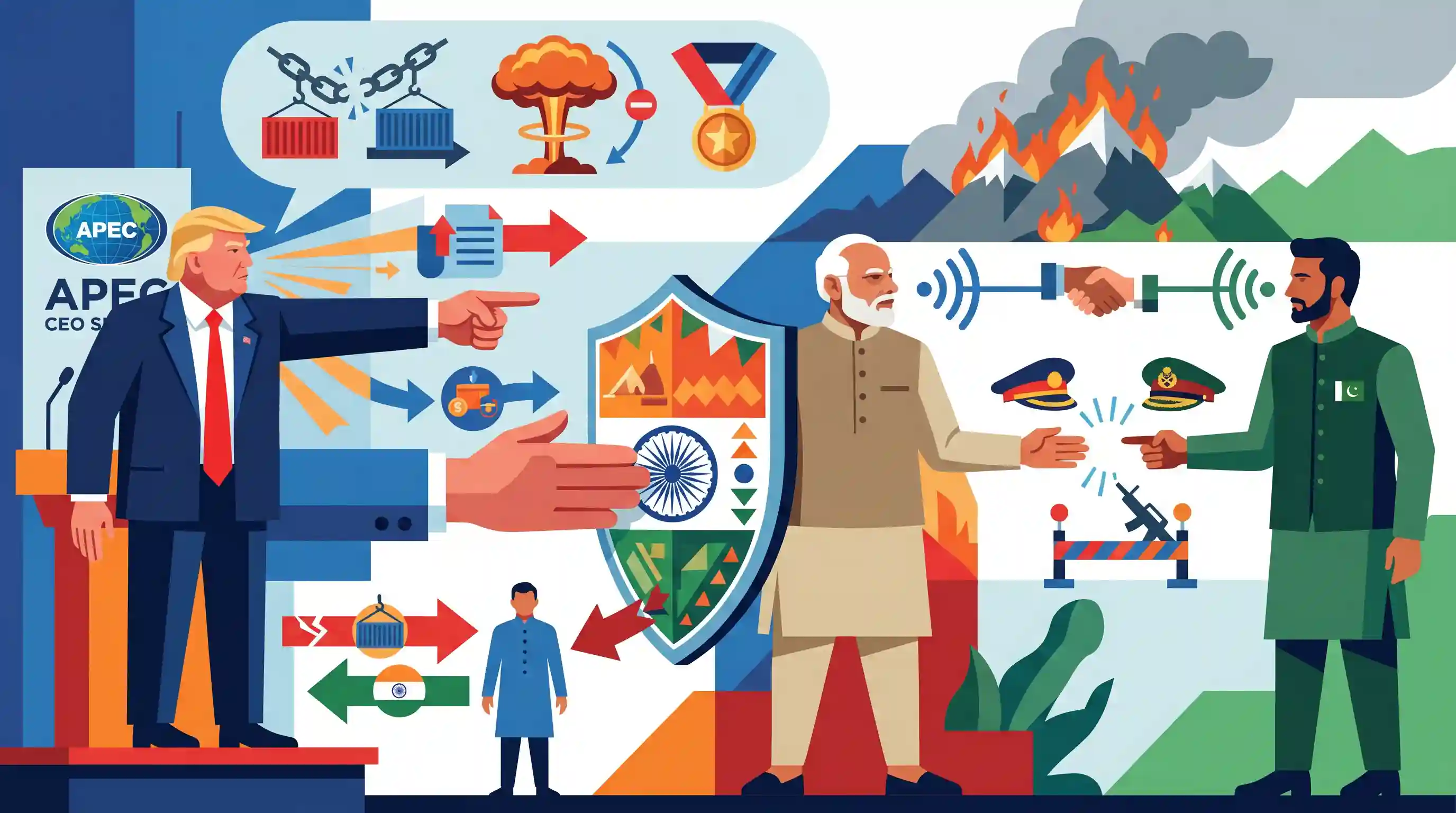
U.S. President Donald Trump, speaking at an APEC CEO Summit, praised PM Narendra Modi but reiterated his claim of mediating an end to recent India-Pakistan hostilities ('Operation Sindoor'). Trump asserted that he used the threat of halting trade to force a ceasefire and avert a potential nuclear escalation. However, India maintains its strict adherence to bilateralism, officially stating that the conflict de-escalation was achieved without third-party intervention, via established communication between the Directors General of Military Operations (DGMOs).
Key Points
- U.S. President Donald Trump claimed he used trade leverage to broker an end to the India-Pakistan conflict ('Operation Sindoor') within 24 to 48 hours.
- Operation Sindoor was launched by India to target terror infrastructure in Pakistan after a deadly terror attack in Pahalgam, Jammu and Kashmir, on April 22.
- Trump highlighted the severe risk of nuclear escalation in the region during the hostilities.
- India officially rejected the mediation claim, asserting that the de-escalation was achieved purely through bilateral communication between the DGMOs of both countries.
Important Terms
Operation Sindoor

A 2025 tri-service military offensive by India targeting terror infrastructure in Pakistan and PoJK. It followed a major terror attack in Pahalgam and was characterized by high-precision, multi-domain strikes.
UPSC context
GS Paper 3 (Security) and GS Paper 2 (IR). Tests knowledge of India's counter-terrorism doctrine and military response to cross-border threats.
Directors General of Military Operations (DGMO)
A senior military officer (typically a Lieutenant General) who oversees planning and operations. The Indian and Pakistani DGMOs use a dedicated hotline for real-time de-escalation and negotiating ceasefires.
UPSC context
GS Paper 2 and 3. Tests understanding of military-to-military communication channels as a tool for diplomatic de-escalation.
Bilateralism
India’s diplomatic stance of resolving disputes with Pakistan through direct mutual engagement. This excludes third-party mediation, a principle codified in the 1972 Simla Agreement.
UPSC context
GS Paper 2 (International Relations). Tests knowledge of foundational foreign policy principles and the Simla Agreement.
Strategic Autonomy
A core foreign policy tenet allowing India to make independent decisions based on national interests without being coerced by external powers or joining formal military alliances.
UPSC context
GS Paper 2 (International Relations). Tests ability to analyze India's positioning in a multipolar world.
Asia-Pacific Economic Cooperation (APEC)
An intergovernmental forum of 21 Pacific Rim economies promoting free trade. While not a member, India engages with the platform to further its regional trade and investment goals.
UPSC context
GS Paper 2 (International Relations). Tests knowledge of regional economic groupings and India's trade diplomacy.
Prelims Trap
"India temporarily accepted U.S. third-party mediation to de-escalate Operation Sindoor due to severe nuclear risks."
India strictly adheres to bilateralism under the 1972 Simla Agreement. The de-escalation was managed entirely through direct DGMO-level talks, rejecting all U.S. mediation claims.
Static Concepts Connected
What are the core tenets of the 1972 Simla Agreement?
- Strict Bilateralism: All differences must be settled through peaceful bilateral negotiations, explicitly excluding the involvement of any third-party mediation.
- LoC Sanctity: Both nations must respect the Line of Control resulting from the 1971 ceasefire, without seeking to alter it unilaterally.
- Non-Use of Force: A mutual commitment to respect each other's territorial integrity and political independence, avoiding the threat or use of force.
How do DGMO talks function in India-Pakistan border management?
- Direct Channel: The Director General of Military Operations (DGMO) hotline serves as the primary military-to-military channel to de-escalate active border crises.
- Ceasefire Maintenance: It is routinely used to negotiate tactical pauses, coordinate local flag meetings, and maintain adherence to ceasefire agreements.
Cross-Topic Patterns
Trade tariffs as diplomatic levers
The US increasingly weaponizes market access and tariff threats to force geopolitical concessions, linking global trade policy directly to traditional security dispute mediation.
Sub-conventional conflict under nuclear overhang
Operations like Sindoor show India's shift toward localized, proactive military strikes against terror infrastructure, testing Pakistan's conventional deterrence without breaching nuclear thresholds.

Expect a multi-statement question contrasting India-Pakistan bilateral mechanisms (Simla Agreement, DGMO) with US economic statecraft.
Linked PYQs · 3
Linked PYQs · 3
- 2016MainsGS3
The terms 'Hot Pursuit' and 'Surgical Strikes' are often used in connection with armed action against terrorist attacks. Discuss the strategic impact of such actions.
- 2015MainsGS2
Terrorist activities and mutual distrust have clouded India-Pakistan relations. To what extent the use of soft power like sports and cultural exchanges could help generate goodwill between the two countries? Discuss with suitable examples.
- 2016MainsGS2
Increasing cross-border terrorist attacks in India and growing interference in the internal affairs of several member-states by Pakistan are not conducive for the future of SAARC (South Asian Association for Regional Cooperation)." Explain with suitable examples.
