US Supreme Court hearing on executive birthright citizenship curbs
Source:The Hindu ↗
Why It Matters
This development provides a prominent contemporary example of executive actions challenging established constitutional provisions, which is highly relevant for comparative constitutional law (comparing U.S. and Indian citizenship laws and judicial review). Additionally, the potential end of birthright citizenship for temporary residents will have a direct and significant impact on the Indian diaspora in the U.S., particularly those on H-1B and other temporary visas.
Summary
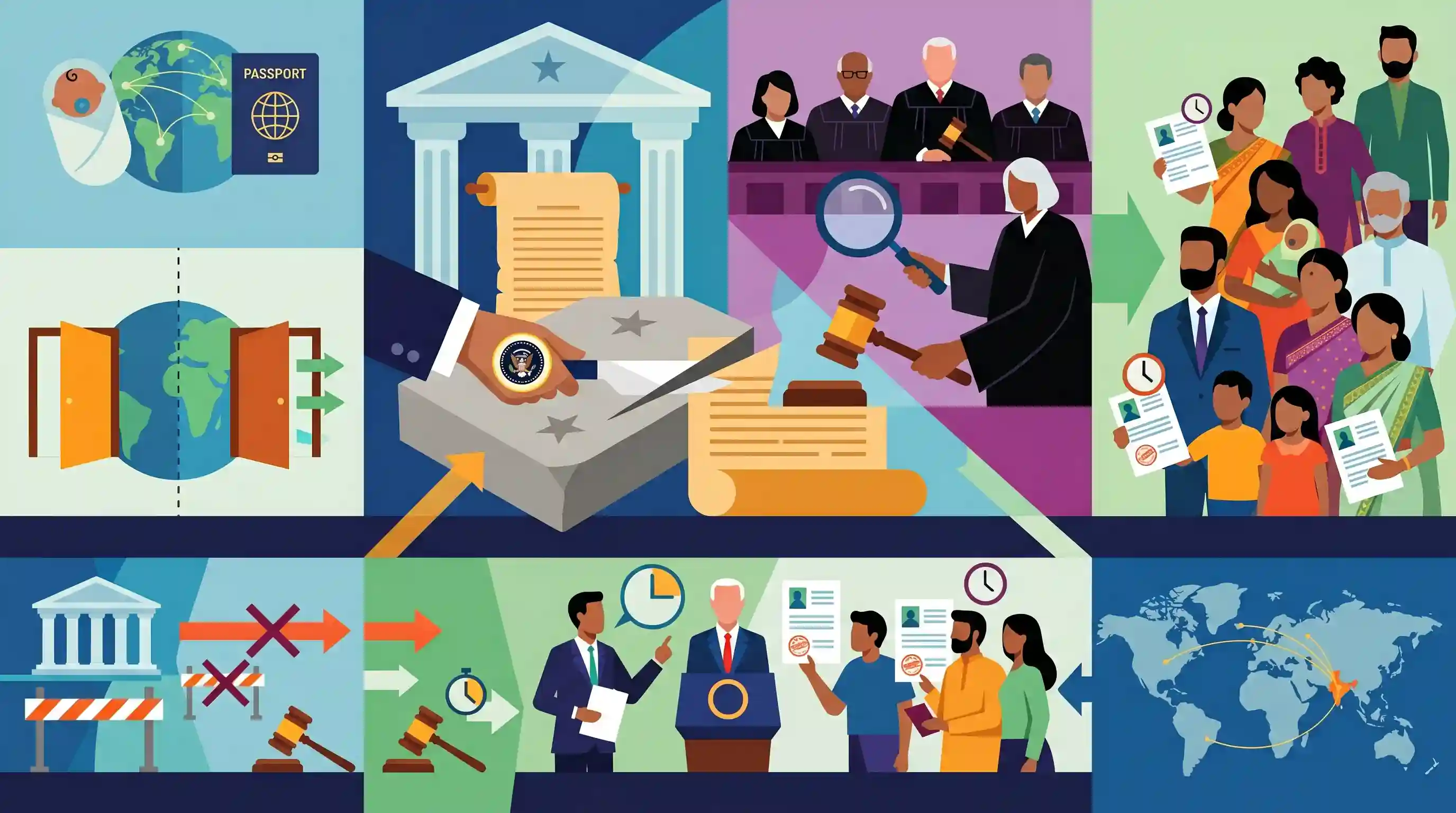
U.S. President Donald Trump is set to attend a Supreme Court hearing regarding his controversial executive order that seeks to end birthright citizenship for children of undocumented immigrants and temporary visa holders. The move directly challenges the traditional interpretation of the 14th Amendment of the U.S. Constitution and has been temporarily blocked by lower courts. The Supreme Court's expedited review of this executive action highlights the tension between executive power and constitutional interpretation, and the impending ruling will carry profound implications for U.S. immigration policy and the sizable Indian diaspora residing in America on temporary work visas.
Key Points
- U.S. President Donald Trump plans to attend an April 1 Supreme Court hearing on his executive order restricting birthright citizenship.
- The executive order, signed on his first day in office, denies citizenship to children born in the U.S. to parents who are undocumented or residing on a temporary basis.
- The order challenges the long-standing interpretation of the 14th Amendment, which has historically granted citizenship to all persons born in the United States.
- Lower courts have currently blocked the implementation of the restrictions, prompting the Supreme Court to take up the case on an expedited basis with a ruling expected by early summer.
- The case highlights the dynamics of separation of powers and judicial review over executive actions, and its outcome will heavily impact foreign nationals, including the Indian diaspora on temporary visas.
Important Terms
14th Amendment (Citizenship Clause)

A post-Civil War constitutional provision (1868) granting citizenship to all persons born or naturalized in the U.S. and subject to its jurisdiction.
UPSC context
GS-II: Comparative Constitution. Essential for understanding citizenship principles (Jus Soli) vs. India's predominantly Jus Sanguinis (blood-right) framework.
Birthright Citizenship
Also known as 'jus soli' (right of the soil), it is the legal principle that citizenship is determined by place of birth.
UPSC context
GS-II: International Relations. Directly impacts the 'Indian Diaspora' as changes affect the legal status of children born to Indian professionals.
Indian Diaspora
The global community of persons of Indian origin. In the U.S., this includes millions of H-1B holders and Green Card applicants.
UPSC context
GS-II: Effect of Policies of Developed Countries. A key pillar of India's soft power and remittance economy.
Judicial Review
The power of the judiciary to examine and potentially invalidate actions of the executive or legislative branches that violate the Constitution.
UPSC context
GS-II: Indian Constitution/Polity. A basic structure doctrine in India; the U.S. case provides a comparative look at judicial checks on executive orders.
H-1B Visa
A non-immigrant visa allowing U.S. employers to temporarily employ foreign workers in specialty occupations; a primary pathway for Indian IT professionals.
UPSC context
GS-II: Bilateral Relations. A major friction point in India-U.S. trade and migration talks.
Separation of Powers
A doctrine ensuring that the executive, legislative, and judicial branches have distinct powers to prevent the abuse of authority.
UPSC context
GS-II: Polity. Tests the limits of 'Executive Orders' vs. 'Constitutional Amendments.'
Prelims Trap
The Indian Constitution explicitly guarantees birthright citizenship (jus soli) to anyone born in its territory.
The Indian Constitution does not grant absolute birthright citizenship. Article 11 delegates citizenship rules to Parliament, which shifted India toward jus sanguinis via the Citizenship Act, 1955.
Static Concepts Connected
How does citizenship acquisition in India differ from the US Constitution?
- Constitutional Embedding: The US 14th Amendment explicitly embeds 'jus soli' (birthright) as a rigid constitutional right, making it difficult to alter.
- Parliamentary Sovereignty: Article 11 empowers Parliament to regulate citizenship. India has progressively shifted from jus soli to jus sanguinis (blood/descent) via amendments.
- Dual Citizenship: The US permits dual citizenship, whereas Article 9 of the Indian Constitution strictly prohibits holding Indian citizenship alongside a foreign one.
What constitutes Judicial Review over executive actions in India vs the US?
- Source of Power: In the US, it stems from the Marbury v. Madison precedent. In India, it is explicitly codified in Articles 13, 32, and 226.
- Due Process vs Procedure: US courts broadly apply "due process of law," whereas Indian courts traditionally use "procedure established by law," though expanded post-Maneka Gandhi.
Cross-Topic Patterns
Diaspora impact of US immigration policy
U.S. immigration shifts (like birthright denial and H-1B limits) directly impact India's remittances and soft power, linking comparative constitutional law to GS2 International Relations and diaspora dynamics.
Executive Orders vs. Article 123 Ordinances
Trump's unilateral executive orders parallel the debates surrounding India's Article 123 (Ordinance making power), offering a comparative study on executive overreach and legislative bypass.

Prelims 2026 will likely test the difference between US 'jus soli' and India's 'jus sanguinis' shift alongside Article 11 provisions.
Linked PYQs · 3
Linked PYQs · 3
- 2020MainsGS2
Indian diaspora has a decisive role to play in the politics and economy of America and European Countries'. Comment with examples.
- 2020MainsGS2
Judicial Legislation is antithetical to the doctrine of separation of powers as envisaged in the Indian Constitution. In this context justify the filing of large number of public interest petitions praying for issuing guidelines to executive authorities.
- 2015MainsGS2
Resorting to ordinances has always raised concern on violation of the spirit of separation of powers doctrine. While noting the rationales justifying the power to promulgate ordinances, analyze whether the decisions of the Supreme Court on the issue have further facilitated resorting to this power. Should the power to promulgate ordinances be repealed?
