United States Economic Sanctions on Iran and Regional Conflict
Source:The Hindu ↗
हे का महत्त्वाचे आहे
The U.S.-Iran war and the naval blockade of the Strait of Hormuz have severe ramifications for India's energy security, global oil prices, and trade routes. Understanding the transition from military to economic warfare (extraterritorial secondary sanctions) is vital for analyzing India's strategic autonomy and bilateral partnerships in West Asia.
सारांश
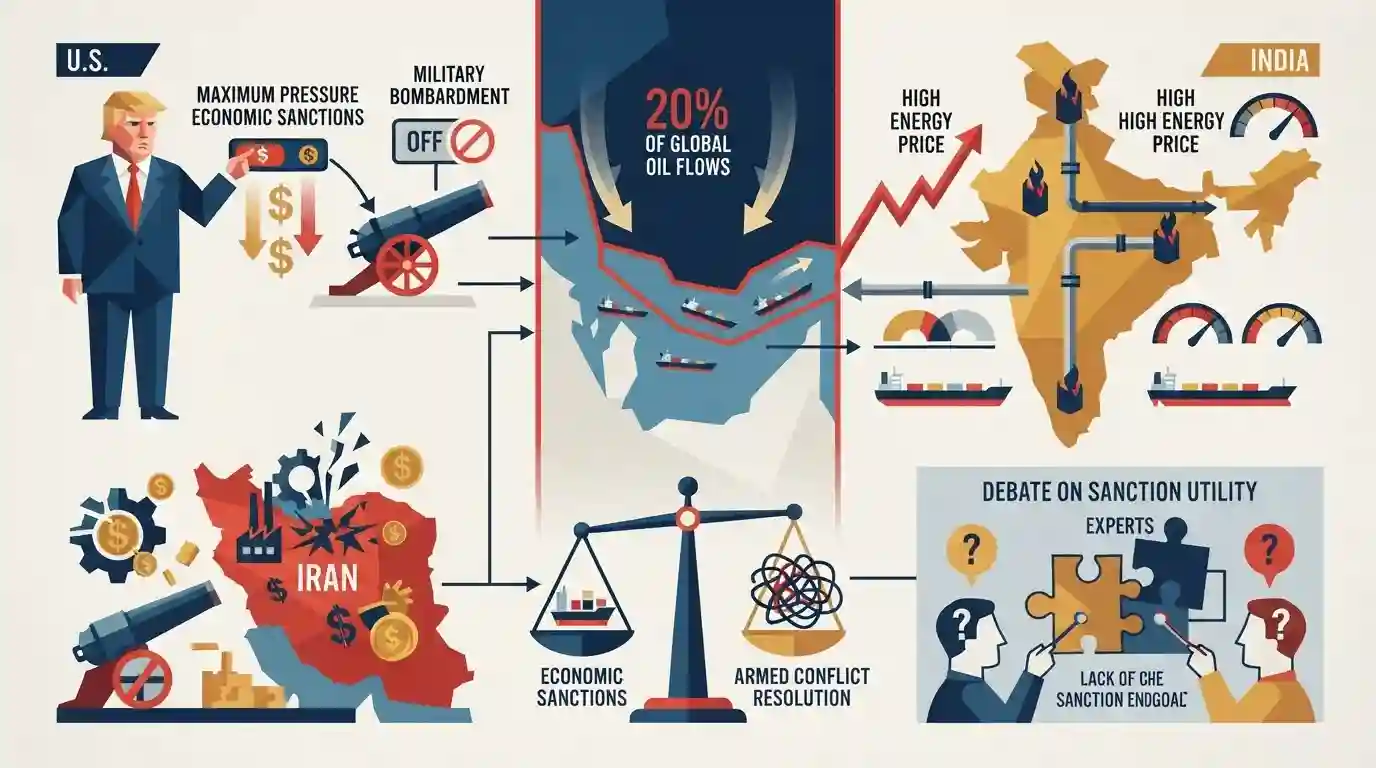
U.S. President Donald Trump has pivoted from direct military bombardment to intensive economic sanctions under 'Operation Economic Fury' to force Iranian compliance. This strategic shift occurs amid high global energy prices and the blockade of the critical Strait of Hormuz chokepoint, which handles 20% of global oil flows. While the measures have heavily damaged Iran's domestic economy, experts argue that economic sanctions lack immediate utility in ending ongoing armed conflicts without clear strategic endgoals.
मुख्य मुद्दे
- The U.S. administration under Donald Trump has shifted its strategy back to aggressive economic warfare under 'Operation Economic Fury' as military campaigns fail to secure a swift resolution.
- The Strait of Hormuz, which hosts roughly 20% of global oil transit, remains largely closed due to the conflict, driving up global energy prices and driving inflation risks worldwide.
- Treasury Secretary Scott Bessent described these economic measures, which include secondary sanctions on third parties doing business with Iran, as the financial equivalent of a bombing campaign.
- Iran's economy is highly strained, with the IMF estimating a 5.4% contraction, domestic inflation soaring to 88.6%, and daily oil exports falling from 1.8 million to under 500,000 barrels.
- Sanctions experts have questioned the shift, warning that economic pressure is a slow-acting tool and that the administration's fluctuating objectives (nuclear enrichment vs. maritime access vs. ballistic missiles) dilute strategic clarity.
महत्त्वाच्या संज्ञा
Operation Economic Fury

A coordinated U.S. economic warfare and naval blockade campaign launched in April 2026 targeting Iran's oil smuggling, shadow banking, and revenue streams to enforce compliance without direct military bombardment.
UPSC context
Relevant for GS-2 (International Relations) as a modern example of economic statecraft and its impact on global geopolitics.
U.S. Treasury Department
The United States' finance ministry, which utilizes its Office of Foreign Assets Control (OFAC) to weaponize financial networks by designing and enforcing the extraterritorial economic sanctions central to strategies against Iran.
UPSC context
Tests GS-2 (Policies of Developed Countries) regarding how unilateral U.S. sanctions impact India's strategic autonomy and global energy trade.
International Monetary Fund
A major international financial institution overseeing global economic stability. It tracks macroeconomic fallout from geopolitical conflicts, assessing metrics like the severe economic contraction and high inflation in sanctioned nations like Iran.
UPSC context
Crucial for GS-2 (Important International Institutions), highlighting how global bodies measure the macroeconomic devastation caused by international conflicts.
पूर्वपरीक्षा सापळा
Chabahar port is situated in the Persian Gulf and is directly impacted by the closure of the Strait of Hormuz.
Chabahar is strategically located on the Gulf of Oman, outside the Strait of Hormuz. This oceanic position is precisely why it allows bypass of the volatile Hormuz chokepoint.
संबंधित स्थिर संकल्पना
What is the geographical and strategic significance of the Strait of Hormuz?
- Connectivity: It is the sole maritime passage connecting the Persian Gulf to the Gulf of Oman and the broader Arabian Sea.
- Bordering states: It is bounded by Iran to the north and the Musandam Peninsula (an exclave of Oman) and the UAE to the south.
- Oil chokepoint: Handles roughly 20% of global petroleum liquids daily, making it the world's most critical energy transit vulnerability.
What are secondary economic sanctions in international relations?
- Mechanism: Unlike primary sanctions, secondary sanctions penalize third-party countries and foreign entities for conducting business with the targeted, sanctioned nation.
- Enforcement: They leverage the dominance of the U.S. financial system, threatening to cut off violators' access to U.S. markets and SWIFT.
- Impact on India: With the expiration of the Chabahar waiver, Indian firms risk secondary sanctions, necessitating alternative structures to sustain strategic regional investments.
आंतर-विषय नमुने
Hormuz blockade & alternative trade corridors
The blockade amplifies the strategic value of Chabahar Port and the INSTC, allowing India to bypass the volatile Persian Gulf entirely to access Central Asia and Russia.
Weaponized finance & de-dollarization
U.S. secondary sanctions and asset freezes prompt Global South economies to accelerate alternative financial architectures, reviving local currency settlements like the Rupee-Rial mechanism to insulate energy imports.

A 2026 map-based question combining the Strait of Hormuz, Gulf of Oman, Chabahar Port, and global oil chokepoints is highly probable.
संबंधित PYQ · 2
संबंधित PYQ · 2
- 2026PrelimsGS1
Ships from which of the following countries have to cross the Strait of Hormuz to reach out to the Indian Ocean ? 1. Bahrain 2. Syria 3. Qatar 4. Egypt Select the answer using the code given below :
- 2012MainsGS2
How have the US sanctions against Iran affected India's bilateral relations with Iran?
