US Suspension of Weapons Aid to Taiwan Amid China Trade Talks
Source:Indian Express ↗
Why It Matters
Highlights a crucial shift in superpower diplomacy where strategic commitments in the Indo-Pacific are used as bargaining chips for trade and economic negotiations, significantly impacting regional stability and Taiwan's security architecture.
Summary
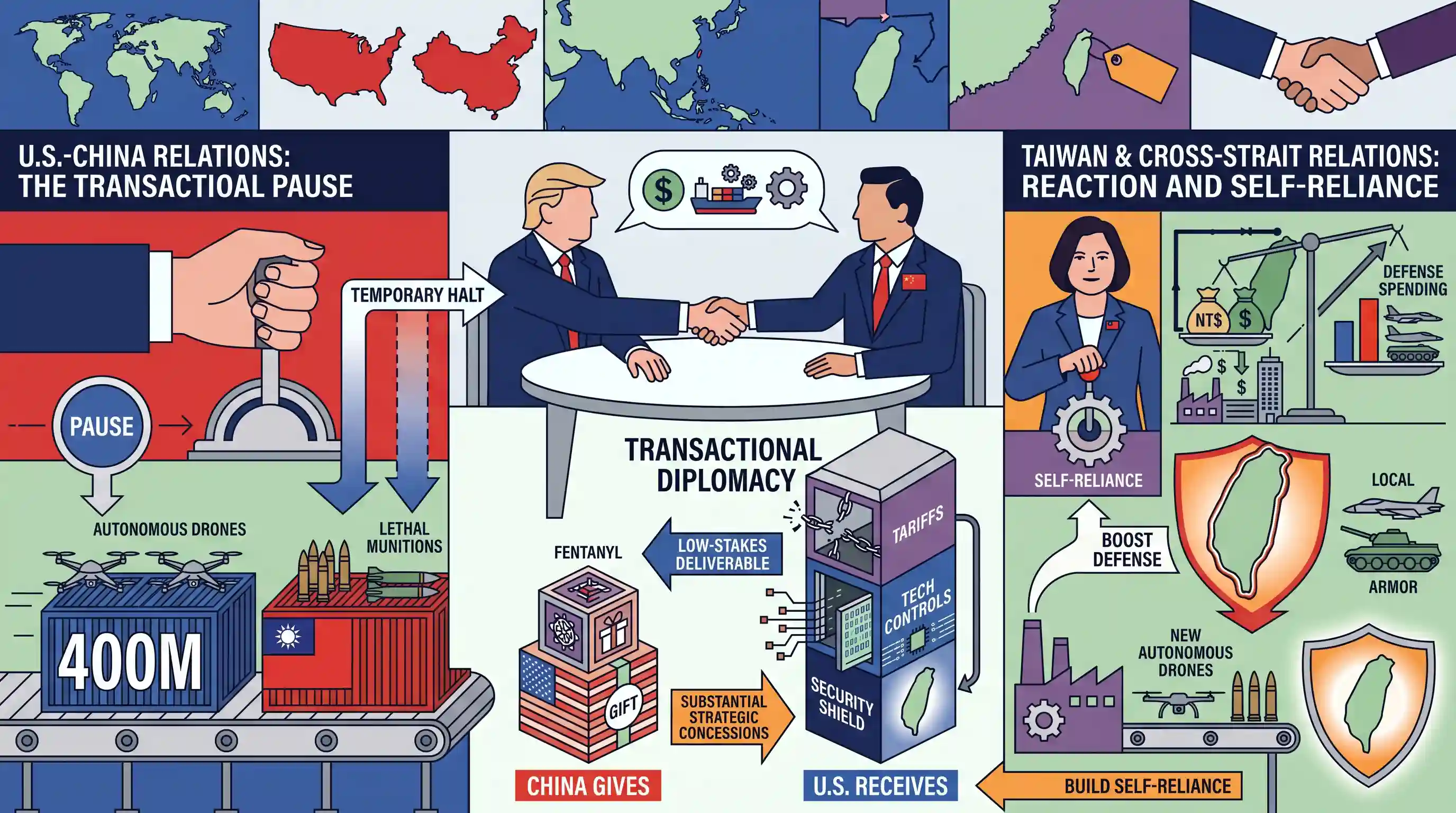
US President Donald Trump has temporarily halted $400 million in weapons assistance to Taiwan, a move largely interpreted as a transactional diplomatic maneuver to facilitate trade talks with China. The suspended aid includes autonomous drones and lethal munitions, prompting Taiwan's leadership to reiterate its commitment to military self-reliance and boosting defense spending. Analysts note that Washington's transactional foreign policy approach may allow Beijing to exchange low-stakes deliverables, such as fentanyl regulations, for substantial strategic concessions on tariffs, technology controls, and Taiwanese security in the Indo-Pacific.
Key Points
- US President Donald Trump has paused $400 million in weapons aid to Taiwan, including lethal munitions and autonomous drones.
- The pause is viewed as a tactical concession to advance trade negotiations with China and secure cooperation on issues like fentanyl and TikTok.
- Taiwan's President Lai Ching-te emphasized the need to build defence capabilities and societal resilience independently, with Taiwan planning to increase defence spending to 5% of its GDP by 2030.
- Geopolitical analysts caution that Beijing may leverage this 'temporary' pause into a prolonged suspension, trading symbolic public relations deliverables for concrete relief on US tariffs, tech controls, and Taiwan.
Important Terms
Chinese Communist Party (CCP)

The founding and sole ruling party of the People's Republic of China, maintaining absolute control over the state government, military, and law enforcement.
UPSC context
GS-II: International Relations; tests knowledge of China's political structure and its impact on Indo-Pacific strategic stability.
Transactional Diplomacy
A foreign policy model based on immediate quid pro quo agreements and direct exchanges rather than long-term strategic alliances or moral principles.
UPSC context
GS-II: US Foreign Policy; critical for analyzing how 'America First' policies reshape global security commitments and trade relations.
Cross-Strait Relations
The geopolitical and diplomatic relationship between Mainland China (PRC) and Taiwan (ROC), centered on the island's status and sovereignty.
UPSC context
GS-II: International Disputes; vital for understanding semiconductor supply chains and maritime security in India's extended neighborhood.
International Crisis Group
An independent NGO that conducts field research and provides policy advice to prevent and resolve global conflicts and humanitarian crises.
UPSC context
GS-II: International Institutions; relevant for non-state actors' roles in global conflict resolution.
Eurasia Group
A major political risk consultancy that analyzes how global political changes affect international markets, investments, and sovereign stability.
UPSC context
GS-III: Economic Development; essential for assessing how geopolitical risks impact India’s economic growth and investment.
Foundation for the Defense of Democracies (FDD)
A US-based think tank focusing on national security, often promoting an activist foreign policy and confrontational approaches to authoritarian competitors.
UPSC context
GS-II: US-China Relations; illustrates the influence of policy institutes in shaping Washington’s strategic stance.
Prelims Trap
"The US formally recognizes Taiwan's sovereignty and is legally bound to intervene militarily if China attacks."
The US follows the 'One China' policy (no formal recognition) and maintains 'strategic ambiguity' on military intervention. The Taiwan Relations Act only mandates providing defensive weapons.
Static Concepts Connected
What is Taiwan's "Porcupine Strategy"?
- Asymmetric defense: Focuses on making a Chinese invasion unacceptably costly rather than trying to match Beijing's conventional military strength.
- Weapons focus: Prioritizes the deployment of mobile, stealthy, and survivable weapons (like autonomous drones, sea mines, and anti-ship missiles).
- Deterrence through attrition: Aims to deter aggression by ensuring severe attrition and logistical nightmares for any attacking amphibious force.
What are the pillars of the US-Taiwan diplomatic posture?
- Taiwan Relations Act: US domestic law (1979) mandating Washington to supply Taiwan with defensive weapons to maintain its self-defense capabilities.
- One China Policy: Acknowledges Beijing's claim over Taiwan without formally endorsing it, maintaining only unofficial, robust ties with Taipei.
- Strategic Ambiguity: Intentional US avoidance of a clear commitment on whether it would militarily defend Taiwan, deterring both Chinese invasion and Taiwanese independence declarations.
Cross-Topic Patterns
Quad implications & India's strategic autonomy
US transactional diplomacy regarding Taiwan raises concerns about the reliability of its security umbrella, potentially pushing India to further emphasize strategic autonomy and indigenous defense capabilities within the Quad framework.
Fentanyl and non-traditional security leverage
The use of non-traditional security issues, like global fentanyl trafficking, as bargaining chips in hard power negotiations (arms sales, tariffs) highlights the blurring lines of modern diplomatic statecraft.

Mains 2026 GS-2 will likely test the impact of 'transactional diplomacy' by major powers on the stability of the Indo-Pacific architecture.
Linked PYQs · 3
Linked PYQs · 3
- 2021MainsGS2
“The USA is facing an existential threat in the form of a China, that is much more challenging than the erstwhile Soviet Union.” Explain.
- 2025MainsGS2
"With the waning of globalization, post-Cold War world is becoming a site of sovereign nationalism.” Elucidate.
- 2025MainsGS2
"The reform process in the United Nations remains unresolved, because of the delicate imbalance of East and West and entanglement of the USA vs. Russo-Chinese alliance.” Examine and critically evaluate the East-West policy confrontations in this regard.
